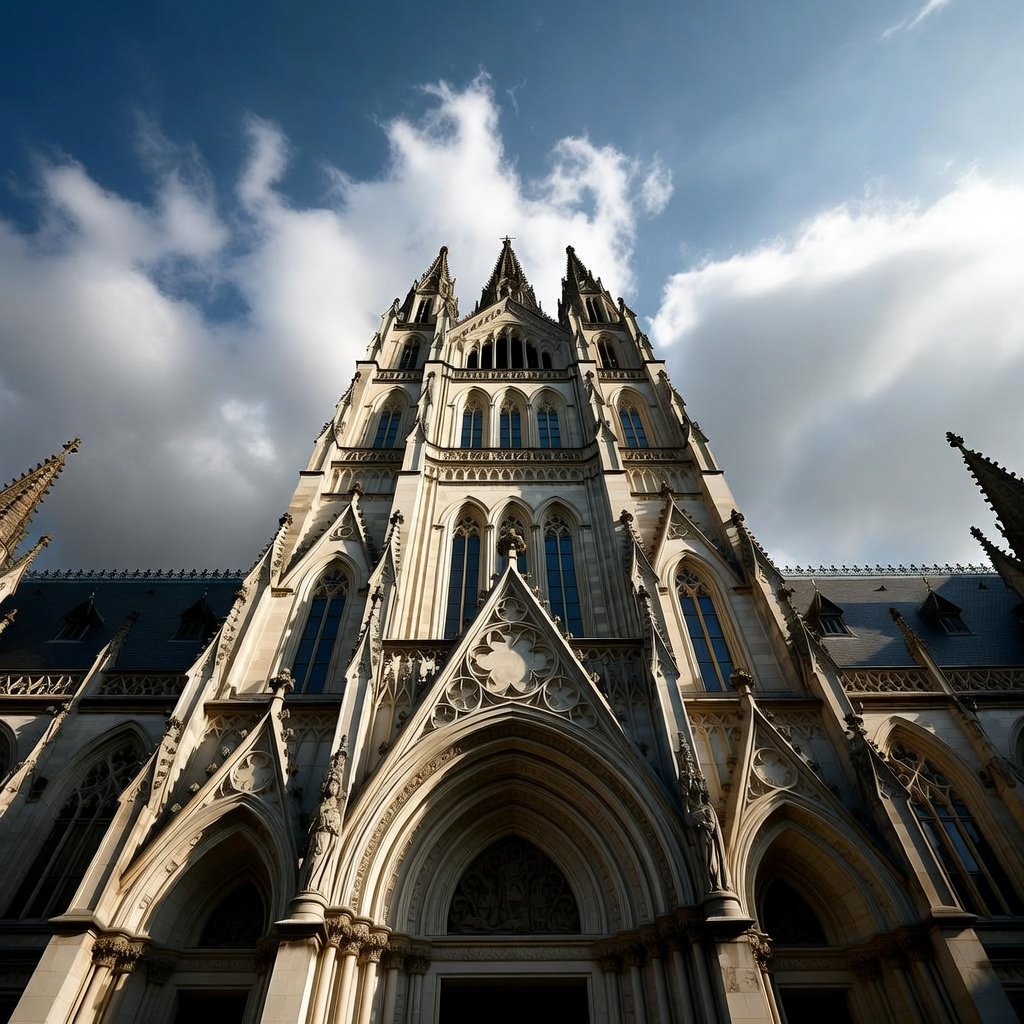
Have you ever stood beneath a towering spire that seems to pierce the heavens, its intricate stonework whispering tales of a bygone era? That’s the magic of neo-Gothic architecture, a revival that breathed new life into the medieval Gothic style during the 19th century. Far from being a mere imitation, neo-Gothic structures blend historical reverence with Victorian innovation, creating landmarks that continue to captivate the world today.
The Gothic style originated in 12th-century Europe, characterized by pointed arches, ribbed vaults, and flying buttresses that allowed for soaring heights and vast stained-glass windows flooding interiors with ethereal light. By the 18th century, however, the ornate Baroque and neoclassical movements had overshadowed it. Enter the Gothic Revival—or neo-Gothic—as a romantic backlash against industrialization’s cold rationalism. Architects like Augustus Pugin and A.W.N. Pugin in England championed this movement, arguing that Gothic embodied moral and spiritual purity. Pugin famously declared, “The greatest glory of a building is its moral purpose,” fueling a wave of restorations and new constructions across Europe and America.
What makes neo-Gothic so visually arresting? It’s the playful exaggeration of Gothic elements: exaggerated verticality, crocketed pinnacles, and gargoyles that serve as both drainage systems and whimsical guardians. Materials evolved too—cast iron and steel enabled even grander spans, while polychrome brickwork added vibrant colors absent in medieval originals. This fusion of old and new resulted in buildings that feel alive, their facades a symphony of light and shadow.
Iconic examples abound. In London, the Palace of Westminster, redesigned by Charles Barry and Pugin after the 1834 fire, stands as a neo-Gothic masterpiece. Its Big Ben tower (officially Elizabeth Tower) looms over the Thames, a symbol of British resilience. Across the Atlantic, New York’s St. Patrick’s Cathedral, completed in 1879, exemplifies American neo-Gothic with its twin spires and rose window, offering a serene escape amid the city’s hustle. Then there’s the Washington National Cathedral in D.C., a 20th-century marvel blending neo-Gothic with modern touches like organ pipes shaped like space shuttles—a nod to America’s forward gaze.
Neo-Gothic’s influence extends beyond bricks and mortar. It inspired literature, from Edgar Allan Poe’s macabre tales to Bram Stoker’s Dracula, evoking mystery and the sublime. In film, think of the shadowy halls in Tim Burton’s works or the haunted elegance of Hogwarts in Harry Potter. Even today, neo-Gothic elements pop up in theme parks like Disney’s Cinderella Castle, proving its timeless appeal.
Yet, neo-Gothic isn’t without critics. Some decry it as nostalgic escapism, ignoring the social upheavals of its era, like the exploitation in Britain’s industrial cities. Still, its structures endure as cultural anchors, reminding us of humanity’s quest for transcendence. In an age of glass skyscrapers, these stone sentinels invite us to pause, look up, and dream. Whether you’re wandering Prague’s neo-Gothic National Theatre or admiring a local church steeple, neo-Gothic architecture bridges past and present, urging us to build not just for utility, but for the soul. So next time you encounter one, linger—its shadows hold secrets worth uncovering.
Comments are closed