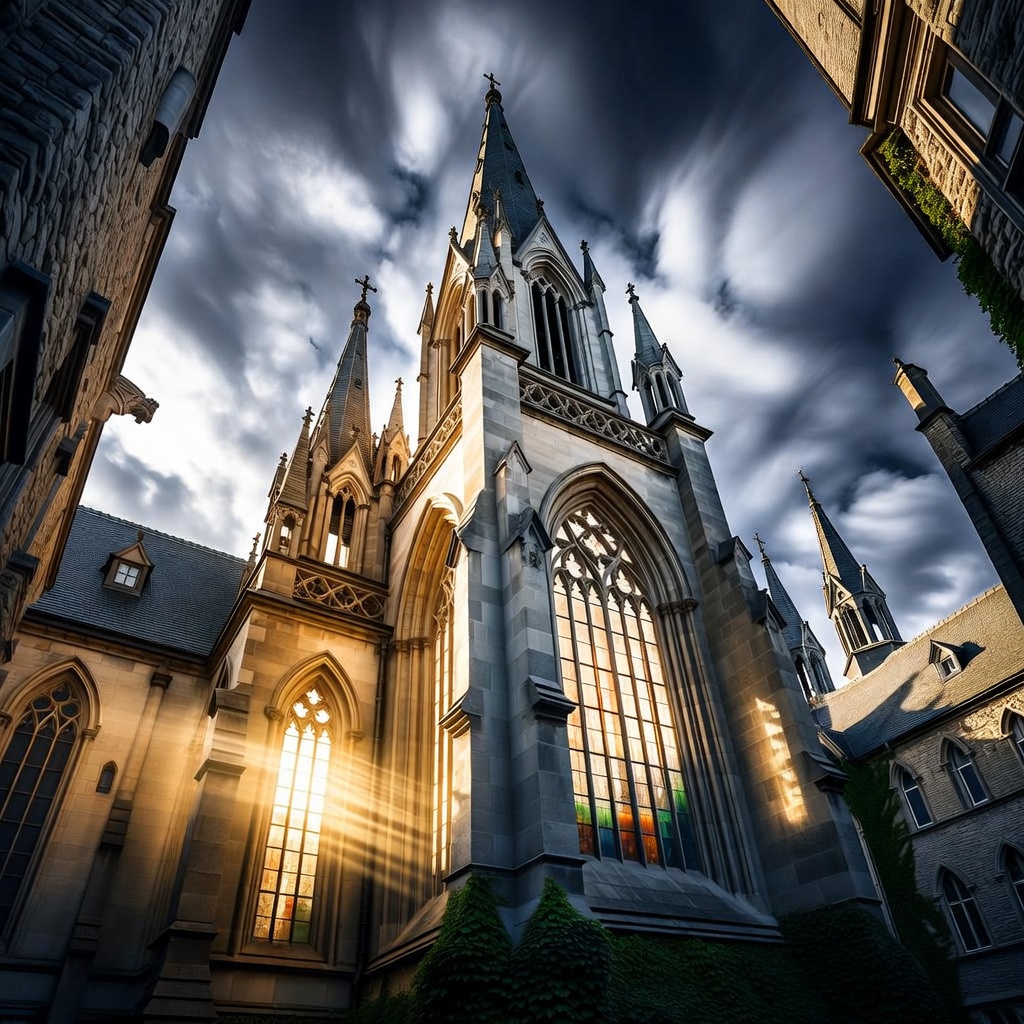
Imagine wandering through a city where ancient stone whispers tales of knights and cathedrals, yet the buildings around you gleam with Victorian ingenuity. This is the magic of neo-Gothic architecture, a 19th-century resurrection of medieval grandeur that transformed skylines from London to New York. Far from mere imitation, neo-Gothic wasn’t just about pretty facades; it was a cultural rebellion against the industrial grind, blending romance with rebellion in every pointed arch and intricate gargoyle.
The story begins in the early 1800s, amid the Romantic movement’s yearning for the past. As factories belched smoke and cities swelled with mechanized monotony, architects like Augustus Welby Northmore Pugin and John Ruskin championed a return to the Gothic style of the Middle Ages. Pugin, a fiery Catholic convert, saw Gothic as the pinnacle of Christian art—organic, vertical, and soul-stirring. His manifesto, *Contrasts* (1836), lambasted classical architecture as pagan and soulless, urging a revival that would elevate the spirit. This wasn’t nostalgia; it was a moral crusade. Queen Victoria’s era embraced it wholeheartedly, funding grand projects that symbolized Britain’s imperial might and moral superiority.
What makes neo-Gothic so captivating? At its core, it revives the medieval Gothic hallmarks: soaring spires that pierce the heavens, ribbed vaults that distribute weight like a spider’s web, and flying buttresses that allow walls to burst into stained-glass windows. But neo-Gothic amps up the drama with Victorian flair—think polychrome brickwork, ornate tracery, and iron reinforcements hidden within to support larger scales. Gargoyles, once mere waterspouts, became whimsical guardians, warding off evil with toothy grins. The style’s verticality draws the eye upward, evoking transcendence, while intricate details reward close inspection, from floral motifs to biblical carvings.
No tour of neo-Gothic is complete without its icons. In London, the Palace of Westminster—rebuilt after a 1834 fire—stands as Pugin and Charles Barry’s masterpiece. Its iconic clock tower (home to Big Ben) and neo-Gothic halls blend parliamentary pomp with ethereal light filtering through rose windows. Across the Atlantic, the United States Cathedral in Washington, D.C., begun in 1907, embodies American ambition. Spanning over 500 feet, it’s a neo-Gothic behemoth with chapels honoring every state, its unfinished spires a testament to ongoing faith.
Closer to home, New York’s St. Patrick’s Cathedral (1858) rises amid skyscrapers, its twin spires a green oasis of spirituality. And let’s not forget the University of Chicago’s campus, where neo-Gothic quads like those at Oxford inspire scholars amid ivy-clad towers. Even in literature, neo-Gothic haunts us—think Edgar Allan Poe’s crumbling abbeys or Bram Stoker’s shadowy castles, mirroring the style’s gothic allure.
Today, neo-Gothic endures as a bridge between eras. It’s influenced modern fantasy—from Hogwarts in *Harry Potter* to video game cathedrals—proving its timeless appeal. Preservation efforts keep these structures alive, reminding us that in an age of glass and steel, a touch of medieval mystery still captivates. Next time you’re in a city with a neo-Gothic gem, pause and look up. Those spires aren’t just stone; they’re stories, waiting to be rediscovered. Whether you’re an architecture buff or a casual stroller, the neo-Gothic world invites you to dream amid the details.
Comments are closed