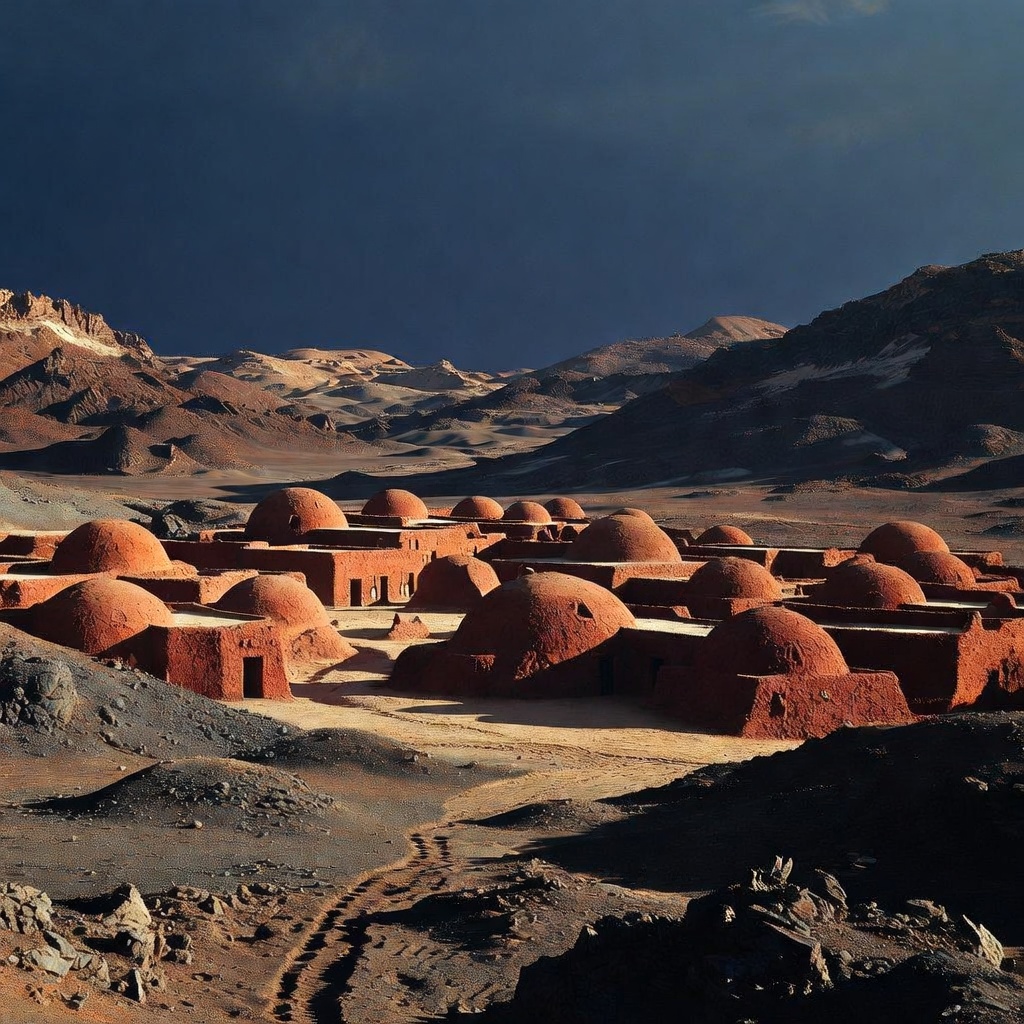
Imagine waking up to a crimson dawn, not on Earth, but on the rusty plains of Mars. For decades, visionaries like Elon Musk and NASA engineers have dreamed of human colonies on the Red Planet. But turning that dream into reality hinges on one critical element: architecture that doesn’t just shelter, but thrives in an alien hellscape. Mars colony design isn’t about aesthetics—it’s a high-stakes blend of engineering, survival science, and bold innovation. Let’s dive into how we’re architecting the future’s off-world outposts.
First, the brutal realities. Mars is unforgiving. Temperatures plummet to -80°F (-62°C) at night, radiation bombards the surface unchecked by a thin atmosphere, and planet-wide dust storms can rage for months, blotting out the sun. Gravity is a mere 38% of Earth’s, which could wreak havoc on human bodies over time. Traditional building methods? Forget them. Shipping every brick from Earth would be prohibitively expensive—think billions per structure. Instead, architects are eyeing in-situ resource utilization (ISRU), mining Mars’ abundant regolith (soil) to fabricate habitats on-site.
Enter 3D printing, the darling of Mars architecture. NASA’s ongoing experiments, like the 3D-Printed Habitat Challenge, showcase printers that extrude regolith mixed with polymers into sturdy walls. Picture massive robotic arms layering a dome-shaped home, layer by volcanic dust layer, creating radiation-shielding thickness without a single human hand. These structures could mimic igloos or even sprawling connected modules, forming a village-like colony. Inflatable habitats, pioneered by companies like Bigelow Aerospace, offer another clever twist. Lightweight, compact modules launch folded in rockets, then expand on Mars like cosmic balloons, reinforced with Kevlar and regolith coatings for durability.
But it’s not all underground bunkers and domes. Sustainability drives the design ethos. Closed-loop life support systems recycle air, water, and waste, turning habitats into self-sustaining ecosystems. Solar panels, perhaps embedded in translucent ETFE roofs (a lightweight plastic used in Earth’s Eden Project), harness the weak Martian sunlight, while nuclear micro-reactors provide reliable power. Greenhouses integrated into habitats grow food hydroponically, their curved glass enclosures doubling as communal spaces—imagine Martian farmers tending vertical gardens under artificial lights, fostering a sense of community in isolation.
Design inspiration draws from both sci-fi and reality. Think of the pressurized corridors in “The Martian” or the modular habitats in Kim Stanley Robinson’s Mars Trilogy, but grounded in prototypes like the HI-SEAS analog missions on Hawaii’s volcanoes. Future colonies might evolve into terraced cities carved into craters, using lava tubes—natural underground caverns—for ready-made shielding. These could house thousands, with atriums simulating Earth skies via holographic projections to combat psychological strain.
Of course, challenges remain. Psychological well-being demands thoughtful layouts: private nooks for solitude, open plazas for social bonds. Low gravity calls for reinforced floors to prevent structural sagging. Yet, the payoff is immense—a blueprint for humanity’s multi-planetary future.
As we edge closer to boots on Martian soil, perhaps via SpaceX’s Starship or NASA’s Artemis program, Mars architecture promises not just survival, but a new chapter in human ingenuity. Who knows? Your future home might be a red-domed marvel, whispering tales of exploration under alien stars.
Comments are closed