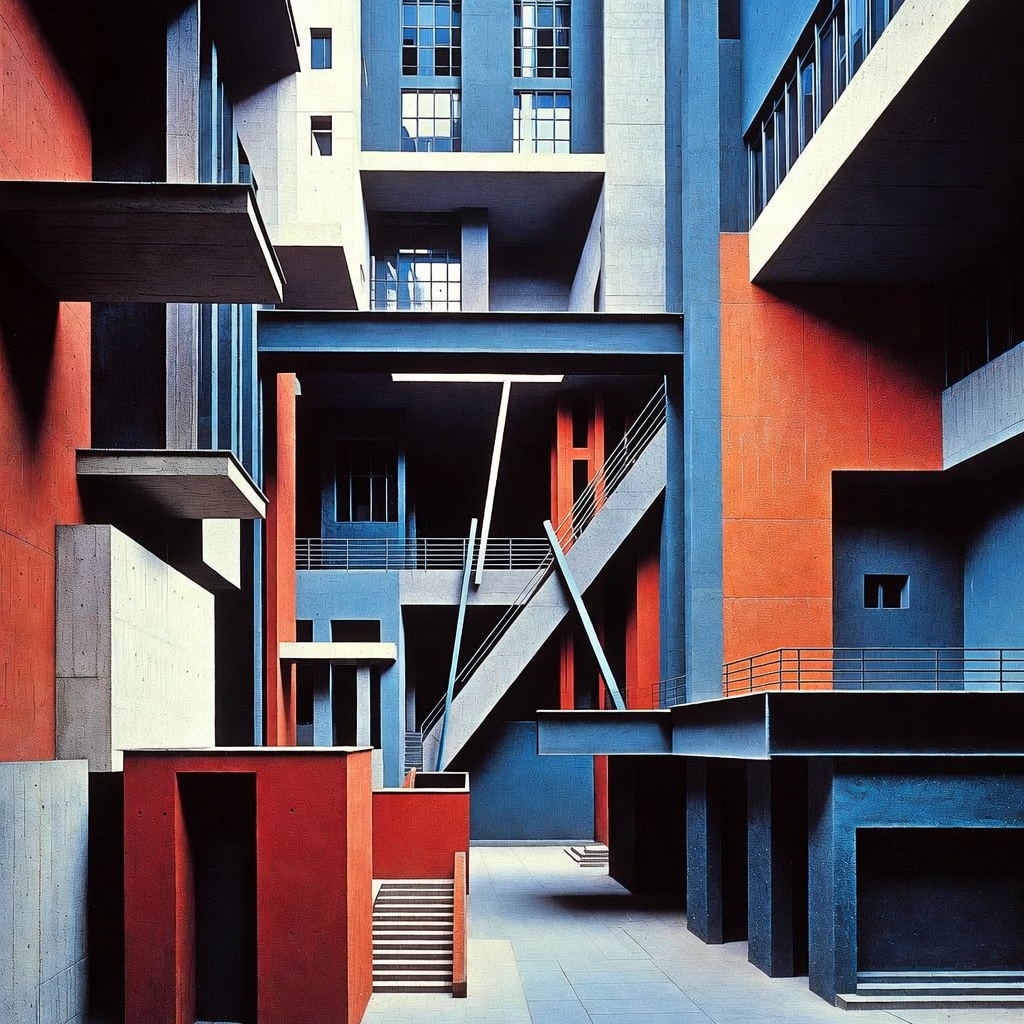
Imagine a world where art isn’t just pretty pictures on a wall but a tool to reshape society—factories humming with purpose, buildings that scream progress, and everyday objects designed to empower the masses. This was the electrifying promise of Soviet Constructivism, a movement that burst onto the scene in the chaotic aftermath of the 1917 Russian Revolution. Born from the ashes of tsarist excess, it aimed to construct a new communist reality, blending art, architecture, and industry into a symphony of functionality and fervor.
At its core, Constructivism rejected the ornamental fluff of the past. Pioneered by visionaries like Vladimir Tatlin, Alexander Rodchenko, and El Lissitzky, it championed “construction” over mere aesthetics—think raw materials like steel, glass, and concrete, assembled with the precision of engineers. Tatlin’s unrealized Monument to the Third International (1919-1920), often called Tatlin’s Tower, epitomized this audacity: a spiraling iron lattice rising 400 meters high in revolutionary Petrograd (now St. Petersburg), meant to house Soviet offices and broadcast propaganda via rotating glass volumes. Though never built due to material shortages and political shifts, it symbolized the movement’s utopian ambition—a literal twist toward the future.
The roots trace back to avant-garde groups like the Suprematists, but Constructivism took a pragmatic turn. In 1921, the Obmokhu collective declared art must serve the proletariat, ditching bourgeois individualism for collective utility. Rodchenko’s spatial constructions—hanging metal sculptures that played with light and shadow—weren’t gallery darlings; they were prototypes for a world where design democratized life. His iconic photographs, like the angled shots of Moscow’s streets, captured the dynamism of urban transformation, while his textiles and posters flooded factories and streets with bold, geometric propaganda.
Architecture became the movement’s megaphone. In the 1920s, Constructivist buildings dotted Moscow and Leningrad, turning drab worker housing into statements of equality. The Narkomfin Communal House (1928-1930), designed by Moisei Ginzburg and Ignaty Milinis, was a ribbon of glass and concrete apartments promoting communal living—laundry shared, kitchens collective—to erode old family structures and foster socialist solidarity. Similarly, Ivan Leonidov’s unrealized Palace of Culture (1929) envisioned vast halls for education and leisure, a people’s palace amid industrial sprawl. These weren’t just shelters; they were ideological machines, optimizing space for the new Soviet man and woman.
Yet, Constructivism’s flame flickered out by the early 1930s. Stalin’s regime, favoring grandiose neoclassicism to project imperial might, branded it “formalist” and bourgeois. Many architects faced purges, their blueprints gathering dust. Still, its influence echoes globally—from Bauhaus minimalism in Germany to modern brutalism and even today’s parametric designs. In an era of cookie-cutter suburbs and fast fashion, Constructivism reminds us that design can ignite social change, urging us to build not just for profit, but for a bolder collective tomorrow.
What if we revived that spirit? Could our cities, choked by excess, use a dose of Constructivist clarity? It’s a question worth pondering as we navigate our own revolutions—digital, environmental, human.
Comments are closed