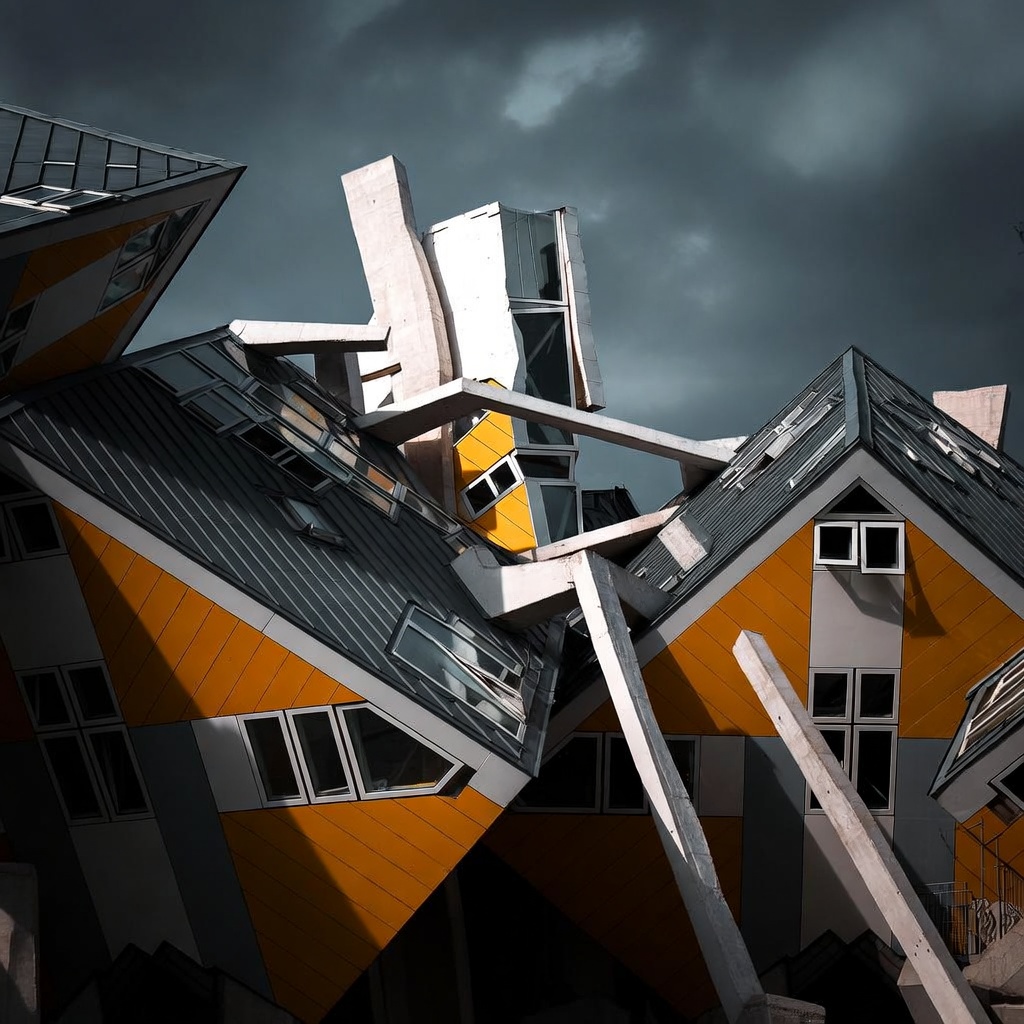
Have you ever stared at a building and thought, “That looks like it was designed by a mad genius who hates straight lines”? If so, you’ve probably encountered deconstructivism, the architectural movement that turned the world of design upside down in the late 20th century. Born from a cocktail of philosophy, postmodern rebellion, and a dash of chaos, deconstructivism isn’t just about building structures—it’s about dismantling our expectations of what a building should be.
Let’s rewind to the 1980s, when the seeds of this movement were sown. The term “deconstructivism” draws inspiration from French philosopher Jacques Derrida’s deconstruction theory, which questions fixed meanings and stable structures in language and thought. Architects took this idea and ran with it, literally twisting and fragmenting traditional forms to create buildings that seem to defy gravity and logic. It wasn’t about destruction for destruction’s sake; it was a deliberate challenge to the rigid, functionalist modernism of the mid-20th century, like Le Corbusier’s pristine boxes. Deconstructivists wanted to expose the hidden instabilities in architecture, making the invisible visible through jagged edges, asymmetrical angles, and unexpected intersections.
The movement burst onto the scene with the 1988 MoMA exhibition in New York, curated by Philip Johnson and Mark Wigley. Featured were seven avant-garde architects: Frank Gehry, Daniel Libeskind, Peter Eisenman, Zaha Hadid, Coop Himmelb(l)au, Rem Koolhaas, and Bernard Tschumi. Their designs screamed rebellion—Gehry’s early sketches for the Guggenheim Museum in Bilbao, Spain, looked like crumpled paper, while Libeskind’s Jewish Museum in Berlin evoked the fractured history of the Holocaust with its zigzag corridors and voids.
Take Gehry’s Guggenheim, opened in 1997: a shimmering titanium whirlwind that snakes along the Nervion River. It doesn’t just house art; it becomes a sculptural experience, drawing millions who gasp at its fluid, deconstructed form. Or consider Hadid’s Heydar Aliyev Center in Baku, Azerbaijan—a sweeping, wave-like structure that blurs the line between building and landscape, as if the earth itself is melting into architecture. These aren’t passive spaces; they provoke, confuse, and delight, forcing us to question symmetry and order.
Critics, of course, weren’t all fans. Some called it pretentious chaos, arguing it prioritized spectacle over practicality—think leaky roofs or disorienting interiors. And yes, constructing these wild forms pushed engineering to its limits, often ballooning costs. But deconstructivism’s influence endures. It paved the way for parametric design and digital fabrication, where algorithms now help realize even more complex geometries. Today, echoes of it appear in everything from Beijing’s CCTV Headquarters (a looping, gravity-defying tower by Koolhaas) to contemporary installations that play with form and function.
In a world obsessed with sleek minimalism and smart cities, deconstructivism reminds us that architecture can be disruptive and human—flawed, emotional, alive. It’s not for the faint of heart, but for those who dare to look closer, it reveals a profound truth: beauty often thrives in the broken pieces. So next time you wander a city skyline, spot the rebels and smile—they’re the ones shaking up the status quo.
Comments are closed