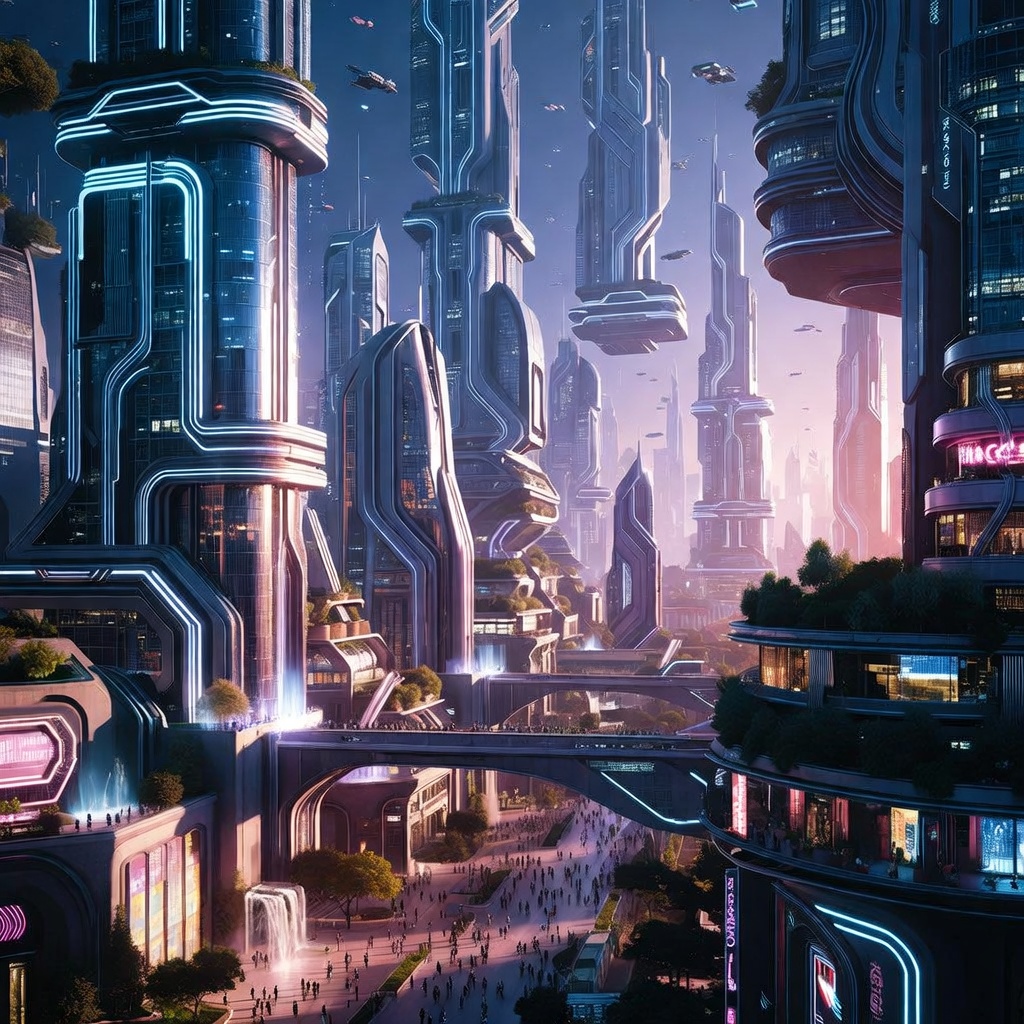
Imagine waking up in a metropolis that pulses like a living organism, its skyline a symphony of twisting spires and hovering habitats. This isn’t a scene from a sci-fi blockbuster—it’s the blueprint for neo-futurist cities, the bold evolution of urban living that’s reimagining our world for the 22nd century. Blending retro-futurism’s optimistic gleam with cutting-edge tech, these visionary hubs promise sustainability, hyper-connectivity, and a dash of wonder. Buckle up; we’re diving into the neon-lit future.
Neo-futurism draws from the 20th-century Futurist movement—think Italian manifestos glorifying speed and machinery—but amps it up with today’s realities: climate crises, AI revolutions, and space-age materials. Architects like Santiago Calatrava and Zaha Hadid laid the groundwork with fluid, dynamic designs, but neo-futurists take it further. Picture NEOM in Saudi Arabia, a $500 billion linear city slashing across the desert, powered entirely by solar and wind. Its mirrored skyscrapers reflect the sun, cooling the structure while generating energy. Or Masdar City in Abu Dhabi, a car-free oasis where autonomous pods zip residents around under shaded canopies, cutting emissions by 40%.
What sets these cities apart? Verticality and symbiosis with nature. Traditional urban sprawl guzzles land; neo-futurist designs stack life skyward. Singapore’s Jewel Changi Airport, with its 150-foot indoor waterfall, hints at this—airports as urban cores. In true neo-futurist style, concepts like Dubai’s Museum of the Future feature cantilevered orbs housing AI labs, while proposals for floating cities off Tokyo Bay use tension-leg platforms to bob gently on waves, resilient to rising seas.
Tech is the beating heart. Drone taxis and hyperloops slash commute times—imagine zipping from Brooklyn to Midtown in five minutes. Smart grids with blockchain ensure energy equity; buildings “breathe” via kinetic facades that harvest wind and rain. Biophilic design reigns: vertical farms spiral up towers, yielding 10 times more food per square foot than soil farming, as seen in Milan’s Vertical Forest, home to 900 trees across two skyscrapers. AR overlays turn streets into interactive canvases—point your glasses at a wall, and it blooms into a virtual garden or historical reenactment.
But it’s not all utopian gloss. Critics flag equity gaps: NEOM’s gigaprojects risk displacing nomads, and high-tech reliance could widen digital divides. Yet proponents counter that neo-futurism democratizes progress—open-source blueprints let Shenzhen-style makerspaces iterate on designs globally.
As climate clocks tick, these cities aren’t fantasies; they’re prototypes scaling fast. China’s Xiong’an New Area integrates maglev trains with wetland restoration, housing 25 million by 2035. Europe’s Skytrain Network eyes elevated rail pods linking megacities. The allure? They reclaim the future from dystopian tropes, offering vibrant, adaptive homes where humanity thrives in harmony with tech.
Step into a neo-futurist city, and you’ll feel the thrill of possibility. It’s not just building taller—it’s dreaming bolder, ensuring our urban legacy soars. Who’s ready to live the dream?
Comments are closed