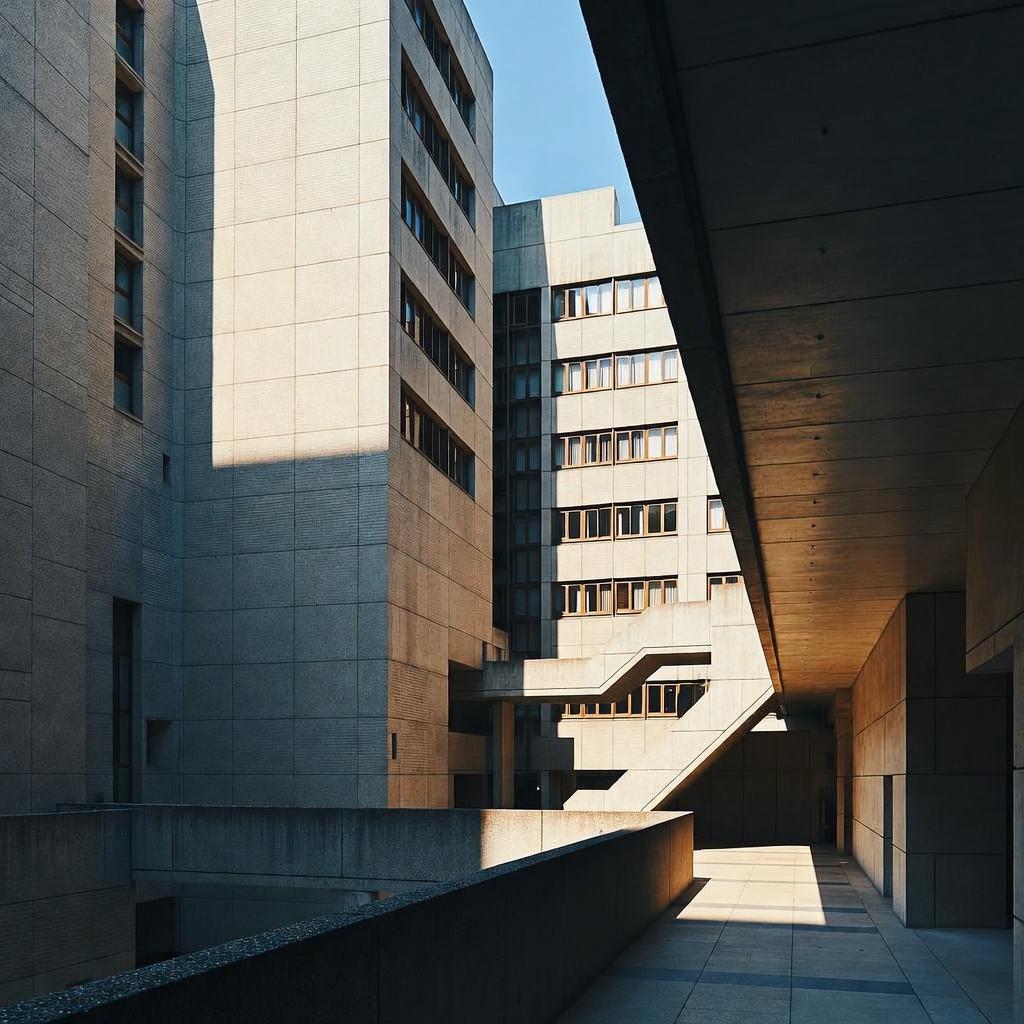
Picture this: it’s the 1960s, and cities are buzzing with post-war optimism. Architects, fueled by concrete fever, are reshaping urban landscapes with raw, unapologetic Brutalism—those hulking masses of exposed aggregate that scream “function over frills.” But amid the tower blocks and civic centers, a playful rebellion emerges: Brutalist playgrounds. These weren’t your candy-colored swing sets; they were monumental sculptures designed for kids to conquer, climb, and crash upon. Welcome to the era when playgrounds became brutal battlegrounds of imagination.
Brutalism in playgrounds hit its stride in the mid-20th century, particularly in Europe and the UK. Architects like Aldo van Eyck in Amsterdam and Playground Studio in Berlin treated play spaces as serious architecture. Van Eyck’s Amsterdam playgrounds, scattered across the city from the 1940s to ’60s, featured stark concrete tunnels, ramps, and sand pits integrated into housing blocks. No railings, no plastics—just honest materials inviting raw adventure. The philosophy? Play isn’t sanitized; it’s chaotic, social, and tied to the urban fabric.
Jump to the UK, where council estates birthed icons like the Southwark Park playground in London, with its jagged concrete pyramids and serpentine slides. Designed in the ’70s, these spaces embodied the welfare state’s ambition: equality through bold design. Kids scrambled over precariously angled slabs, slid down sheer drops, and hid in bunker-like enclosures. Safety? Minimal. A 1970s parent might wince today, but back then, scraped knees built character. These playgrounds drew from avant-garde influences—think Alison and Peter Smithson’s “streets in the sky” concepts, miniaturized for tots.
Why Brutalism for play? It was cheap, durable, and anti-elitist. Concrete could be molded into fantastical forms without ornate detailing, weathering the elements and endless trampling. Play theorists like Lady Allen of Hurtwood championed “junk playgrounds” evolving into structured Brutalism, arguing for environments that mirrored life’s ruggedness. In Sweden, the “Plaskogen” designs by Carl Mannström featured massive, abstract boulders and arches, turning parks into explorable artworks.
Fast-forward, and nostalgia has revived these relics. Many survived demolition waves in the ’80s-’90s, when rubberized, lawsuit-proof equipment took over. Today, Instagram hordes flock to restored gems like the Žižkov TV Tower playground in Prague—hulking concrete hands cradling slides—or Berlin’s Erich-Kläber Park, with its fortress-like tunnels. Preservationists fight to save them, citing their sculptural merit and role in “adventure playground” heritage.
Yet, Brutalism’s playground legacy whispers a warning: in our padded, litigious world, have we sanitized joy? These concrete colossi remind us that play thrives on risk, texture, and the thrill of the unknown. Next time you’re near one—perhaps Liverpool’s mysterious “Wobbly Bridge” relic—climb on. Channel that inner child, and feel the brutal pulse of unfiltered fun. Who knows? You might just rediscover the kid who fears nothing.
Comments are closed