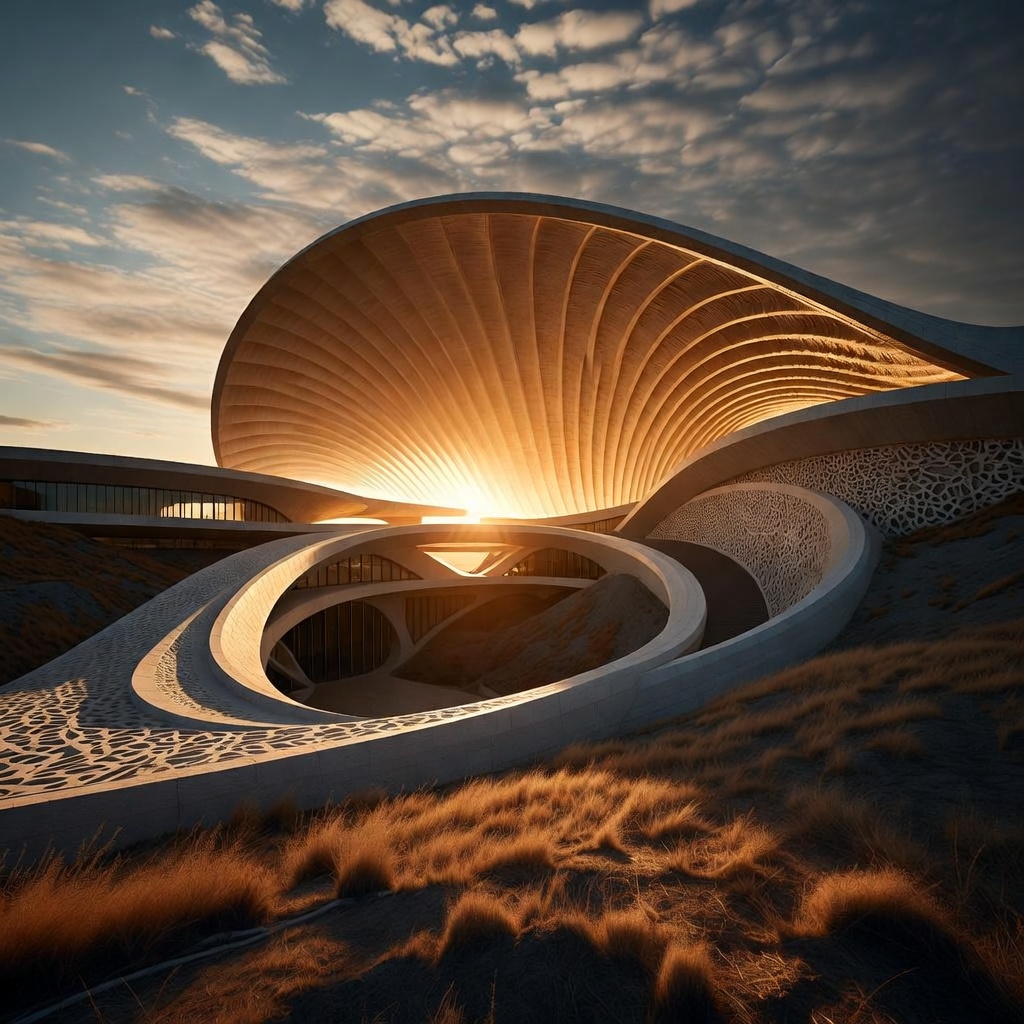
Imagine a building that twists like a dancer’s spine, its form sculpted not by human hands alone, but by algorithms that breathe life into steel and glass. Welcome to the world of parametric architecture, where math meets creativity in a symphony of curves, folds, and fluidity. This isn’t sci-fi—it’s the cutting edge reshaping our skylines, from Beijing’s Bird’s Nest Stadium to Sydney’s pixelated harborside wonders.
At its core, parametric design harnesses computational power to generate complex geometries that traditional drafting could never dream of. Architects use software like Grasshopper (a plugin for Rhino 3D), Dynamo for Revit, or even Python scripts to define parameters—variables like angles, curvatures, or environmental factors. Change one input, and the entire structure adapts in real-time. It’s like giving a building a set of DNA instructions: tweak the genes, and watch the form evolve.
Pioneered in the late 20th century, parametricism gained rocket fuel with digital tools in the 1990s. Zaha Hadid, the queen of fluidity, was an early evangelist. Her Heydar Aliyev Center in Baku, Azerbaijan, flows like a frozen wave, its seamless surfaces born from parametric models that optimized airflow, light, and structural integrity. No straight lines here—just pure, organic momentum.
Why does this matter? Parametric architecture solves real-world puzzles. Take sustainability: algorithms can simulate wind patterns, solar exposure, and material stress, minimizing waste. The King Abdulaziz Center for World Culture in Saudi Arabia uses parametric facades that shade interiors naturally, slashing energy use by up to 40%. Or consider responsiveness—buildings that “perform.” The Al Bahar Towers in Abu Dhabi feature a parametric sun-tracking brise-soleil system: thousands of flower-like panels that close against the desert sun, mimicking nature’s efficiency.
But it’s not all high-tech utopia. Critics argue parametric designs can feel alienating, like alien pods dropped into human cities. The complexity drives up costs—custom fabrication via CNC machines or 3D printing isn’t cheap. And there’s the black-box risk: if you don’t understand the parameters, you’re at the mercy of the machine. Yet proponents counter that this is evolution, not excess. Tools like AI-driven generative design (think Autodesk’s tools) now democratize it, letting even small firms craft bespoke masterpieces.
Looking ahead, parametric architecture is fusing with biotech and smart cities. Picture facades that self-heal or adapt to climate shifts via embedded sensors. Projects like BIG’s VIA 57 West in New York—a parametric pyramid slicing the skyline—hint at a future where buildings are living algorithms.
In a world of cookie-cutter condos, parametric design dares us to dream bigger, bendier, and bolder. It’s proof that when architects unleash the power of parameters, they don’t just build structures—they sculpt possibilities. Next time you gaze at a swooping roofline, tip your hat to the code behind the curve. The revolution is just getting started.
Comments are closed