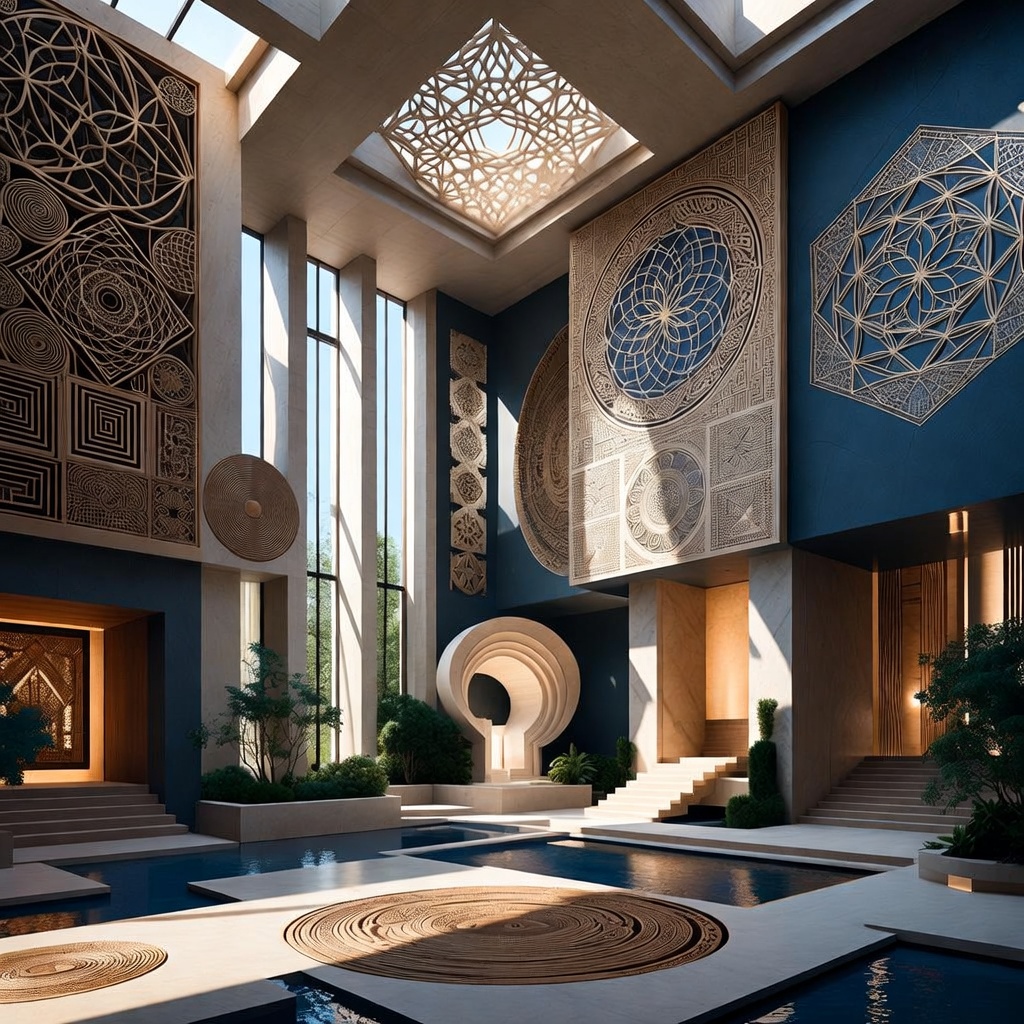
Have you ever stared at a snowflake, a honeycomb, or the spiral of a nautilus shell and felt a cosmic whisper? That’s sacred geometry at work—ancient patterns derived from mathematics and nature that ancient civilizations like the Egyptians, Greeks, and Mayans revered as the language of the universe. From the Flower of Life to the Fibonacci sequence, these shapes aren’t just pretty; they’re the fundamental building blocks of existence. Fast-forward to today, and sacred geometry is having a renaissance in modern design, blending mysticism with minimalism to create spaces, products, and visuals that resonate on a soul-deep level.
In architecture, sacred geometry is the secret sauce behind iconic modern structures. Take Zaha Hadid’s flowing forms or the Oculus at New York’s World Trade Center—its ribbed exoskeleton echoes the vesica piscis, a sacred intersection of two circles symbolizing unity and creation. Designers like these draw from the golden ratio (approximately 1:1.618), a proportion found in the Parthenon and Leonardo da Vinci’s Vitruvian Man, to craft buildings that feel intuitively harmonious. Why does it work? Science backs it up: our brains are wired to find these ratios aesthetically pleasing, triggering feelings of balance and calm. In sustainable design, the Fibonacci spiral inspires efficient solar panels and organic-shaped eco-homes, mimicking nature’s energy-efficient patterns to reduce waste and maximize light.
Fashion and product design are equally enchanted. Brands like Stella McCartney and Veja incorporate mandala-inspired prints and hexagonal patterns—think honeycombs for breathable fabrics or the Seed of Life motif on sneakers. Jewelry lines from Alex and Ani feature Metatron’s Cube pendants, believed to align chakras while doubling as chic statement pieces. Even tech giants like Apple nod to it: the bitten logo subtly evokes the golden spiral, and their product curves follow phi ratios for that addictive ergonomic grip. It’s no accident—sacred geometry fosters subconscious trust and delight, boosting user engagement.
Digital design amplifies this magic. UI/UX wizards use the Flower of Life grid for intuitive app layouts, creating interfaces that feel alive and navigable. Instagram filters and NFTs explode with fractal geometries, turning sacred patterns into viral art. Wellness brands layer them into yoga mats, meditation apps, and crystal grids, merging spirituality with sleek minimalism.
Why the surge now? In our chaotic, screen-saturated world, sacred geometry offers grounding. It’s a reminder that we’re part of a vast, interconnected cosmos—practical yet profound. As AI and VR evolve, expect these patterns to shape immersive metaverses, where virtual temples built on Platonic solids redefine digital sacred spaces.
Next time you swipe through a beautifully designed app or step into a sunlit atrium, pause. You’re not just experiencing aesthetics; you’re tapping into eternity’s code. Sacred geometry proves that the future of design isn’t reinventing the wheel—it’s remembering how it was divinely spun in the first place. Dive in, create, and let the patterns guide you.
Comments are closed