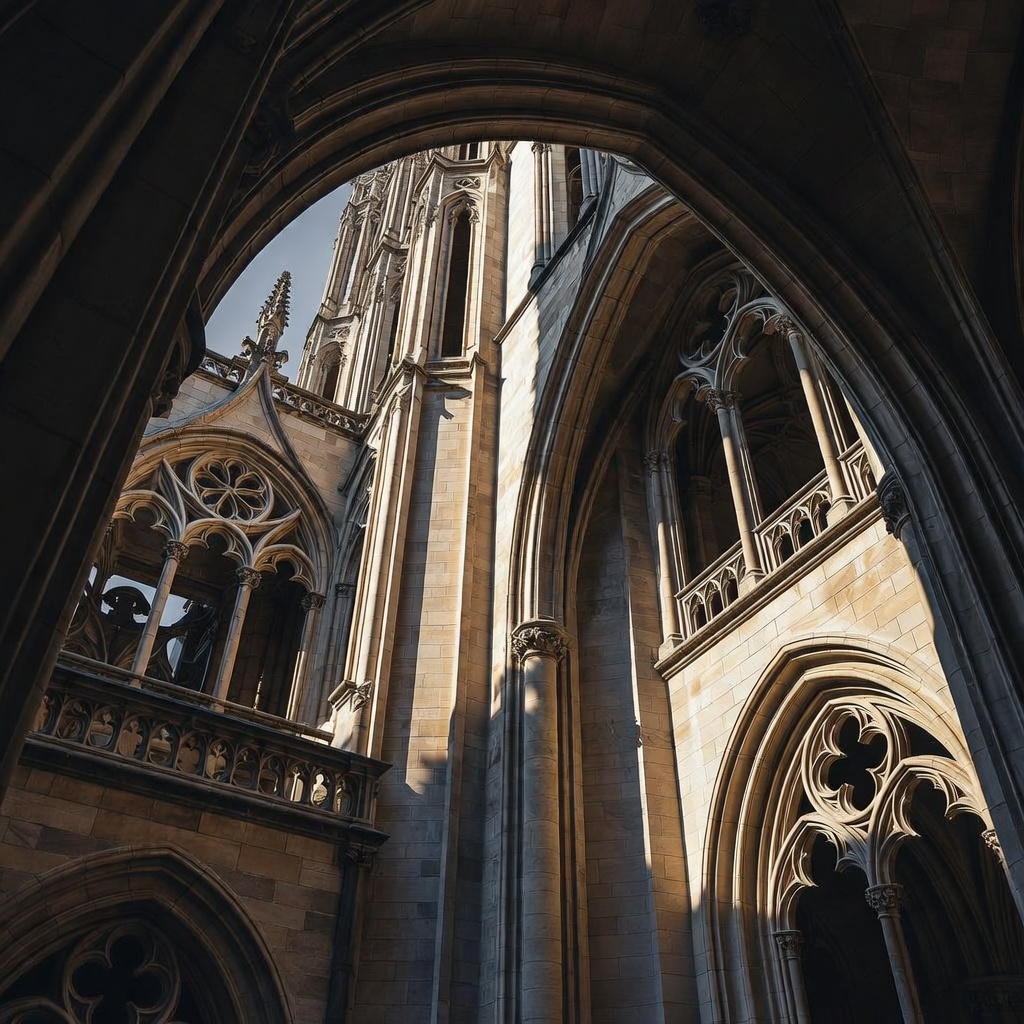
In the heart of a bustling city, where steel skyscrapers pierce the clouds, stands a cathedral that whispers secrets from centuries ago. Its pointed arches soar like frozen lightning bolts, gargoyles leer from the eaves, and stained-glass windows paint the floor in jewel-toned stories. This isn’t a medieval relic—it’s a neo-Gothic masterpiece, born in the 19th century yet feeling eternally ancient. Welcome to the enchanting world of neo-Gothic architecture, where Victorian dreamers resurrected the Gothic spirit to challenge the industrial grind.
Neo-Gothic, or Gothic Revival, emerged in the late 18th century as a romantic rebellion against the stark rationalism of neoclassicism and the cold machinery of the Industrial Revolution. Architects like Augustus Pugin in England and Eugène Viollet-le-Duc in France championed it, arguing that Gothic design embodied Christian virtues, moral purity, and a connection to the divine. Pugin famously declared in “Contrasts” (1836) that the era’s factories were “satanic mills,” while Gothic cathedrals represented heaven on earth. This wasn’t mere nostalgia; it was a cultural crusade.
The style exploded across Europe and North America. In Britain, Parliament’s Palace of Westminster (1840–1876), redesigned by Charles Barry and Pugin after a fire, became the ultimate neo-Gothic icon. Its intricate tracery, ribbed vaults, and 315-foot Big Ben tower (officially Elizabeth Tower) blend medieval grandeur with practical politics. Across the Atlantic, America’s Gilded Age embraced it fervently. The Cathedral of St. John the Divine in New York City (begun 1892) sprawls like a Gothic behemoth, unfinished yet awe-inspiring, with its massive nave and bizarre sculptural menagerie—from pilgrims to endangered species symbolizing stewardship.
What makes neo-Gothic so captivating? It’s the drama: flying buttresses that defy gravity, pinnacles stabbing the sky, and ornate crocketed spires evoking upward aspiration. Materials evolved too—cast iron and steel allowed unprecedented heights and delicacy, as seen in the intricate ironwork of the Eiffel Tower’s lesser-known Gothic cousins or the Woolworth Building in Manhattan (1913), the “Cathedral of Commerce” with its lacy terra-cotta facade.
Universities drank deeply from this wellspring. Oxford and Cambridge’s new colleges mimicked medieval quadrangles, while in the U.S., Yale’s Harkness Tower (1924) and Princeton’s Gothic dorms created timeless campuses that still draw students into a Harry Potter-esque fantasy. Even civic buildings joined the fray: Chicago’s Tribune Tower (1925) fused neo-Gothic with skyscraper ambition, incorporating ancient stones from global landmarks into its base.
Today, neo-Gothic endures, influencing fantasy realms from Hogwarts to video games. Restoration projects, like Notre-Dame’s post-2019 revival, remind us of its resilience. Yet, critics once dismissed it as fussy escapism. History proves otherwise—neo-Gothic structures stand as bold testaments to humanity’s yearning for beauty amid modernity’s march. Next time you pass a pointed arch or grinning gargoyle, pause. You’re not just seeing stone; you’re witnessing a revival that refuses to fade into shadow.
Comments are closed