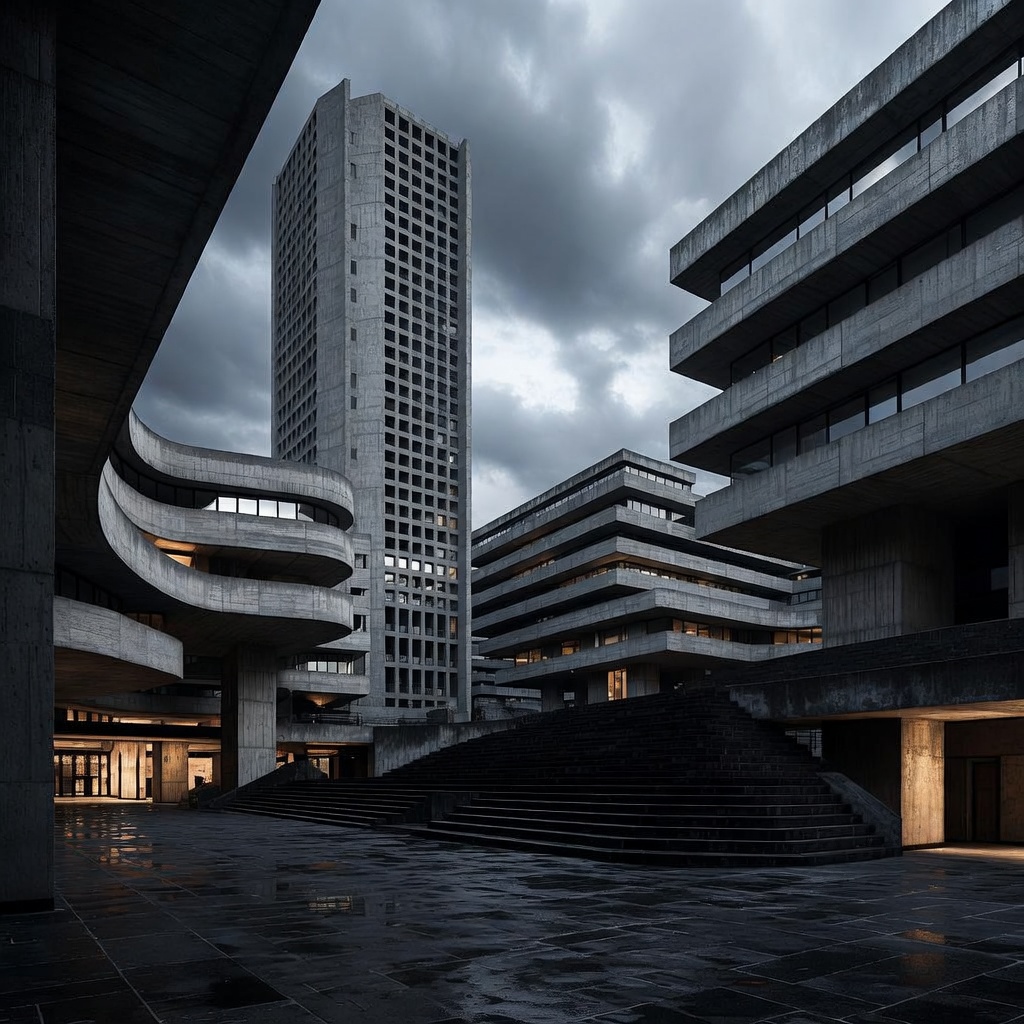
In the shadow of sleek glass skyscrapers and minimalist lofts, a hulking giant from the mid-20th century is clawing its way back into the spotlight: Brutalism. Once dismissed as the architectural equivalent of a concrete sledgehammer—cold, monolithic, and unapologetically raw—this style is experiencing a ferocious revival. Designers, developers, and Instagram architects are rediscovering its raw power, turning what was derided as “urban eyesore” into the height of hip sophistication. Why now? And what does it mean for our cities? Let’s pour some concrete on the facts.
Born in the post-World War II era, Brutalism emerged from the minds of visionaries like Le Corbusier and Alison and Peter Smithson. The term, coined disparagingly by architect Reyner Banham in 1955, derives from the French “béton brut,” meaning raw concrete. These buildings weren’t finished with pretty veneers; they celebrated the material’s honest texture—poured, molded, and scarred by wooden formwork. Think Boston City Hall’s fortress-like bulk or London’s Barbican Estate, with its sculptural towers piercing the sky. Brutalism was socialism in stone: affordable housing, civic centers, and universities built en masse to rebuild shattered societies. It embodied utopian ideals—equality through bold, functional forms that prioritized community over ornament.
By the 1970s and ’80s, the backlash hit hard. Critics called it oppressive, maintenance-nightmarish (that porous concrete loves staining and leaking), and environmentally tone-deaf. Many Brutalist icons faced the wrecking ball—Habraken’s Yale Art and Architecture Building nearly met its end. But survival bred nostalgia. Enter the revival, turbocharged by the digital age.
Social media is Brutalism’s unlikely savior. Platforms like Instagram filter its textures into moody, high-contrast perfection. Hashtags like #Brutalism and #Brutal_Architecture boast millions of posts, transforming drab Soviet-era blocks in Eastern Europe into pilgrimage sites for photographers and influencers. Architects are riffing on it too. Firms like OMA (Rem Koolhaas’s outfit) nod to Brutalist massing in projects like Qatar’s National Museum, while younger studios like 6a Architects in London restore gems like themeli’s Southbank Centre with loving fidelity.
What fuels this comeback? Authenticity in an era of fakery. Amid glassy homogeneity, Brutalism’s tactility—those rhythmic béton ridges, geometric voids—feels defiantly human-scaled and emotive. It’s anti-algorithm: no smooth curves for AI renders here. Sustainability plays a role; retrofitting existing concrete hulks beats new builds’ carbon footprint. And culturally, it’s punk rock for the design world—raw rebellion against twee Scandi minimalism.
Yet, it’s not without controversy. Preservationists battle demolitions, like the recent outcry over Australia’s Robin Boyd structures. Critics argue revival risks sanitizing Brutalism’s radical edge, turning social housing into boutique lofts for the elite.
As we hurtle toward denser urban futures, Brutalism’s revival signals a craving for permanence amid flux. It’s not just nostalgia; it’s a blueprint for resilient, expressive cities. Next time you pass a brooding concrete behemoth, snap a pic—you might be witnessing history’s next chapter. Who knew raw cement could feel so fresh?
Comments are closed