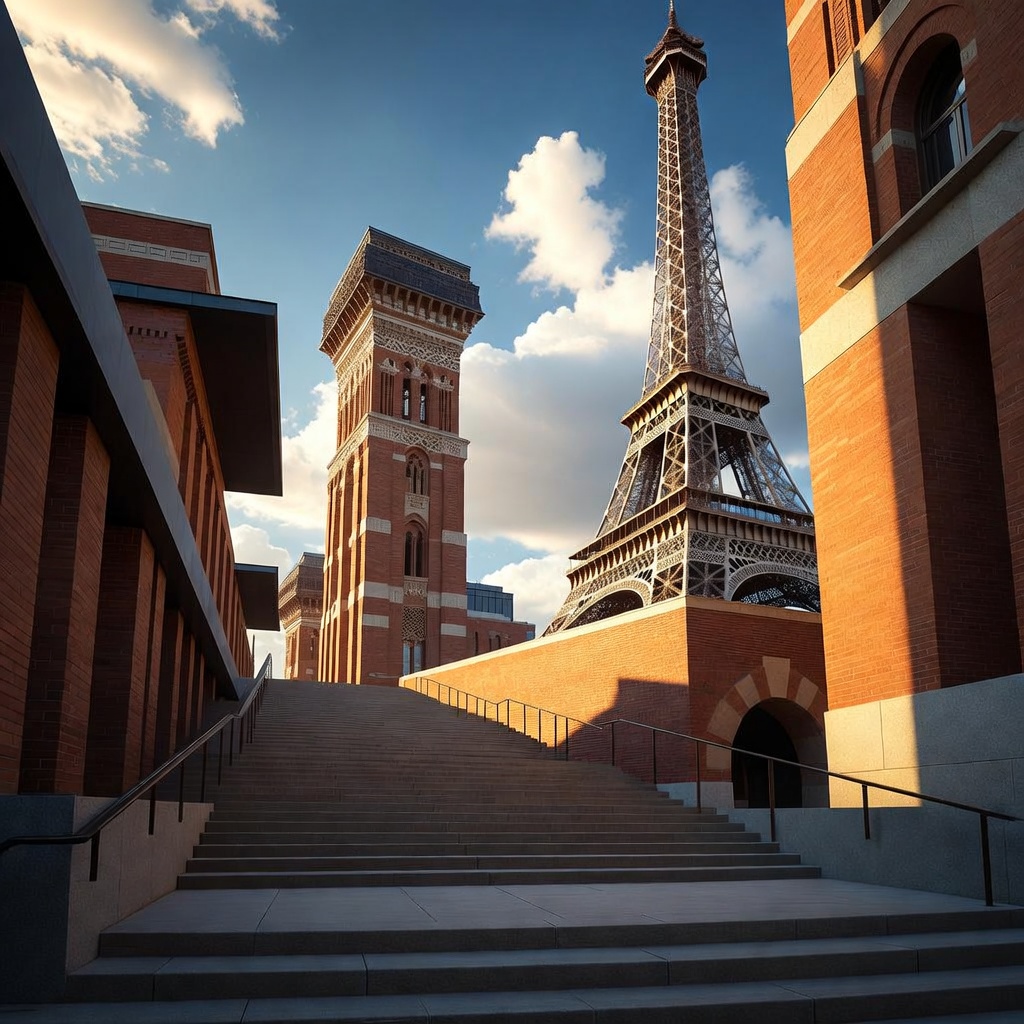
Have you ever stared at a fern leaf, mesmerized by how each frond echoes the whole in perfect miniature? Or zoomed into a coastline on Google Earth, watching rugged bays repeat their jagged dance at every scale? That’s the magic of fractals—self-similar patterns that repeat infinitely, defying the ordinary rules of geometry. Now, imagine channeling that infinite complexity into the buildings we live in, work in, and wander through. Welcome to fractal pattern architecture, where math meets masonry in a symphony of recursive beauty.
Fractals aren’t just pretty pictures on your screensaver; they’re a blueprint for nature’s efficiency. Coined by mathematician Benoit Mandelbrot in the 1970s, fractal geometry describes irregular shapes that look the same no matter how much you magnify them. Think Romanesco broccoli or snowflakes—endless iterations creating organic harmony. Architects, ever the innovators, have seized this concept to craft structures that feel alive, sustainable, and downright hypnotic.
One standout pioneer is Zaha Hadid, whose fluid designs often nod to fractal logic. Her Heydar Aliyev Center in Baku, Azerbaijan, undulates like a frozen wave, with curving facades that repeat motifs at multiple scales. From afar, it’s a sleek blob; up close, intricate folds and panels fractalize into a labyrinth of light and shadow. It’s not mere aesthetics—fractal patterns optimize airflow, distribute structural loads evenly, and maximize natural light, making buildings more energy-efficient.
Closer to home (or at least more Instagram-famous), the fractal influence shines in modern high-rises like the Poly Grand Theater in Beijing, designed by Vector Architects. Its roof mimics a crumpled origami sheet, with triangular facets repeating across scales to create sheltered plazas below. Or consider the Bhutan National Memorial Chorten, where traditional mandala patterns fractalize into stupa tiers, blending ancient spirituality with mathematical precision.
But fractals aren’t just for showpieces; they’re revolutionizing affordable housing and urban planning. In arid regions like the Middle East, architect Abdulrahman Gazzaz’s fractal-inspired Masdar City prototypes use self-similar wind towers. These stack like Russian dolls, channeling breezes through narrowing channels for passive cooling—no AC required. Studies from MIT show fractal layouts can reduce urban heat islands by up to 20%, as varied scales trap and release heat more naturally than boxy grids.
Why does this matter? In a world grappling with climate chaos and cramped cities, fractal architecture offers scalable solutions. It draws from nature’s 3.5-billion-year R&D lab: termite mounds ventilate via fractal tunnels, tree canopies fractalize for optimal sunlight. By mimicking these, we build resilient structures that adapt, evolve, and inspire awe.
Skeptics might call it gimmicky, but walk through a fractal foyer—say, the spiraling staircases of the Guggenheim Museum (a proto-fractal vibe)—and feel the pull. It’s disorienting, delightful, infinite. As we hurtle toward smarter cities, fractal patterns remind us: the most profound designs aren’t imposed; they unfold, layer by layer, echoing the universe’s endless code.
Next time you trace a lightning bolt or leaf vein, ponder the skyline. Fractals aren’t the future—they’re already reshaping our world, one recursive ripple at a time.
Comments are closed