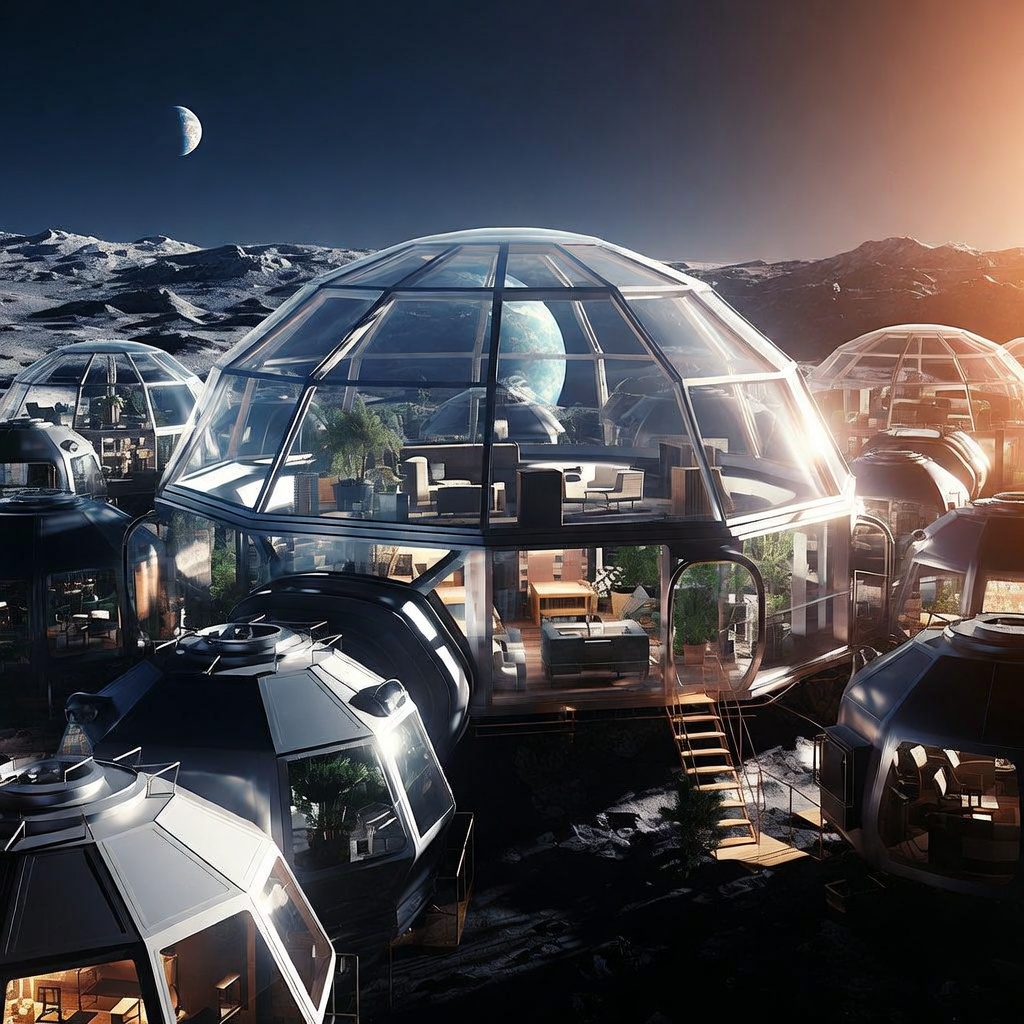
Imagine waking up to a sunrise that lasts two weeks, with Earth hanging like a blue marble in your bedroom window. No, this isn’t a sci-fi flick—it’s the reality awaiting pioneers in lunar habitat modules. As NASA, SpaceX, and private ventures race toward sustainable Moon bases, these self-contained living pods are the unsung heroes turning regolith dreams into habitable reality. Let’s dive into the engineering marvels making lunar life not just possible, but plausible.
At the heart of lunar habitats are inflatable modules, pioneered by Bigelow Aerospace and refined by NASA’s Artemis program. Unlike rigid metal cans, these expand like high-tech balloons once deployed from rockets. Picture a compact cargo packed into a Starship trunk, then blooming into a 300-square-meter palace on the Moon’s surface. Made from layered Kevlar-like fabrics infused with Vectran—stronger than steel by weight—they withstand micrometeorite pings and the Moon’s brutal temperature swings from -173°C nights to 127°C days. Radiation shielding? Multi-layer “translucent” designs scatter cosmic rays, while embedded water bladders double as life support and meteor bumpers.
But it’s not just about popping balloons. Inside, habitats are mini-Earths. Closed-loop life support systems recycle air, water, and waste with 95% efficiency, using electrolysis to split H2O into breathable oxygen and rocket fuel. Hydroponic farms glow under LED lights, churning out greens from lunar soil enriched with Earth microbes. A single module could sustain four astronauts indefinitely, with modular connectors allowing “Lego-like” expansion into villages. ESA’s Moon Village concept envisions clusters buried under regolith berms for extra insulation, powered by vast solar arrays unfurling like mechanical flowers during the 14-day lunar day.
Challenges? Plenty. Lunar quakes from shrinking core contraction demand shock-absorbing designs, while dust—sharp as glass—clings electrostatically, gumming seals. Solutions include electrostatic repellents and 3D-printed regolith bricks for outer shells. Cost is dropping: inflatable tech slashes launch mass by 60%, and in-situ resource utilization (ISRU) mines oxygen from ilmenite-rich soil.
The payoff is cosmic. These modules aren’t pit stops; they’re launchpads for Mars and beyond. By 2030, expect prototypes at the lunar south pole, tapping water ice for fuel. Companies like Blue Origin are prototyping with Orbital Reef tech, while China’s ILRS plans hermetic domes. Soon, tourists might sip coffee in a lunar lounge, gazing at our fragile home.
Lunar habitats symbolize humanity’s next giant leap—not just surviving, but thriving under alien stars. As we stack these modules, we’re not colonizing the Moon; we’re exporting Earth, one inflatable bubble at a time. Who’s packing their bags?
Comments are closed