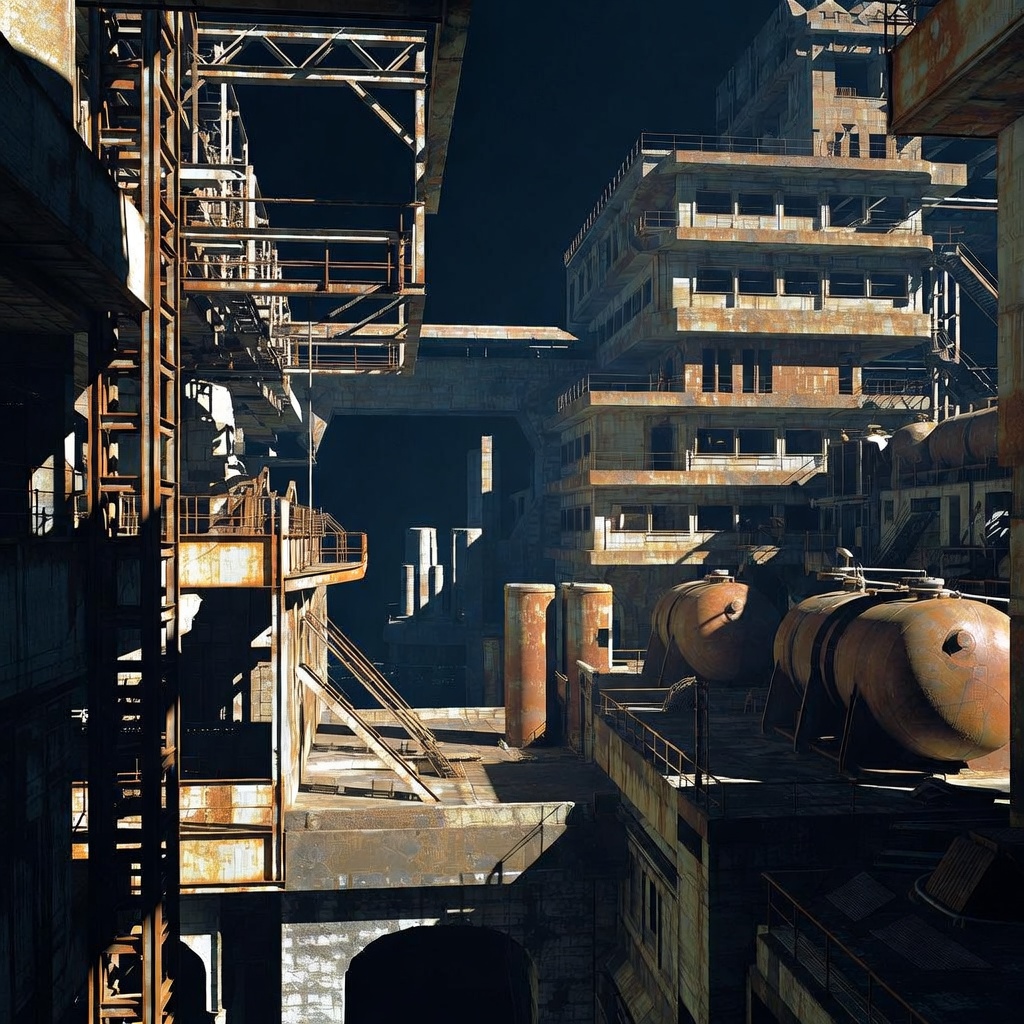
In the vast silence of space, where time stretches into eternity, lie the skeletal remains of humanity’s boldest architectural gambits. These aren’t crumbling castles or vine-choked factories on Earth—they’re orbital outposts, lunar habitats, and Martian prototypes, frozen in a state of perpetual abandonment. Picture this: a sprawling lattice of solar panels drifting in low Earth orbit, their mirrors cracked like shattered ice, silently tumbling through the void. Welcome to the eerie world of abandoned space exploration architecture, where ambition outpaced reality, leaving behind monuments to what might have been.
Our story begins with NASA’s Skylab, launched in 1973 as America’s first space station. This 100-ton behemoth, essentially a converted Saturn V rocket upper stage, orbited Earth for six years, hosting three crews who conducted groundbreaking experiments in microgravity. But a mission gone wrong—micrometeoroid shielding ripped off during launch—doomed it early. By 1979, with no shuttle ready to service it, Skylab was deorbited, plunging fiery chunks into the Australian outback. Today, fragments rust in museums, but its ghostly path still haunts orbital debris catalogs. Skylab’s design was revolutionary: multi-level modules with domed observatories and exercise bikes bolted to walls to combat bone loss. Abandoned, it became a cautionary tale of overreach.
Fast-forward to the Soviet Union’s Salyut series, the secretive precursors to Mir. Salyut 1, launched in 1971, was the world’s first space station, a cylindrical habitat packed with living quarters, labs, and docking ports. Cosmonauts lived there for weeks, but tragedy struck when the Soyuz 11 crew perished during reentry. Subsequent stations like Salyut 7 met lonelier fates. After 1986 operations, it was left derelict, its systems failing until a planned deorbit in 1991 scattered debris over Argentina. These stations featured ingenious fold-out solar wings and cramped crew quarters with fold-down bunks—compact marvels of Soviet engineering, now reduced to spectral entries in declassified archives.
The Moon holds its own forsaken relics. During the Apollo era, the Lunar Module descent stages were left behind as passive seismometers and reflectors. But envision the unbuilt: NASA’s canceled Lunar Surface Habitat concepts from the 1970s, inflatable modules and buried lava tube bases designed to shield against radiation. Artist renders show geodesic domes spanning craters, hydroponic farms glowing under artificial suns. Similarly, the Soviet Lunokhod rovers’ support structures—abandoned launch pads at Baikonur still bear scars from LK lander tests that never flew.
Modern ghosts include China’s Tiangong-1, which tumbled uncontrolled into the Pacific in 2018 after outliving its usefulness, and the growing clutter of defunct satellites forming artificial rings around Earth. Private ventures like Bigelow Aerospace’s expandable habitats, prototyped in orbit, now gather dust in bankruptcy warehouses.
These abandoned architectures whisper of hubris and ingenuity. They remind us that space is unforgiving—radiation erodes seals, thermal cycles crack hulls, and orbits decay without upkeep. Yet, they inspire. Artemis and Starship aim to revive lunar bases, learning from these precursors. Scan the stars tonight; somewhere up there, a silent station waits, its corridors echoing with the ghosts of explorers who dared to build beyond the sky.
(Word count: 462)
Comments are closed