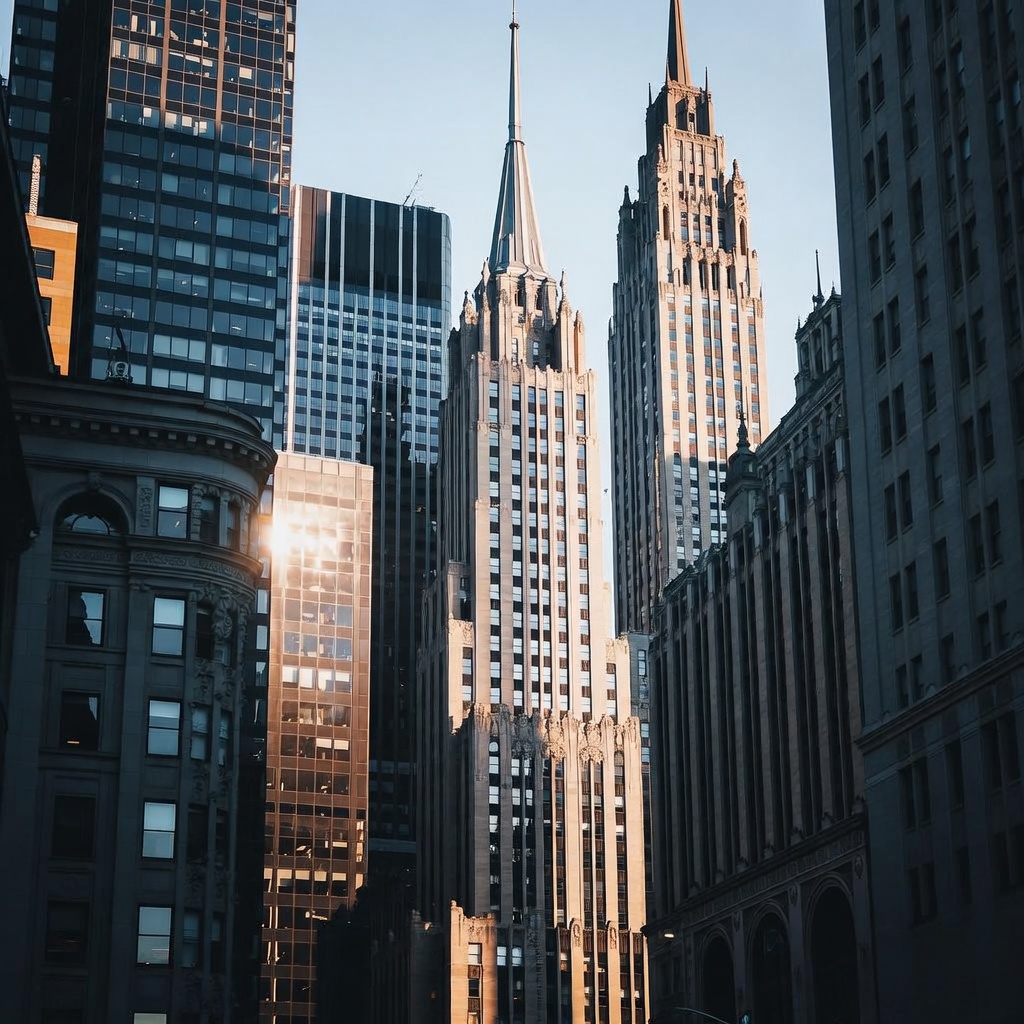
New York City’s skyline is a jagged symphony of ambition, but amid the glass monoliths, the Art Deco spires stand as elegant time capsules—slender, ornate sentinels piercing the clouds with Art Deco flair. These architectural filigrees, born in the Roaring Twenties and Great Depression, weren’t just decorative flourishes; they symbolized humanity’s defiance against gravity and economic gloom. Think of them as the city’s jazz-age crowns, blending Egyptian motifs, ziggurats, and streamlined modernism into vertical poetry.
The golden age of these spires peaked between 1920s and 1930s, when architects like William Van Alen and Shreve, Lamb & Harmon channeled the era’s exuberance into steel and stone. Key features? Tapering forms that evoke ancient obelisks or Mayan pyramids, often clad in stainless steel or limestone for that signature gleam. Setbacks—those terraced steps mandated by 1916 zoning laws—create wedding-cake profiles, culminating in spires that add illusory height without extra bulk. Intricate detailing abounds: sunburst patterns, mythological figures, and geometric motifs executed in gleaming metal, catching the light like frozen fireworks.
No discussion skips the Chrysler Building, the spire supreme. Completed in 1930, its 125-foot stainless-steel crown—hubcap-like discs stacked in a hyperbolic cascade—radiates from a brick shaft, glowing sunset-orange at dusk. It’s the tallest Art Deco spire in the city, a private vanity project by auto magnate Walter Chrysler that briefly eclipsed the Empire State Building. Speaking of which, the Empire State’s 1931 antenna spire, originally a mooring mast for dirigibles (a nod to futuristic dreams), soars 1,454 feet, its Art Deco base etched with heroic friezes of industry and progress. Then there’s 1 Wall Street, its 1931 setbacks adorned with terracotta eagles and a subtle spire-like pinnacle, now reborn as a luxury residential tower.
These weren’t mere aesthetics; they embodied the 1925 Paris Exposition Internationale des Arts Décoratifs, which inspired the style’s name. In Depression-era New York, spires signaled resilience—proof that glamour could rise from rubble. The GE Building (1933) at Rockefeller Center features a subtle spire integrated into its massing, flanked by bas-reliefs of Mercury and Prometheus, tying Deco to classical grandeur.
Today, these spires matter more than ever. Amid homogenization of supertall glass needles, they remind us of craft and narrative in architecture. The Chrysler, landmarked in 1978, dodged demolition threats, sparking the preservation movement that saved Grand Central. Modern echoes appear in One World Trade Center’s subtle spire (2014), a 408-foot beacon honoring the original towers, or the supertall designs nodding to Deco streamlining. They foster civic pride, drawing 14 million tourists yearly to Midtown’s Art Deco Historic District, boosting billions in economic impact.
In a world of sameness, New York’s Deco spires whisper: Build bold, build beautiful. They crown the city not just physically, but culturally—enduring icons of aspiration, frozen in eternal ascent. Next time you’re at street level, look up; those twists against the sky are history’s defiant jazz riff.
Comments are closed