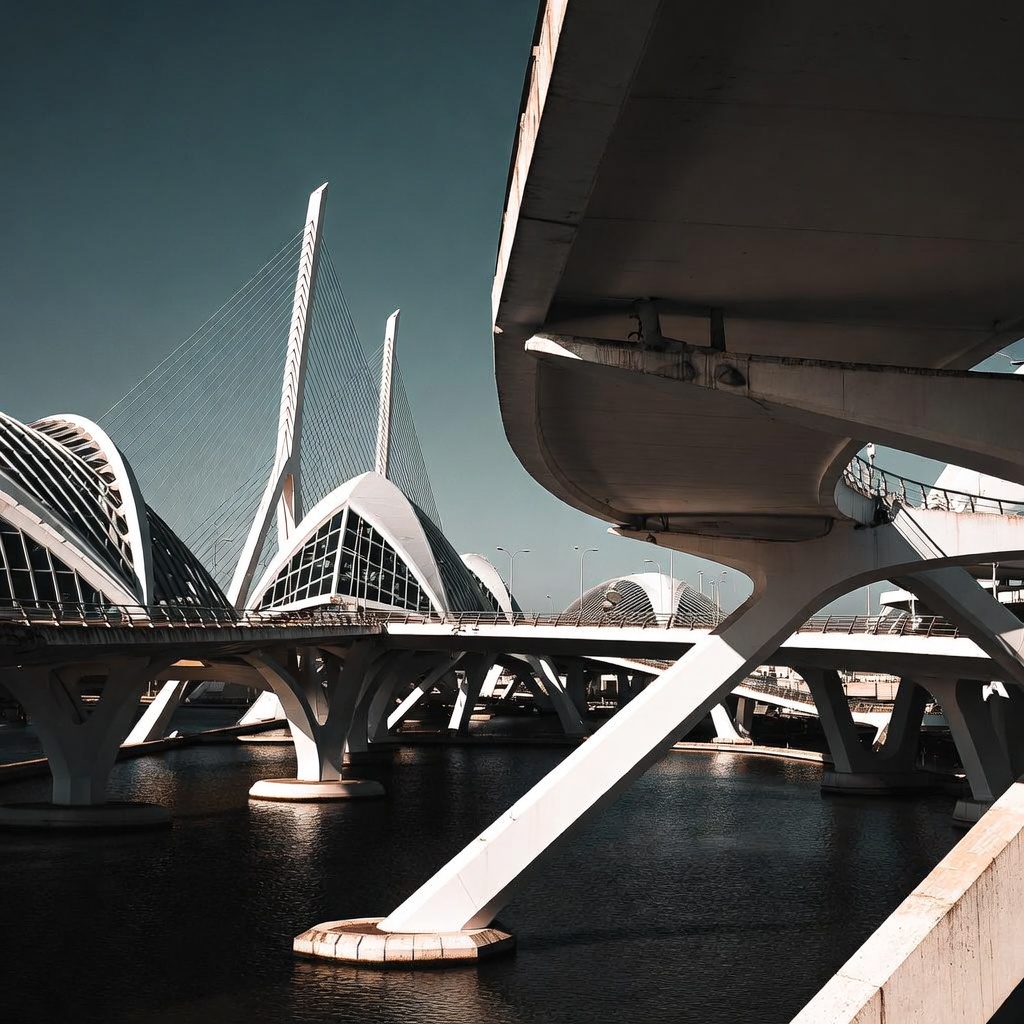
Imagine a bridge that doesn’t just stand still against the rush of rivers and traffic—it moves, breathes, and adapts like a living organism. This is the genius of Santiago Calatrava, the Spanish architect and sculptor whose kinetic bridges redefine infrastructure as art. These marvels blend engineering precision with organic fluidity, responding to wind, water, or human command. They’re not mere crossings; they’re symphonies in steel and motion.
Calatrava’s kinetic philosophy draws from nature’s own mechanisms—think bird wings, insect exoskeletons, or the human skeleton. His bridges feature moving parts: bascules that lift like drawbridges on steroids, cables that tense and release, and counterweights that enable graceful swings. Key to their design is the fusion of form and function. Take the Pegasus Bridge in Calais, France (originally the Choisy-le-Roi Bridge, relocated in 2013). This 72-meter span rotates 90 degrees horizontally to open for ships, powered by hydraulic pistons hidden within its slender, wing-like arms. Its aluminum deck gleams under lights, mimicking a mythical creature in flight. Safety features abound: redundant hydraulic systems, seismic sensors, and wind monitors ensure reliability, while aesthetic elements like illuminated masts turn nighttime openings into spectacles.
Historically, Calatrava’s kinetic innovations echo the medieval drawbridges of Europe but supercharge them with modern tech. Born in 1951 in Valencia, he studied at the prestigious ETH Zurich, where he merged architecture with structural engineering. His early works, like the 1992 Alamillo Bridge in Seville—a cable-stayed behemoth leaning dramatically backward—hinted at motion. But kinetic bridges exploded in the 2000s amid urban renewal projects craving icons. The Samuel Beckett Bridge in Dublin (2009) is a standout: a harp-shaped bascule that tilts skyward at 40 degrees, its twin masts evoking sails or musical strings. In Rotterdam, the Erasmusbrug (1996)—while not fully kinetic—foreshadowed his style with its harp silhouette and subtle sway under pedestrian loads, earning the nickname “The Swan.”
Fast-forward to today, and Calatrava’s influence pulses through global megacities. The recently completed Margaret Hunt Hill Bridge in Dallas (2012) features a kinetic-like tension in its S-shaped arches, symbolizing Texas swagger. Emerging projects, like proposed moving spans in Abu Dhabi, promise even bolder feats. Why do they matter now? In an era of climate chaos and urban density, kinetic bridges solve real problems: they minimize waterway disruptions for maritime traffic, reduce construction footprints by enabling on-demand openings, and withstand extreme weather with adaptive mechanics. Economically, they boost tourism—Dublin’s bridge draws 10 million viewers annually during openings.
Beyond utility, Calatrava’s bridges matter culturally. They humanize the built environment, reminding us that engineering can inspire awe. In a world of bland overpasses, these kinetic wonders celebrate movement, resilience, and beauty—proving that the path forward is one that dances with the elements. As cities evolve, Calatrava’s legacy ensures bridges aren’t just connectors; they’re storytellers, forever in motion.
Comments are closed