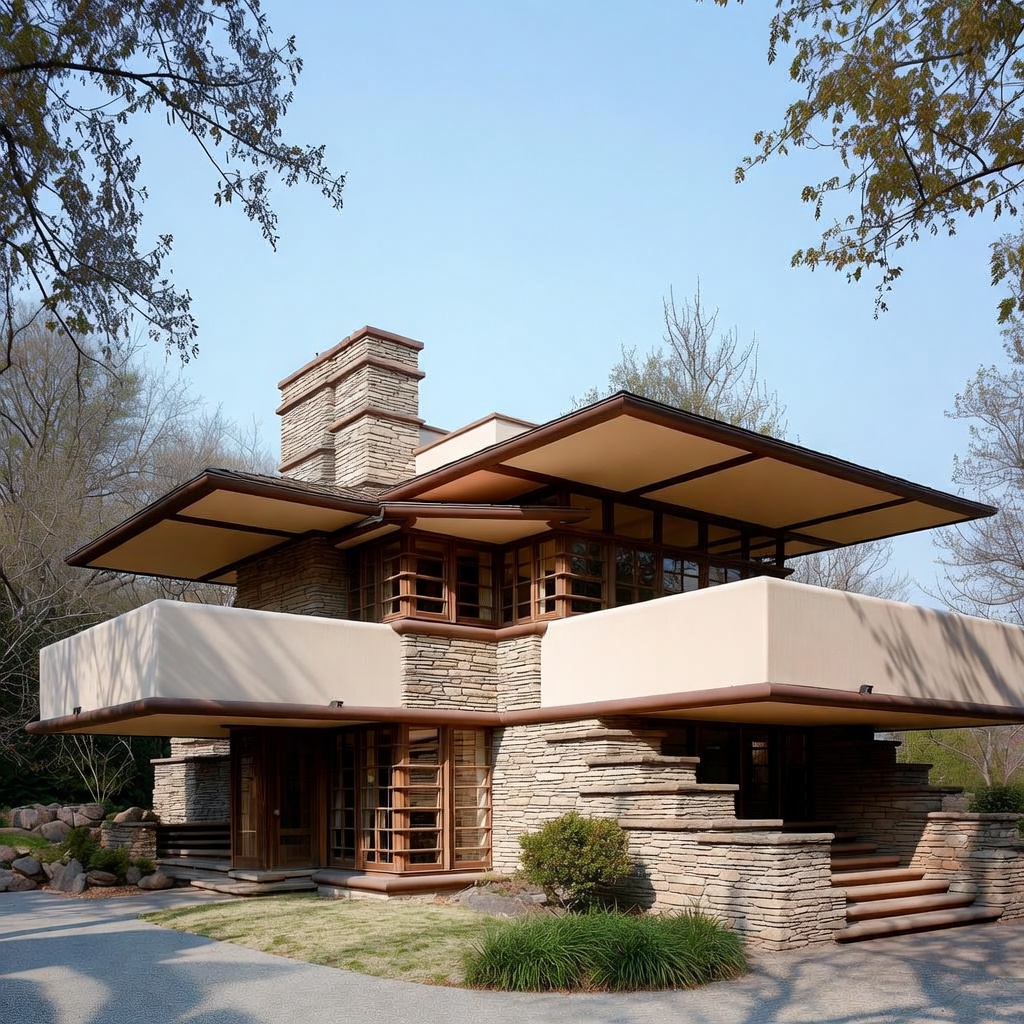
Frank Lloyd Wright didn’t just design buildings—he sculpted living extensions of the earth. Born in 1867 amid the smoke-belching factories of America’s Industrial Revolution, Wright rejected the era’s rigid, boxy architecture. Influenced by the rolling Wisconsin hills of his childhood and thinkers like Louis Sullivan, he forged “organic architecture” as a philosophy where form emerges from function, site, and nature itself. His mantra? “No house should ever be on a hill or on anything. It should be of the hill.”
At its core, organic architecture fuses buildings seamlessly with their surroundings. Wright championed horizontal lines to echo the prairie landscape, using materials like local stone, wood, and concrete that mimic natural textures. Cantilevered roofs, open floor plans, and vast windows dissolve barriers between indoors and out, letting light and air flow freely. Take Fallingwater, his 1935 masterpiece in Pennsylvania’s Bear Run. Perched—not plopped—over a cascading waterfall, the house’s stacked concrete terraces blend with the rocky streambed. Water gurgles beneath the living room floor, turning the home into a symphony of sound and stone. It’s not imposition; it’s integration.
Historically, Wright’s ideas sprouted in the 1900s with his Prairie School homes, like the Robie House in Chicago (1910), which stretched low and wide with overhanging eaves to shelter against Midwest winds. Post-Depression, he innovated with Usonian houses—affordable, modular designs for the middle class, emphasizing built-in furniture and radiant floor heating. His Guggenheim Museum in New York (1959) spiraled upward like a nautilus shell, challenging verticality with a continuous ramp that draws visitors into an organic flow.
Today, Wright’s legacy pulses in modern designs. Norman Foster’s Hearst Tower in Manhattan echoes his light-filled atriums, while Japan’s Mikko coffee shop channels Usonian simplicity with site-specific wood grains. Sustainability architects cite Wright as a pioneer: his passive solar techniques in Taliesin West (Arizona, 1937)—using desert rocks for thermal mass—prefigure net-zero homes. Amid climate crises, organic principles matter urgently. They combat urban sprawl by rooting structures in place, reducing energy needs, and fostering biophilic connections that boost mental health. Studies from the Terrapin Bright Green group show nature-integrated spaces cut stress by 60%.
Wright’s vision endures because it demands humility before nature. In a world of glassy skyscrapers, his buildings remind us: true architecture harmonizes, doesn’t dominate. Step into a Wright space, and you don’t just inhabit it—you belong to it. As he quipped, “The mother art is architecture. Without an architecture of our own, we have no soul of our own civilization.” In rediscovering organic design, we’re reclaiming that soul—one hill, one hearth at a time.
(Word count: 428)
Comments are closed