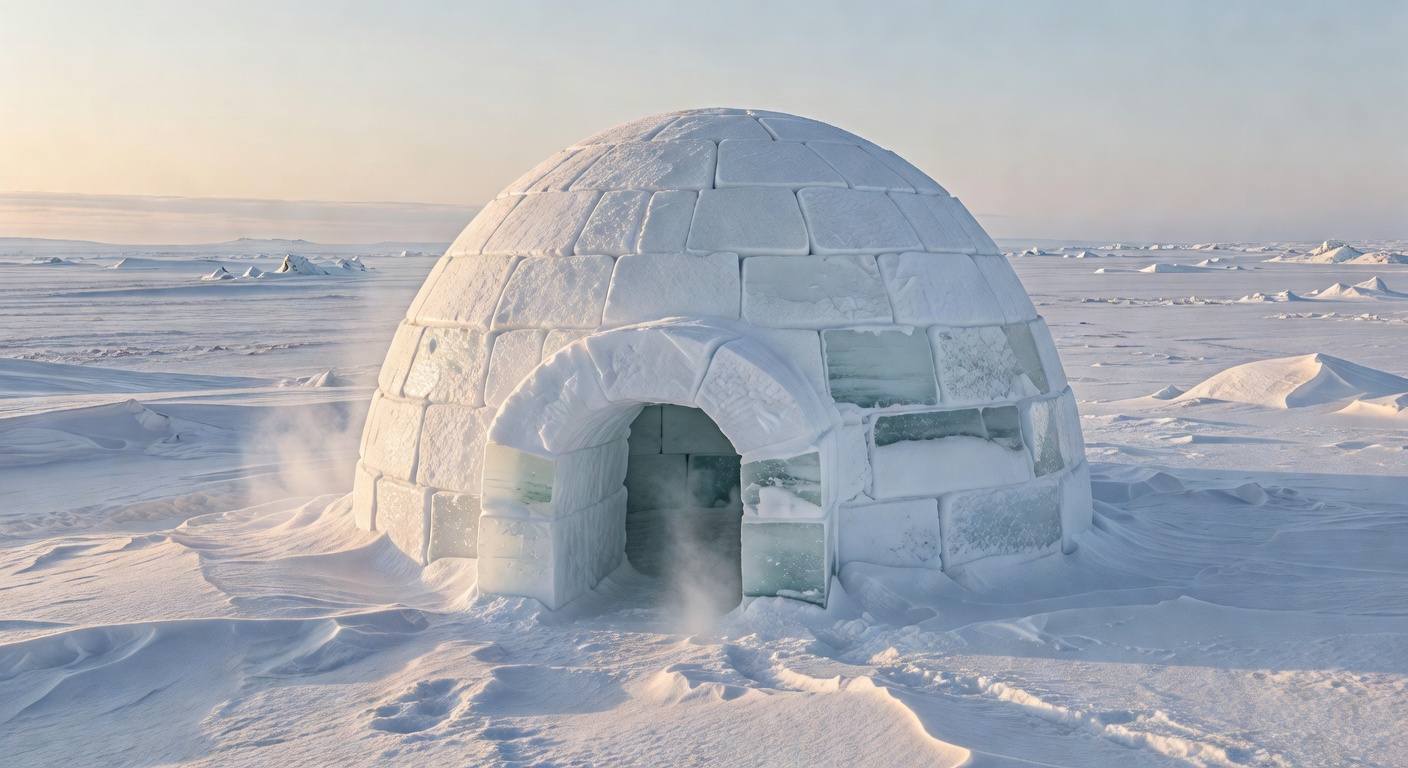
Few structures embody human ingenuity against nature’s extremes like the Inuit igloo. Crafted from snow blocks in the Arctic’s brutal cold, these domes weren’t just shelters—they were precision-engineered survival machines. Let’s delve into their design secrets, historical roots, and surprising relevance today.
At the heart of igloo engineering lies snow’s overlooked superpower: its insulating properties. Fresh snow is about 95% air, trapping warmth like a natural thermos. Inuit builders selected wind-packed snow slabs, about 2-3 feet long, 1.5 feet high, and 8 inches thick—cut with a specialized snow knife for uniformity. Construction began with a circular base, spiraling upward in a tightening helix. Each block was angled inward by roughly 30 degrees, leaning against the previous row to form a self-supporting catenary arch. This curve distributes weight efficiently, preventing collapse under snow loads.
The real genius unfolds inside. The entrance tunnel, dug slightly uphill and often extended with snow blocks, acts as a cold trap: incoming frigid air sinks and stays put, while rising body heat warms the dome. A small ventilation hole at the top, precisely placed above the sleeping platform, allows CO2 to escape without losing heat. No nails, no tools beyond a knife and makingshift saw—yet the igloo could withstand 50 mph winds and house a family comfortably at 20-30°F inside when it’s -40°F outside. Sealskin windows, if used, admitted light without weakening the structure.
Historically, igloos trace to the Thule people around 1000 AD, but peaked with 19th-century Inuit hunters. They were temporary—lasting weeks to months—built in hours by skilled teams. Explorer Vilhjalmur Stefansson documented their use in 1910s expeditions, marveling at how a single igloo outperformed canvas tents. Women and children often stayed in village sod houses year-round, reserving igloos for nomadic hunts.
Today, igloos inspire modern innovation. Architects like Germany’s Igloohaus company produce insulated concrete “igloos” for energy-efficient homes, mimicking the dome’s thermal stability. In survival training—from military ops to adventure guiding—igloo-building teaches physics firsthand: thermal dynamics, structural loads, and material science. Climate research draws parallels too; as Arctic ice melts, understanding snow architecture informs sustainable housing for Indigenous communities facing housing shortages.
Why does this matter now? In a world chasing net-zero buildings, the igloo proves simplicity trumps complexity. Its passive heating slashes energy needs by 90% compared to modern homes, offering lessons for off-grid living amid climate chaos. Next time you huddle by a heater, tip your hat to the Inuit engineers who turned frozen fluff into fortresses—proof that the best tech is often the oldest.
Comments are closed