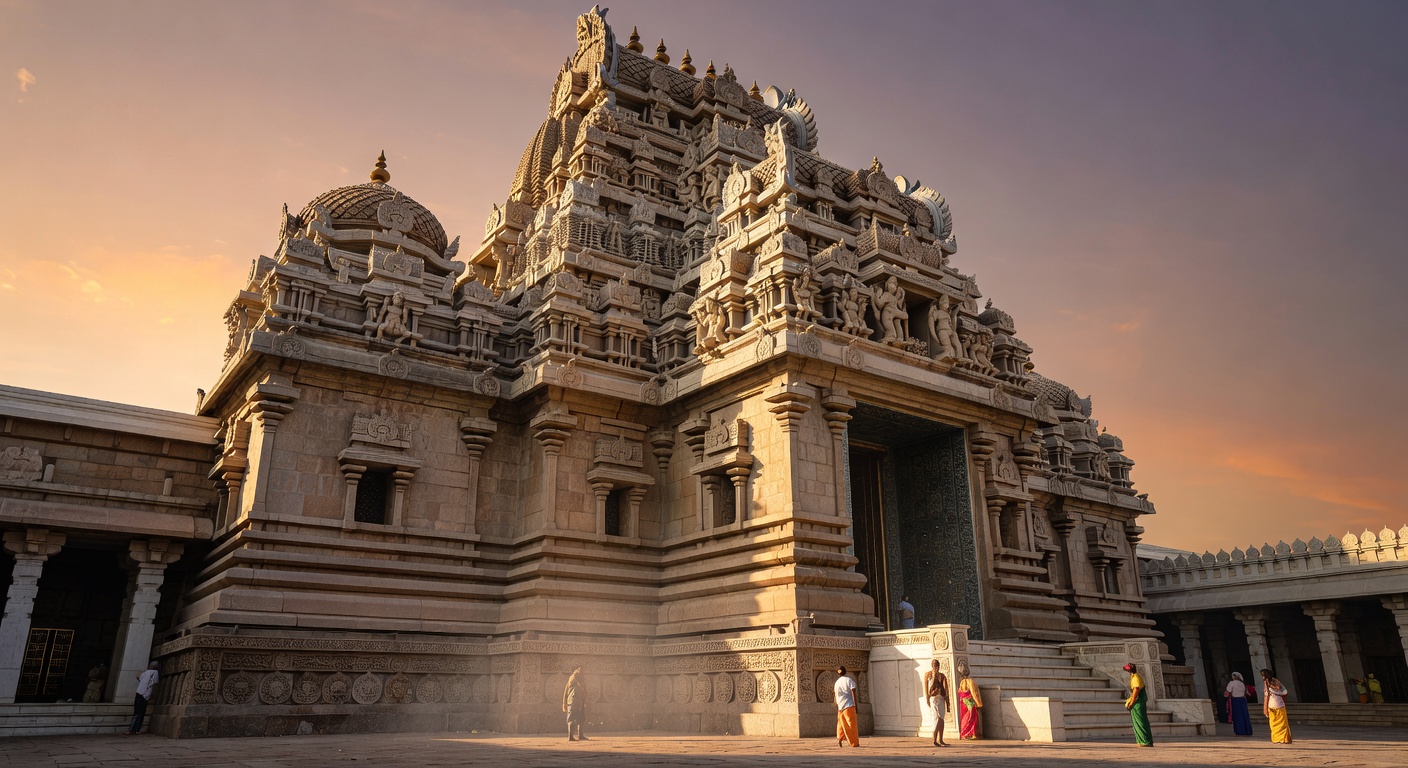
Hindu temples stand as more than places of worship—they’re architectural poems etched in stone, where geometry unfolds the universe’s hidden order. At their core lies Vastu Shastra, an ancient science of design that aligns structures with cosmic rhythms. Unlike Western cathedrals with their soaring verticality, Hindu temples (or mandirs) hug the earth, their forms mimicking Mount Meru, the mythical axis mundi piercing heaven and earth.
The geometry begins with the square, the most sacred shape, symbolizing stability and the four directions. Temples are laid out on vastupurushamandala grids—squares divided into 64, 81, or even 1,000 smaller modules called pada. Each pada corresponds to a deity or cosmic force, dictating where shrines, halls, and gateways sit. The garbha griha, the womb-like sanctum housing the deity, occupies the precise center, ensuring energy converges like a black hole of devotion.
Curves disrupt the grid’s rigidity, introducing dynamism. Shikhara spires rise in tiers of miniature shrines, their curvaceous profiles—receding then flaring—evoke flames licking the sky or the rhythmic sway of a cosmic dance. Nagara temples in northern India sport these steep, honeycombed towers; Dravidian ones in the south flatten into stepped vimanas, like ziggurats stacked with precision. Proportions follow golden ratios and sulbasutras, Vedic math texts predating Pythagoras by centuries, ensuring harmony between human scale and divine vastness.
Historically, this geometry crystallized around the 5th century CE with the Gupta Empire’s Dashavatara Temple at Deogarh, an early nagara masterpiece gridded on 64 padas. By the 11th century, the Khajuraho temples in Madhya Pradesh exploded in erotic-sculpted splendor, their Vastu plans fractal-like, repeating motifs from macro to micro. Chola bronzes and South Indian gopurams carried it forward, embedding fractal geometry that mathematicians today hail as precursors to chaos theory.
Modern examples pulse with relevance. The Akshardham complex in Delhi (2005) deploys computer-modeled Vastu grids spanning 100 acres, blending ancient mandalas with LED lights for immersive rituals. In the U.S., the Swaminarayan Temple in Robbinsville, New Jersey, mirrors Gujarat’s originals using Turkish limestone carved via CAD software, proving Vastu’s adaptability.
Why does this matter now? In a fractured world of straight lines and screens, temple geometry reconnects us to wholeness. It embodies sustainability—aligning with solar paths and monsoon flows for natural ventilation—and psychology, where fractals reduce stress, as studies on sacred spaces confirm. Amid climate anxiety, Vastu’s earth-centric ethos offers blueprints for resilient design. Temples aren’t relics; they’re living algorithms, reminding us that true architecture bends space to heal souls.
(Word count: 428)
Comments are closed