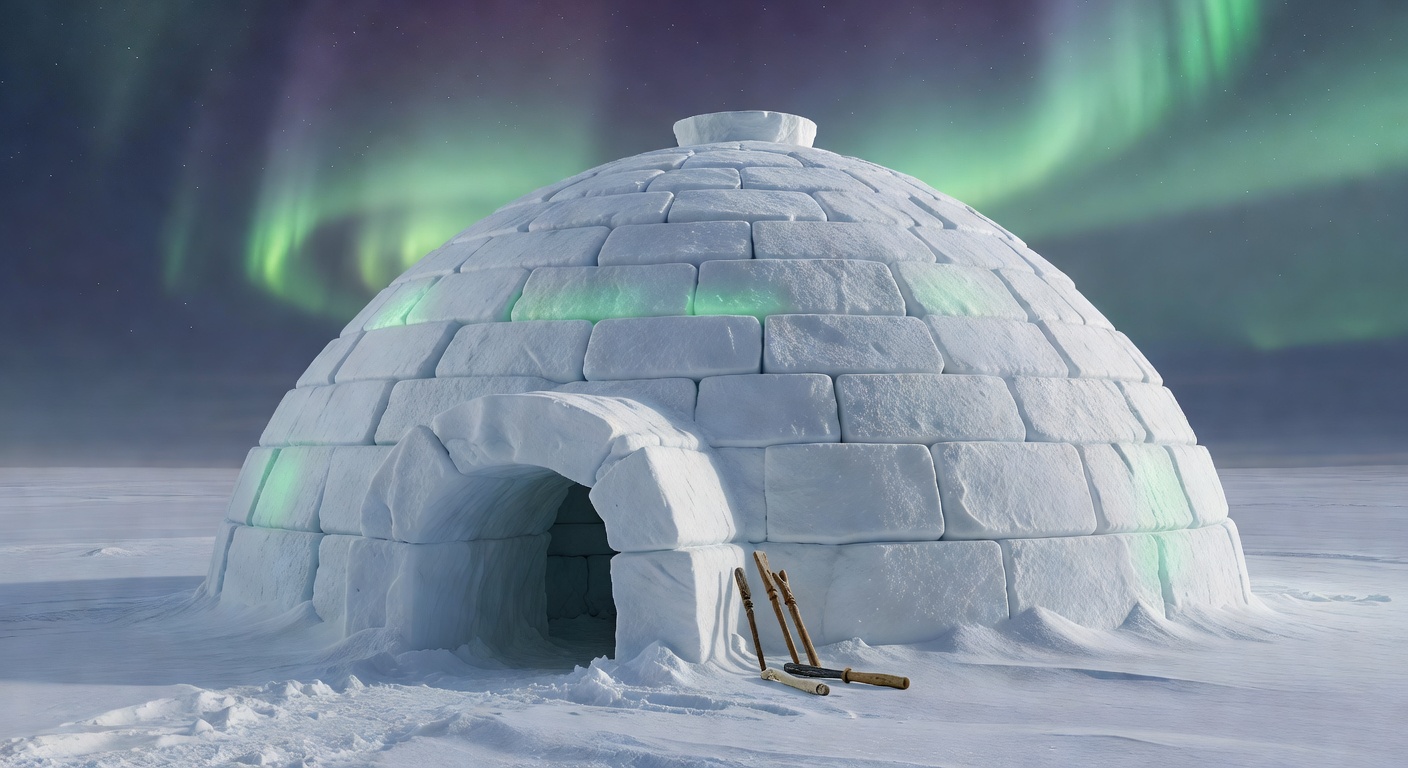
Igloos stand as one of humanity’s most elegant responses to extreme cold, a testament to Inuit engineering prowess honed over millennia. Far from the haphazard snow huts of myth, these dome-shaped shelters showcase precise construction techniques that prioritize warmth, stability, and efficiency. Built primarily from snow blocks—never ice—the igloo’s design leverages the insulating properties of compacted snow, trapping body heat while repelling Arctic winds gusting up to 100 km/h.
The construction process begins with site selection: a flat, wind-swept area where loose snow has been packed into dense slabs by nature’s freeze-thaw cycles. Using a long-bladed snow knife crafted from bone, metal, or wood, the builder harvests blocks about 60 cm long, 45 cm high, and 15 cm thick. These are laid in a spiral pattern, each course leaning slightly inward at a 30-40 degree angle. The spiral creates a self-supporting catenary arch, distributing weight evenly to prevent collapse. A keyhole-shaped entrance tunnel, dug at ground level, blocks cold air—denser than warm air—from infiltrating the main chamber. Inside, a raised sleeping platform of packed snow and skins elevates inhabitants above the coldest air layer, while a ventilation hole at the dome’s apex allows smoke from a seal-oil lamp to escape without losing heat.
Historically, igloos emerged among the Inuit of Canada’s Central Arctic and Greenland around 2,000 years ago, coinciding with Thule culture migrations. They served as temporary winter camps during seal hunts, complementing permanent sod or whalebone homes. Oral traditions and archaeological finds, like those at Cape Dorset, reveal refinements: interior linings of moss or caribou skins boosted insulation, and multi-room igloos housed extended families. European explorers like Vilhjalmur Stefansson documented these in the early 1900s, marveling at interiors reaching 15-20°C even when outside plunged to -40°C—proof of the igloo’s remarkable thermal efficiency, with walls up to 1 meter thick acting as natural insulators.
Today, igloos inspire modern engineering amid climate challenges. Architects like Germany’s Fritz Aurich build oversized snow domes for eco-tourism, using mechanized snow presses for precision. In survival training, programs like those from the Canadian Armed Forces teach igloo-building for polar expeditions, emphasizing its low-tech resilience. Contemporary Inuit communities in Nunavut occasionally revive the practice for cultural festivals, blending tradition with GPS-guided hunts.
Why does igloo engineering matter now? In a warming world, it models sustainable, material-efficient design: zero-waste construction from ambient resources, passive heating without fuel dependency. Biomimicry experts study its curves for earthquake-resistant domes, while disaster relief NGOs prototype igloo-like shelters from local snow or foam. As Arctic ice melts, preserving this knowledge honors Inuit innovation and equips us for precarious futures—proving that sometimes, the smartest structures are built block by frozen block.
Comments are closed