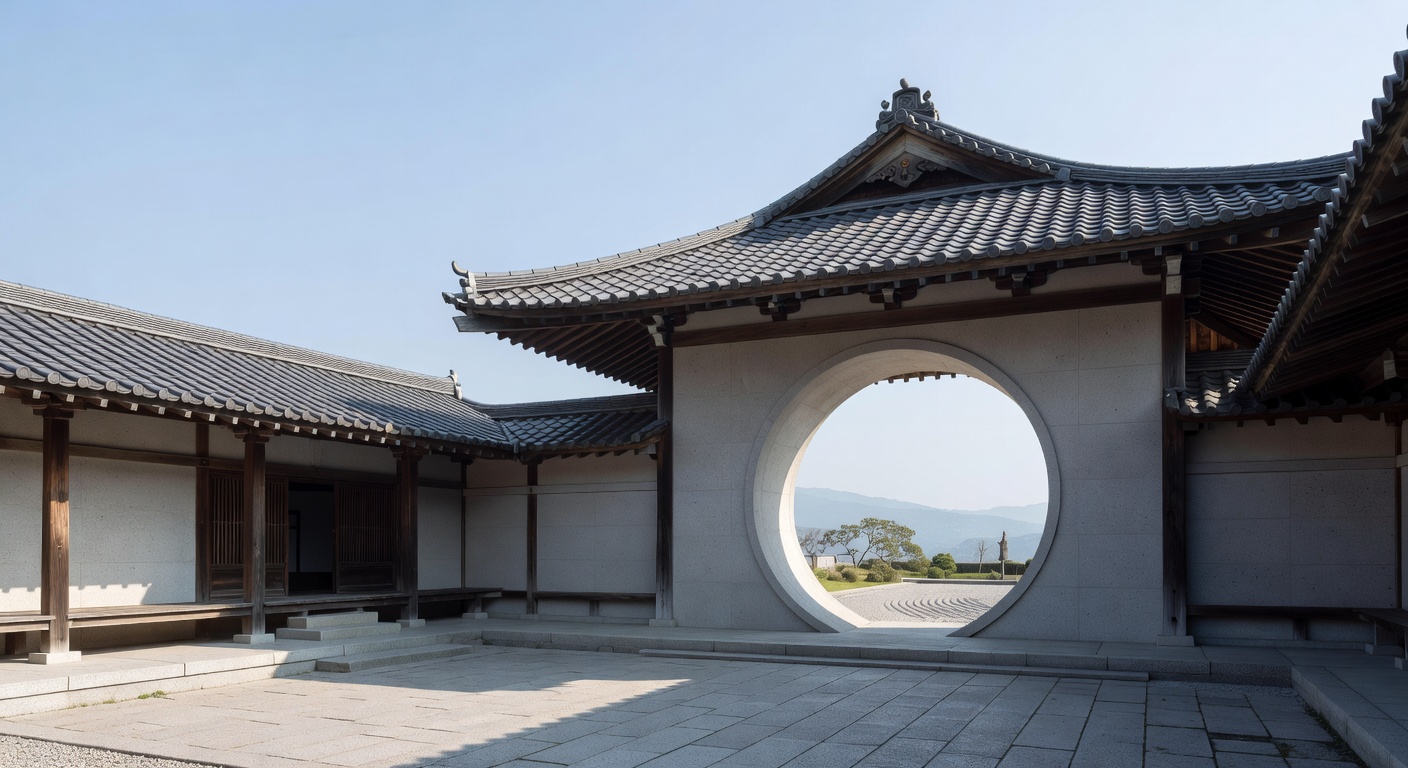
Step into a Buddhist temple, and the air feels lighter, the mind quieter. This isn’t accident—it’s the deliberate craft of minimalism, honed over centuries to strip away distraction and reveal essence. Buddhist temple design embodies wabi-sabi imperfection and Zen restraint, using space, light, and sparse elements to foster contemplation. Far from barren, it’s a profound invitation to presence.
At its core, temple minimalism prioritizes emptiness as much as form. Key features include vast open halls with polished wooden floors that reflect subtle light, evoking boundlessness. Altars hold just a Buddha statue—often carved from simple wood or stone—flanked by incense burners and minimal floral offerings. No clutter: walls remain bare or adorned with faded ink paintings of mountains and cranes, symbols of transience. Tatami mats or smooth pebbles guide the eye to a single focal point, like a gilded stupa or lantern. Natural materials dominate—cedar beams, rice paper screens (shoji), and river stones—aged to patina, celebrating impermanence over permanence.
Historically, this aesthetic traces to ancient India around the 3rd century BCE, where Emperor Ashoka’s stupas were mound-like relics emphasizing humility. It evolved in China during the Tang Dynasty (618-907 CE), blending with Daoist simplicity, then refined in Japan’s Kamakura period (1185-1333) via Zen Buddhism. Masters like Eisai and Dogen imported Chan practices, birthing austere temples like Kyoto’s Ryoan-ji with its iconic rock garden—15 stones amid white gravel raked into ripples, impossible to view all at once, mirroring enlightenment’s elusiveness. These spaces rejected ornate Hindu influences, aligning with Buddha’s Middle Way: neither excess nor deprivation.
Modern examples amplify this legacy. Tokyo’s Senso-ji, while tourist-bustling, retains minimalist pagoda purity amid neon chaos. Eiheiji in Fukui Prefecture, founded by Dogen in 1244, exemplifies monastic minimalism—dormitories stripped to futons and low tables, encouraging zazen meditation. In the West, Seattle’s Northwest Dharma Association adapts it with open-plan meditation halls using reclaimed timber, proving scalability. Architects like Japan’s Tadao Ando draw direct inspiration, as in his Church of Light, where concrete minimalism echoes temple voids pierced by a cruciform slit.
Why does this matter today? In our hyper-stimulated era of endless scrolls and smart clutter, temple minimalism offers a blueprint for mental decluttering. Studies from mindfulness research, like those at Harvard, link sparse environments to reduced cortisol and heightened focus—echoing ancient sutras. It combats consumerism, urging us to value space over stuff, fostering resilience amid uncertainty. Whether redesigning your home office with a single bonsai or visiting a temple, it reminds: true richness lies in what you leave out. Embrace it, and simplicity becomes your sanctuary.
Comments are closed