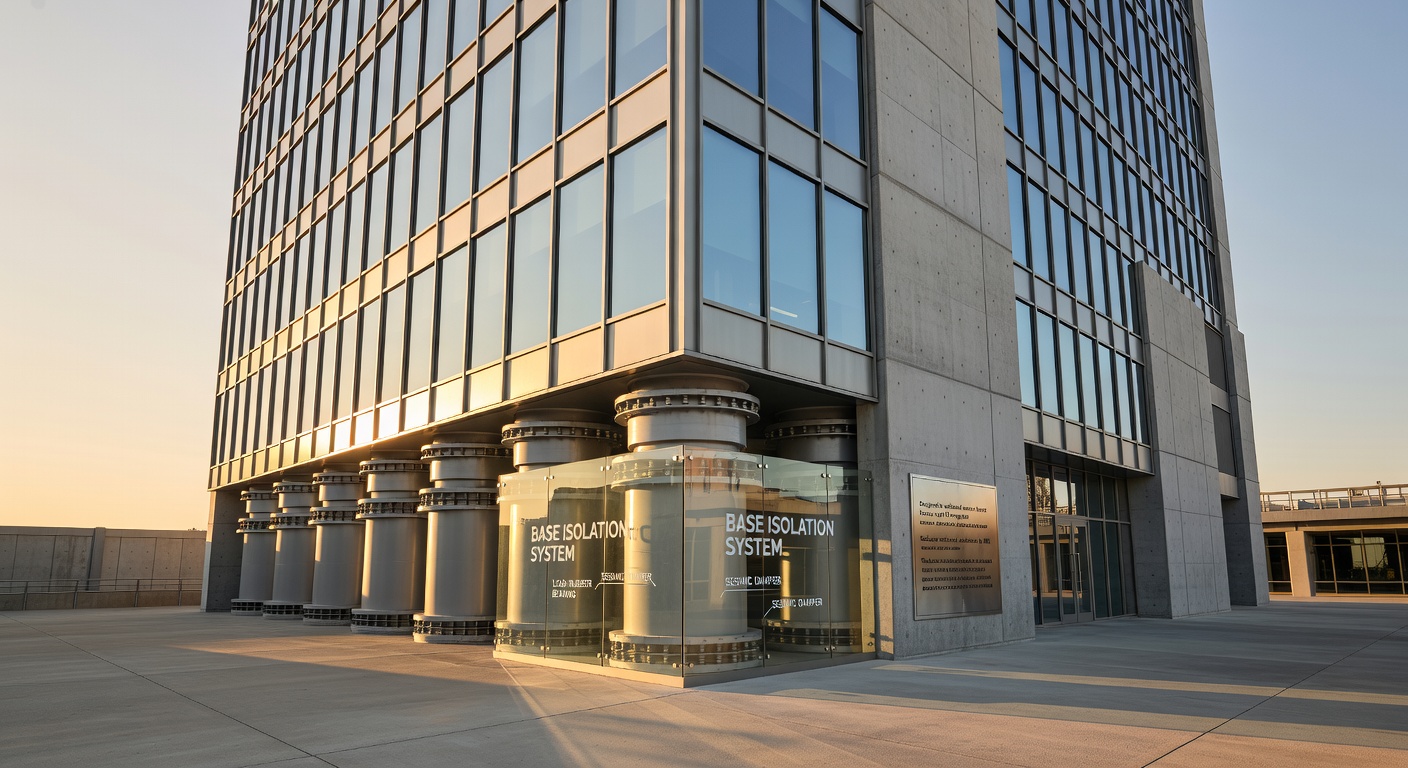
Earthquakes strike without warning, turning solid ground into a treacherous wave. Yet amid the chaos, innovative engineering offers a lifeline: base isolation. This technique decouples buildings from the earth’s violent tremors, allowing structures to sway gently while the ground heaves beneath them. It’s like giving a skyscraper roller skates—smooth, controlled movement that absorbs shocks instead of shattering under them.
At its core, base isolation relies on isolators placed between a building’s foundation and the ground. These aren’t ordinary pads; they’re sophisticated devices engineered for resilience. Lead-rubber bearings, a staple since the 1970s, combine rubber layers for flexibility with a lead core for energy dissipation. When seismic waves hit, the rubber shears sideways, stretching and compressing to dampen vibrations, while the lead deforms plastically, converting kinetic energy into heat. Friction pendulum bearings take it further: curved sliding surfaces atop a lubricated disc let the building slide laterally up to a meter, recentering itself via gravity. Modern variants incorporate high-damping rubber or fluid-filled systems, tunable to a site’s specific soil and quake risks. Retrofitting existing structures often uses these too, jacking up buildings to slide in isolators without full demolition.
The concept traces back to ancient ingenuity—Japanese pagodas from the 7th century flexed on stone bases to survive quakes—but modern base isolation crystallized post-World War II. New Zealand pioneered it in the 1970s with the William Clayton Building in Wellington, the world’s first isolated high-rise, which rode out tremors unscathed. Japan, quake central, embraced it aggressively after the 1995 Kobe earthquake killed over 6,000. Today, Tokyo Skytree, a 634-meter broadcasting tower completed in 2012, boasts 38 isolators, separating its base from the shaft to handle magnitude-9 events. In the U.S., the San Francisco City Hall retrofit and Salt Lake City’s stalactite-laden conference center showcase it. Christchurch’s cardboard cathedral, a 2013 temporary marvel, used isolators to endure aftershocks from a devastating 2011 quake.
Why does this matter now? Climate change amps up seismic risks indirectly through shifting tectonics and urban sprawl into hazard zones. Megacities like Istanbul, Tokyo, and Los Angeles house millions in quake-prone areas; unmitigated, a big one could cascade into economic Armageddon—trillions in damages, as modeled for the anticipated San Andreas rupture. Base isolation slashes that threat: studies from the Pacific Earthquake Engineering Research Center show isolated buildings suffer 80-90% less acceleration, sparing lives and slashing repair costs. It’s not foolproof—costs run 5-10% higher upfront, and it shines for mid-to-high rises on firm soil—but insurance premiums drop, and resilience soars. As retrofits proliferate, from Italy’s seismic mandates to California’s building codes, base isolation isn’t just engineering; it’s a quiet revolution, letting cities dance through doomsday rather than crumble. In an era of unstoppable plates, it’s humanity’s elegant countermove.
Comments are closed