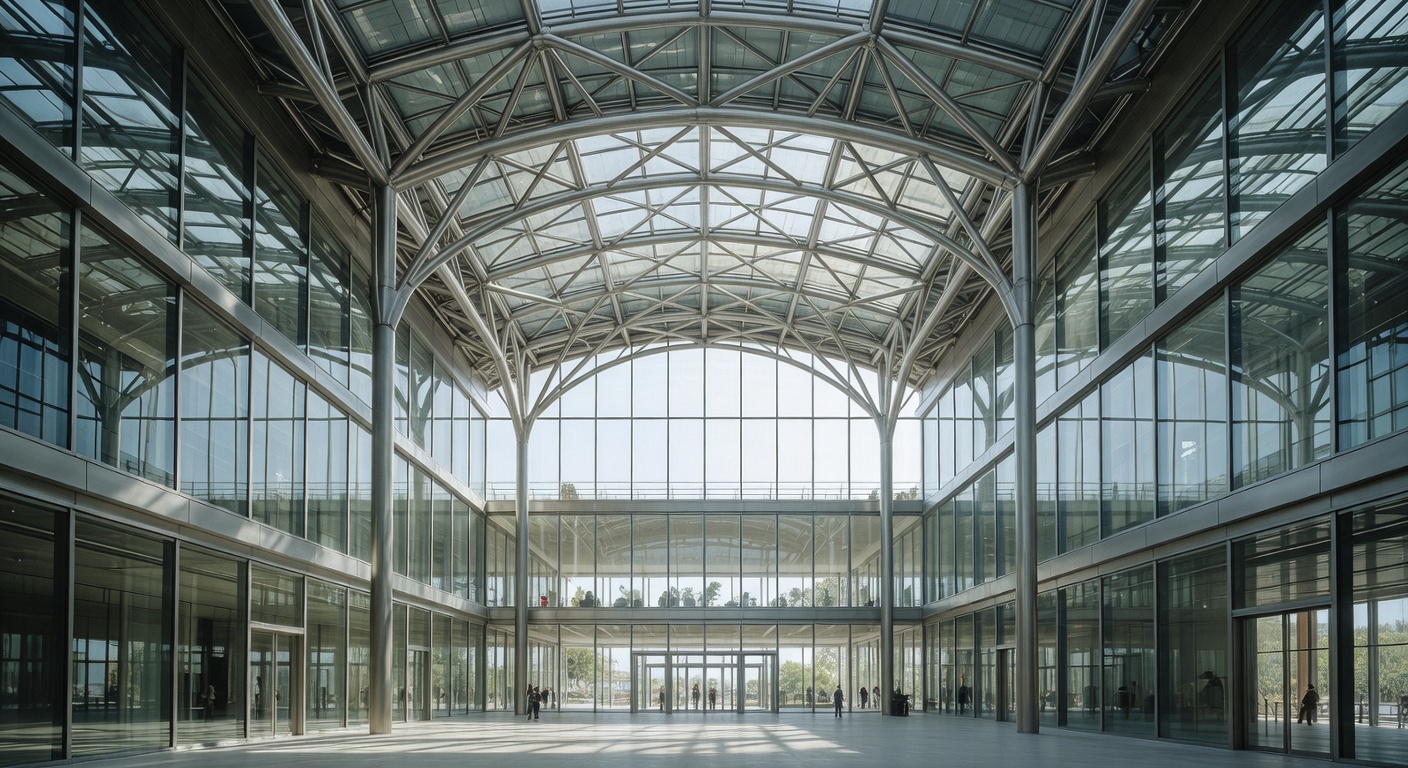
Norman Foster doesn’t just build buildings—he engineers icons that redefine how we interact with our urban landscapes. As the godfather of high-tech architecture, his work fuses cutting-edge technology with human-centric design, turning steel, glass, and concrete into expressions of precision and possibility. Let’s peel back the layers of this architectural revolution, from its roots to its skyline-dominating legacy.
High-tech architecture, or “high-tech expressionism,” emerged in the 1970s as a bold riposte to the brutalist concrete slabs of post-war Europe. Pioneered by the likes of Foster, Richard Rogers, and Renzo Piano, it celebrated the building as a machine for living—exposed ducts, vibrant colors, and modular components worn on the sleeve like a techie’s gadget collection. Foster’s breakthrough came with the 1978 Sainsbury Centre for Visual Arts in Norwich, England. Here, vast glass walls and a flexible internal “servicing tower” allowed endless reconfiguration, embodying the movement’s mantra: form follows function, but function can be exhilaratingly visible.
Key features of Foster’s high-tech style include structural honesty—think cables, trusses, and rivets flaunting their load-bearing duties—and an obsession with energy efficiency. His designs prioritize natural light, ventilation, and adaptability, often using double-skin facades that act like high-tech lungs, regulating temperature without guzzling power. The HSBC Tower in Hong Kong (1985) exemplifies this: its modular “pods” suspended from external mega-columns create vast, column-free floors inside, while atria funnel breezes through the structure, slashing air-conditioning needs by 40%. It’s architecture as infrastructure, where the skeleton steals the show.
Fast-forward to today, and Foster’s influence pulses through modern megaprojects. The Gherkin—officially 30 St Mary Axe (2004)—is a pinnacle, its helical glass form slicing London’s skyline like a futuristic pickle. That spiraling skin isn’t just eye candy; it optimizes wind flow, reducing sway and boosting natural ventilation, making it 40% more efficient than neighboring towers. Recent triumphs include Apple Park in Cupertino (2017), a 2.8-million-square-foot “spaceship” ringed by the world’s largest curved glass panels, where boreholes tap geothermal energy for near-zero carbon operation. And in Madrid, the 2021 Enrique Tierno Galván Metro station showcases his latest: luminous ETFE cushions that flood platforms with daylight, blending high-tech with everyday utility.
Why does this matter now? In an era of climate catastrophe and urban explosion, Foster’s high-tech ethos offers a blueprint for sustainable ambition. His buildings don’t just stand; they perform—sequestering carbon, harvesting sunlight, and adapting to future needs. As cities grapple with net-zero mandates, Foster proves that beauty and brains can coexist, challenging us to demand more from our skylines. In his hands, technology isn’t cold; it’s the warm pulse of progress, inviting us to rethink what’s possible when architecture evolves with us.
Comments are closed