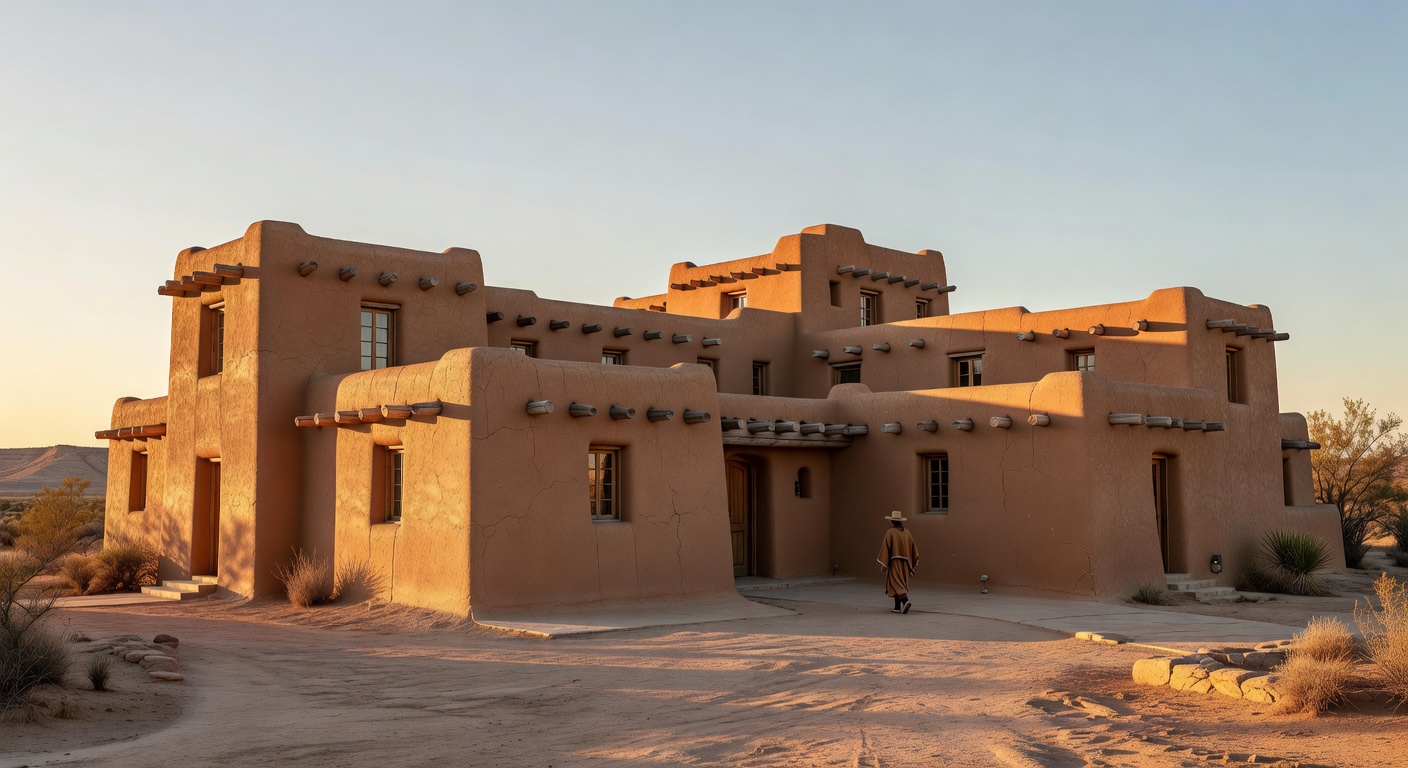
Pueblo Revival architecture stands as a testament to how ancient ingenuity can shape modern landscapes, blending the earthy wisdom of Native American pueblos with Spanish colonial flair. These adobe structures, reborn in the early 20th century, capture the Southwest’s spirit in sun-baked clay walls and flat roofs that seem to rise directly from the desert floor.
At its core, Pueblo Revival draws from the multi-storied dwellings of ancestral Puebloans in places like Taos and Acoma. Key features include thick adobe brick walls—typically 18 to 24 inches thick—crafted from sun-dried mud, straw, and sand. These walls provide natural insulation, keeping interiors cool in scorching summers and warm during chilly nights, a passive climate control that predates modern HVAC by millennia. Roofs are characteristically flat, supported by vigas: massive wooden beams projecting from the walls like welcoming arms. Ladder-like elements hint at traditional pueblo access, while rounded corners and projecting parapets add a fortress-like silhouette against the horizon.
Windows and doors are small and deep-set, framed by colorful ristras of chiles or corn hung outside. T-shaped doorways, a nod to pueblo doorways designed for defense, enhance the aesthetic. Interiors often feature exposed wooden latillas (smaller beams) over ceilings, saltillo tile floors, and nichos—recessed wall shelves—for displaying pottery or religious icons. The palette stays true to the land: tawny earth tones, with accents of turquoise or red from local pigments.
Historically, this style surged during the 1920s Santa Fe building boom, fueled by the City Beautiful movement and tourism. Architects like Mary Colter and John Gaw Meem championed it, restoring authenticity after decades of neglect. The 1912 La Fonda Hotel in Santa Fe exemplifies early efforts, while Meem’s 1930s designs for the University of New Mexico integrated Pueblo Revival into civic life. It countered Victorian excesses, embracing regionalism amid America’s push for identity post-World War I.
Today, modern examples thrive. The luxurious Inn of the Five Graces in Santa Fe updates the style with sustainable adobe and reclaimed wood, blending luxury with tradition. In Phoenix, the Pueblo Grande Museum showcases a preserved platform mound alongside Revival replicas. Homeowners retrofit adobe with energy-efficient upgrades like insulated foam cores, proving its relevance in an eco-conscious era.
Why does Pueblo Revival matter now? In a world of glass towers and fleeting trends, it offers authenticity and sustainability. Adobe sequesters carbon, requires minimal energy to produce, and harmonizes with arid climates amid climate change. It fosters cultural continuity, honoring Indigenous and Hispanic roots while inspiring resilient design. Whether in boutique resorts or suburban homes, these forms remind us that beauty born of necessity endures, grounding us in place and history. As the Southwest grapples with growth, Pueblo Revival isn’t just nostalgic—it’s a blueprint for living lightly on the land.
Comments are closed