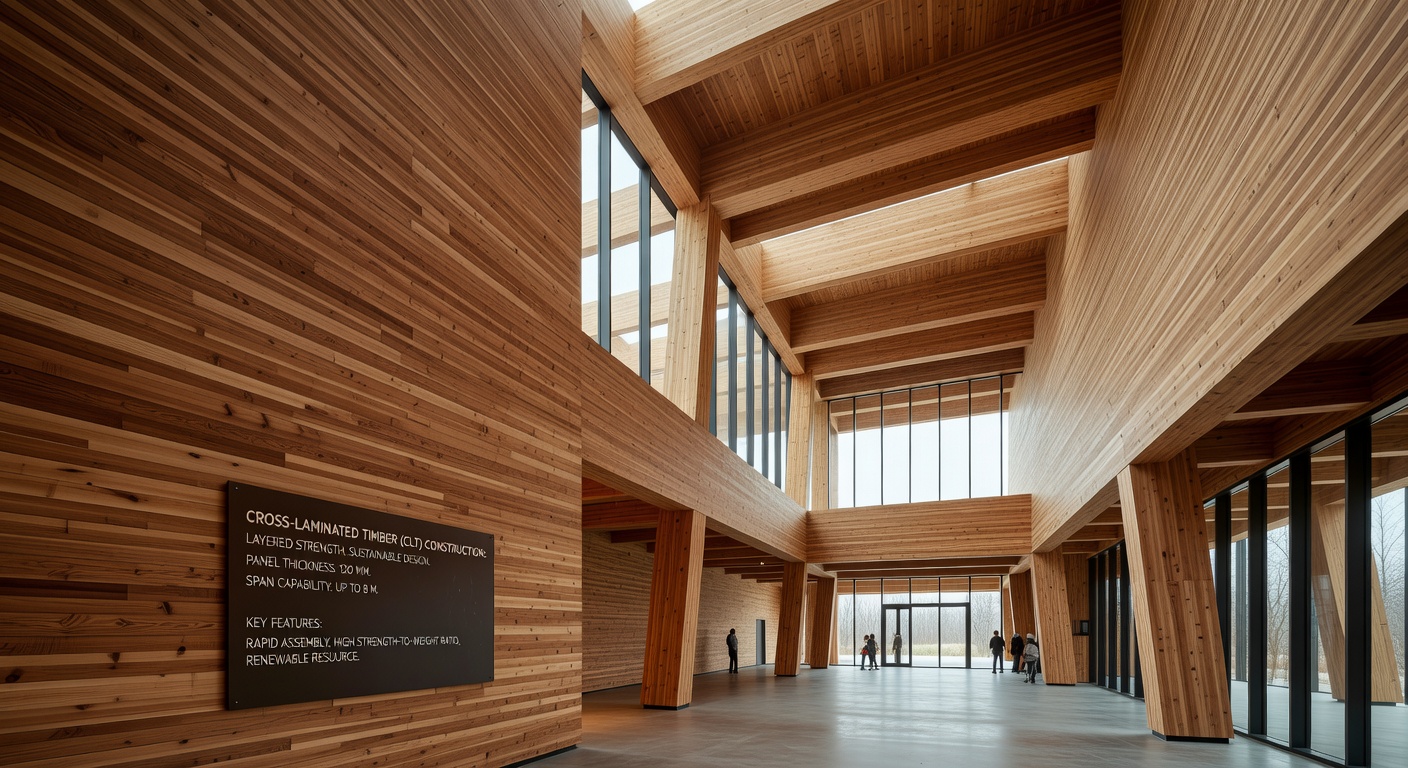
Cross-laminated timber, or CLT, is shaking up the construction world like a lumberjack’s axe through a forest of steel and concrete. This engineered wood product stacks layers of lumber in alternating directions, glued under pressure, creating panels as strong as concrete but lighter, warmer, and far more sustainable. Think of it as plywood’s burly big brother—rigid enough for load-bearing walls, floors, and roofs, yet flexible for seismic zones.
What makes CLT stand out? Its key features start with composition: each panel comprises odd-numbered layers (usually three to nine), with grains running perpendicular between them. This cross-grain magic delivers exceptional strength-to-weight ratios—up to five times lighter than concrete for equivalent spans—allowing faster assembly via prefabrication. On-site, crews snap panels together like giant Legos, slashing build times by 30-50% compared to traditional methods. Fire resistance surprises many: charred outer layers insulate the core, meeting or exceeding codes without chemical treatments. Acoustics shine too, muffling urban noise better than steel, while thermal mass keeps interiors cozy, reducing HVAC demands.
CLT’s roots trace to Europe in the 1990s, pioneered in Austria by firms like Binderholz. Early adopters tested mid-rise buildings, proving wood could go beyond cabins. By 2010, it leaped stateside with projects like the 2012 Murray Grove apartment in Vancouver, a nine-story pioneer. Fast-forward to today: the 18-story Mjøstårnet in Norway (2019), the world’s tallest timber building at 280 feet, towers as a CLT-concrete hybrid, blending 2,500 cubic meters of wood with steel for stability. In the U.S., the 10-story Ascent in Milwaukee (2022) pushes 284 feet, incorporating mass timber for faster erection amid labor shortages. These aren’t novelties; they’re blueprints for denser cities.
Why does CLT matter now? Climate urgency tops the list. Wood sequesters carbon—every cubic meter stores about a ton of CO2—while concrete and steel guzzle emissions (concrete alone: 8% of global CO2). CLT buildings lock that carbon away for decades, cutting embodied carbon by 45-75% versus conventional high-rises. Urbanization demands quick, affordable housing; CLT delivers, with costs competitive at scale (panels run $5-10 per square foot). It revitalizes forestry economies, using fast-grown softwoods like spruce and pine from sustainable sources. Challenges persist—moisture sensitivity requires design tweaks, and supply chains lag in some regions—but incentives like tax credits and codes updating for mass timber (e.g., U.S. IBC 2021) accelerate adoption.
As cities grapple with housing crunches and net-zero pledges, CLT offers a timber ticket to resilient, green skylines. From boutique offices to supertalls, it’s proving wood isn’t just for the woods anymore—it’s rebuilding our world, plank by plank.
Comments are closed