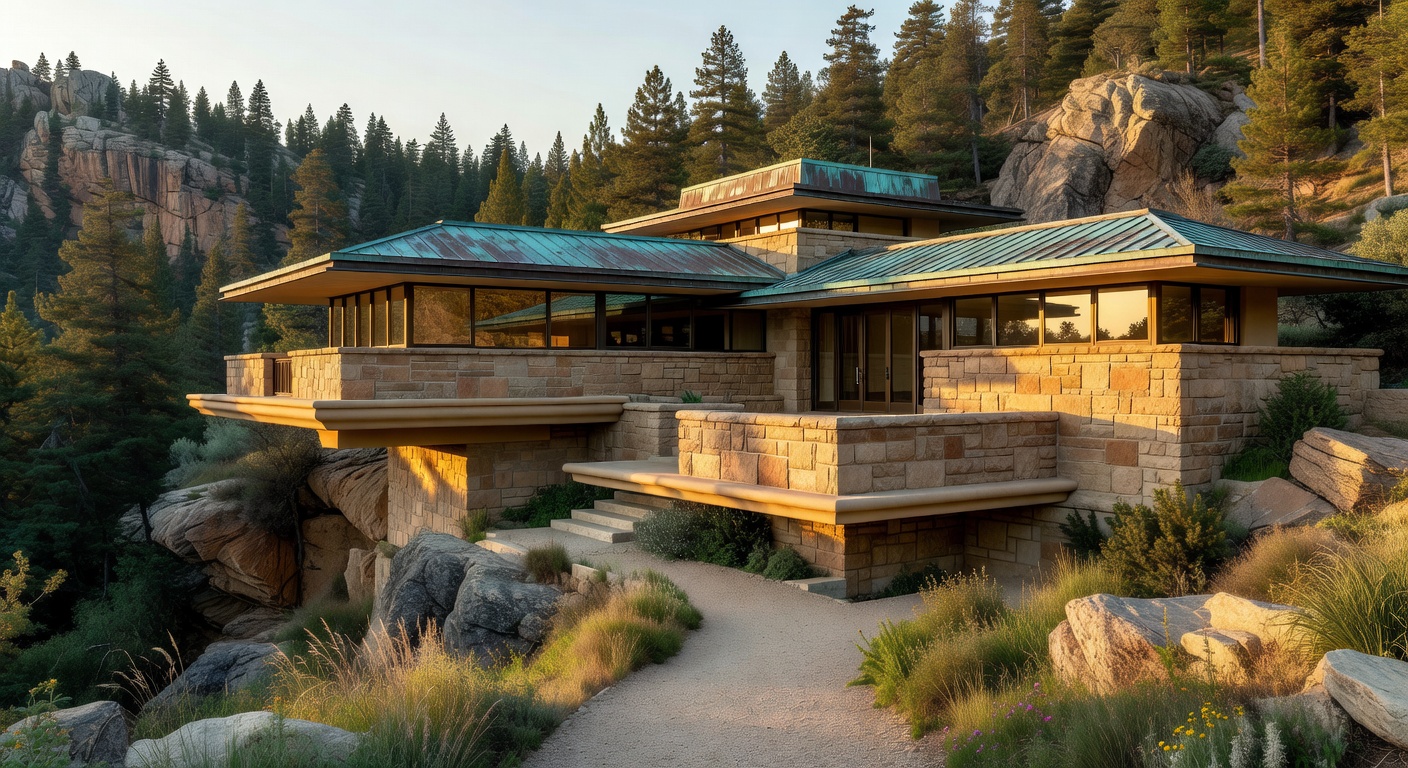
Frank Lloyd Wright didn’t just design buildings; he sculpted living extensions of the earth. Born in 1867 amid the industrial clamor of post-Civil War America, Wright rejected the era’s boxy, ornament-heavy architecture. Influenced by the sprawling Wisconsin prairies of his youth and thinkers like Louis Sullivan—his mentor who preached “form follows function”—Wright forged organic architecture. This philosophy sought to harmonize structures with their natural surroundings, making buildings breathe with their environment rather than dominate it.
At its core, organic architecture emphasizes unity. Wright’s buildings grow from site-specific details: local materials like Wisconsin limestone or Arizona desert stone ensure the structure feels native. Horizontal lines mimic the earth’s expanse, with low profiles that hug the ground. Expansive windows and cantilevered roofs dissolve barriers between interior and exterior, flooding spaces with light and views. Take Fallingwater, his 1935 Pennsylvania masterpiece perched over a waterfall. Instead of viewing the cascade from afar, the house channels its roar through hearths and terraces, turning nature into an indoor symphony. Or the Guggenheim Museum in New York (1959), with its spiraling ramp evoking a nautilus shell—form and function coiled in elegant continuity.
Historically, Wright’s ideas clashed with the steel-and-glass modernism of contemporaries like Le Corbusier. The 1906 Robie House in Chicago exemplifies his Prairie style: overhanging eaves shelter wide porches, while open floor plans shatter Victorian compartments, fostering democratic flow. His 1930s Broadacre City vision proposed decentralized, car-friendly communities integrated with farmland—a radical counter to urban density.
Today, Wright’s legacy pulses in sustainable design. Modern architects like Seattle’s Olson Kundig draw from his playbook, crafting homes with solar-integrated roofs and reclaimed wood that blend into forests. The Darwin D. Martin House restoration in Buffalo showcases how adaptive reuse preserves his ethos amid climate challenges—energy-efficient retrofits without sacrificing soul. In an age of cookie-cutter sprawl and ecological peril, organic architecture matters profoundly. It reminds us that good design heals divides: between human and habitat, built and wild. Wright quipped, “The mother art is architecture,” but he’d add it’s also stewardship. By rooting buildings in place, we combat homogenization, reduce carbon footprints through durable, context-aware builds, and nurture well-being. Studies from the Frank Lloyd Wright Foundation highlight how his homes boost occupant harmony with nature, lowering stress in our screen-saturated world.
Wright’s influence endures because it transcends trends. In a planet gasping under concrete weight, his call to “live with the beautiful” isn’t nostalgia—it’s blueprint for resilience. Step into a Wright space, and you don’t just inhabit; you participate in an ongoing dialogue with the land. That’s architecture alive.
(Word count: 448)
Comments are closed