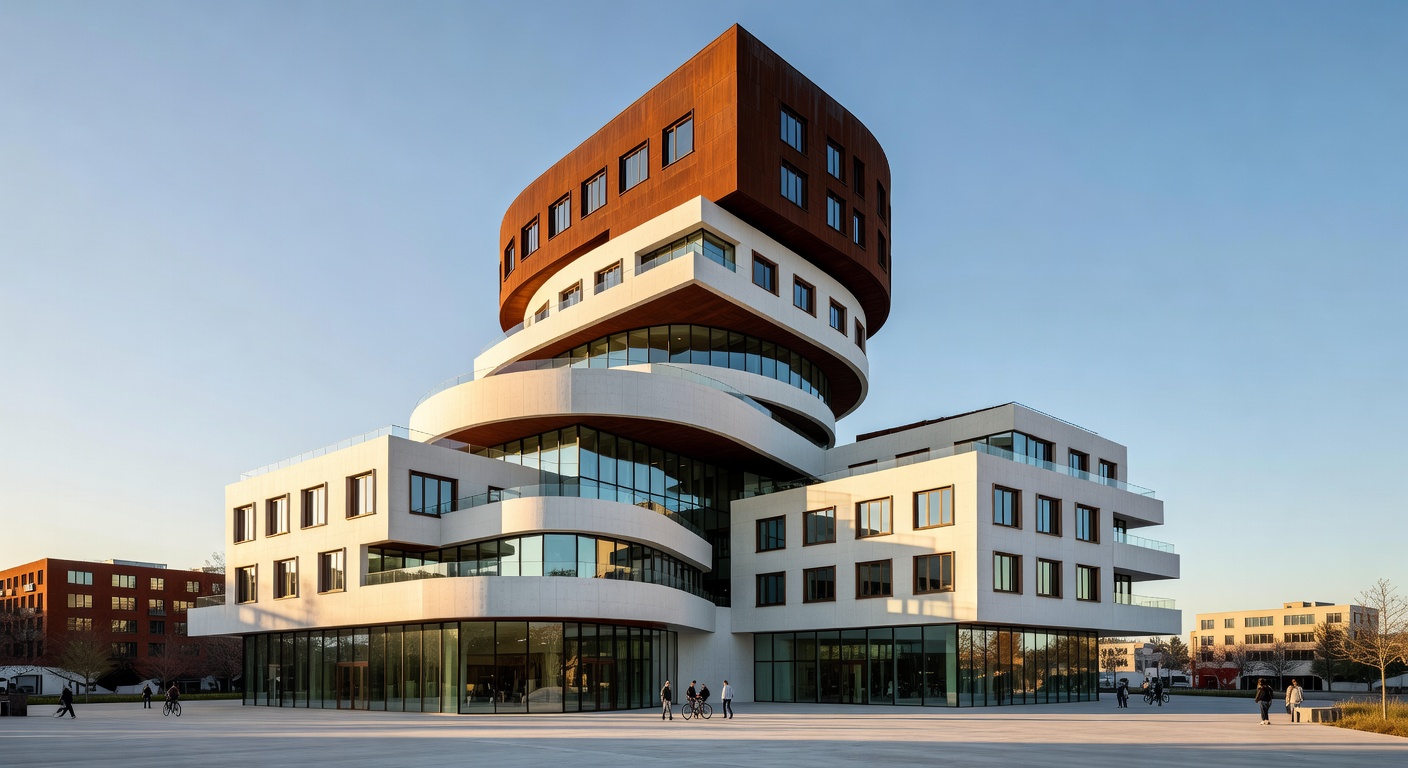
Bjarke Ingels doesn’t just design buildings; he crafts experiences that twist the ordinary into the extraordinary. As the founder of Bjarke Ingels Group (BIG), this Danish architect embodies “playful functionalism,” a philosophy that marries strict utility with whimsical delight. Forget sterile modernism—Ingels proves that architecture can solve real problems while sparking joy, turning skyscrapers into playgrounds and housing into habitats that evolve with their inhabitants.
Rooted in Denmark’s functionalist tradition, Ingels’ approach flips the script on mid-20th-century rigor. Think back to the 1930s Bauhaus era, where form strictly followed function, prioritizing efficiency over emotion. Scandinavian modernists like Arne Jacobsen refined this into clean, humane designs, but Ingels injects hedonism. He calls it “hedonistic sustainability,” blending environmental smarts with fun. “Yes is more,” his manifesto declares, rejecting zero-sum choices between beauty, utility, and ecology. It’s functionalism on a sugar rush—buildings that work harder and grin wider.
Key to his style are stacked, shifting forms that defy gravity and expectation. Take VIA 57 West in New York (2016), a hybrid residential tower shaped like a skewed pyramid. Its slanted courtyard funnels wind and light into a public park, boosting urban density while creating communal green space. Functionally, it maximizes apartments on a tight site; playfully, the prow-like facade evokes a ship slicing through Manhattan’s concrete sea. Or consider the LEGO House in Billund, Denmark (2017), a technicolor stack of massive bricks that kids (and adults) can climb. It houses the toy company’s museum but doubles as a public jungle gym, embodying modular play as both literal and architectural.
Modern examples amplify his global reach. In Paris, the 2024 Twisting Towers for the VIA Cotonou project spiral upward, their helical forms optimizing solar exposure and views while nodding to African vernacular weaving. Closer to home, BIG’s redesign of Vancouver’s Vancouver Convention Centre Expansion weaves indigenous cedar into a living roof that supports biodiversity. These aren’t gimmicks; they’re smart responses to climate crises, using playful geometry for passive cooling, rainwater harvesting, and social connectivity.
Why does this matter today? In an era of climate urgency and urban sprawl, Ingels shows architecture can be optimistic problem-solving. Playful functionalism counters dystopian megastructures with humane scale—buildings that invite interaction, foster community, and adapt to change. Amid housing shortages and biodiversity loss, his work proves delight isn’t a luxury; it’s a tool for engagement. When people love their environment, they’re more likely to sustain it. Ingels challenges architects to think beyond blueprints: design for delight, and function follows. In a world craving hope, his wink-back buildings remind us that the future can be fun—and functional.
(Word count: 448)
Comments are closed