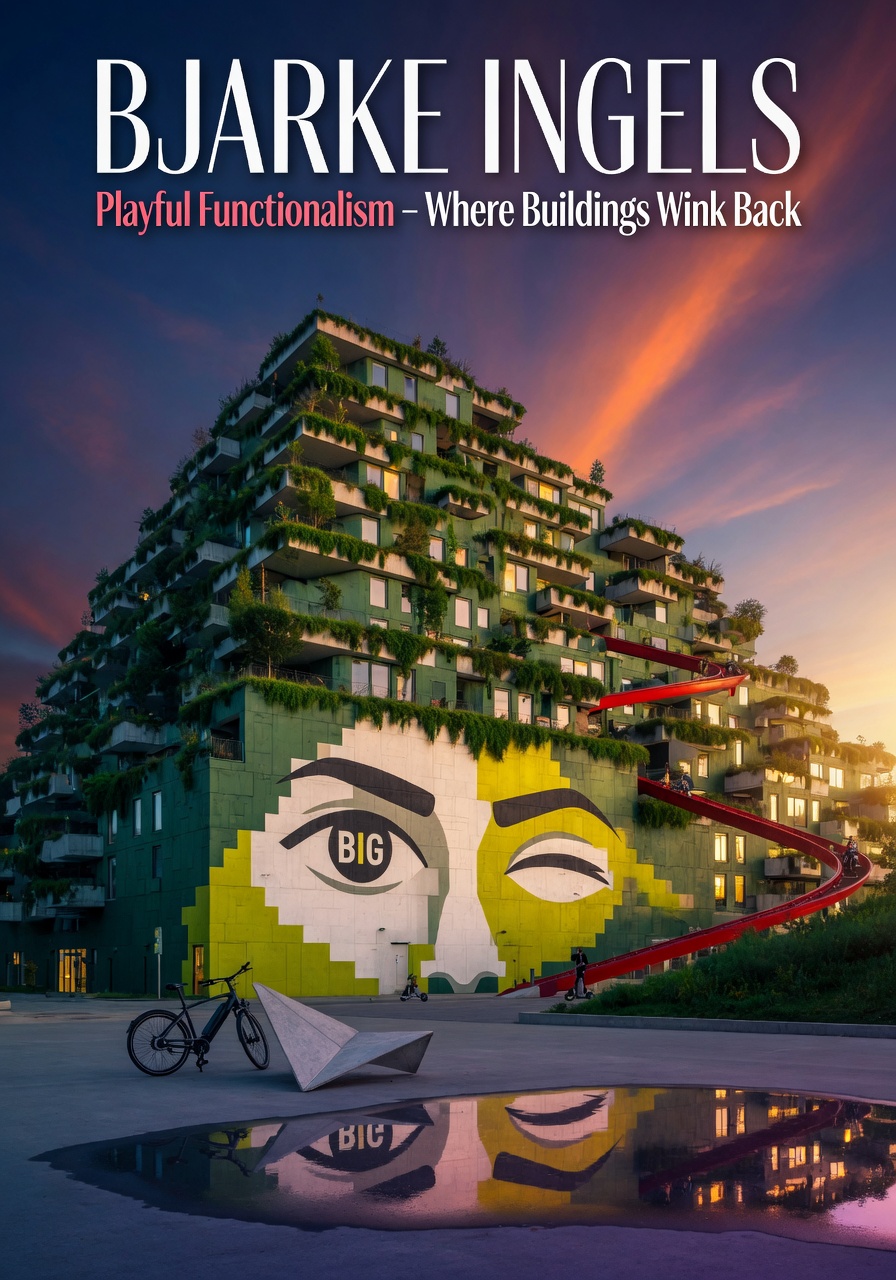
Bjarke Ingels treats architecture as an active conversation rather than a fixed statement. As founder of Bjarke Ingels Group, he has built a practice around what he calls playful functionalism—designs that meet practical demands while inviting people to interact, explore, and enjoy the spaces they occupy. Instead of the cool detachment often associated with modernism, his work layers in surprise and adaptability, turning dense urban sites into places that feel generous and alive.
His roots lie in Denmark’s long functionalist tradition, yet he has pushed it in a different direction. Where earlier generations stressed strict efficiency and restrained expression, Ingels adds a layer of pleasure he terms hedonistic sustainability. The idea rejects trade-offs between performance, beauty, and environmental responsibility. His 2009 manifesto “Yes Is More” captures that stance: every project should deliver more than one benefit at a time, whether that means better daylight, lower energy use, or simply more room for social life. The result feels less like a lecture on green building and more like an invitation to use space differently.
That approach shows up clearly in his built work. VIA 57 West in New York rises as a tilted pyramid whose courtyard pulls light and air down to street level, creating a public park on a tight Manhattan block while still packing in hundreds of apartments. In Billund, the LEGO House stacks oversized colored bricks into a climbable landmark that houses a museum yet functions as an open playground for anyone who walks by. More recent projects extend the same logic across continents. The twisting residential towers planned for Paris optimize solar angles and views through their helical shapes, while BIG’s expansion of the Vancouver Convention Centre incorporates a living roof of native cedar that manages stormwater and supports local species. In each case, the geometry serves measurable goals—cooling, density, biodiversity—without losing its visual spark.
These choices matter because cities now face simultaneous pressures from housing shortages, rising temperatures, and shrinking green space. Ingels’s buildings suggest that solutions do not have to feel grim or purely technical. When a structure offers clear advantages and a sense of delight, people tend to use and maintain it longer. That combination of performance and engagement turns individual projects into small arguments for a more optimistic kind of urban growth, where architecture earns its keep by staying useful and staying interesting at the same time.
Comments are closed