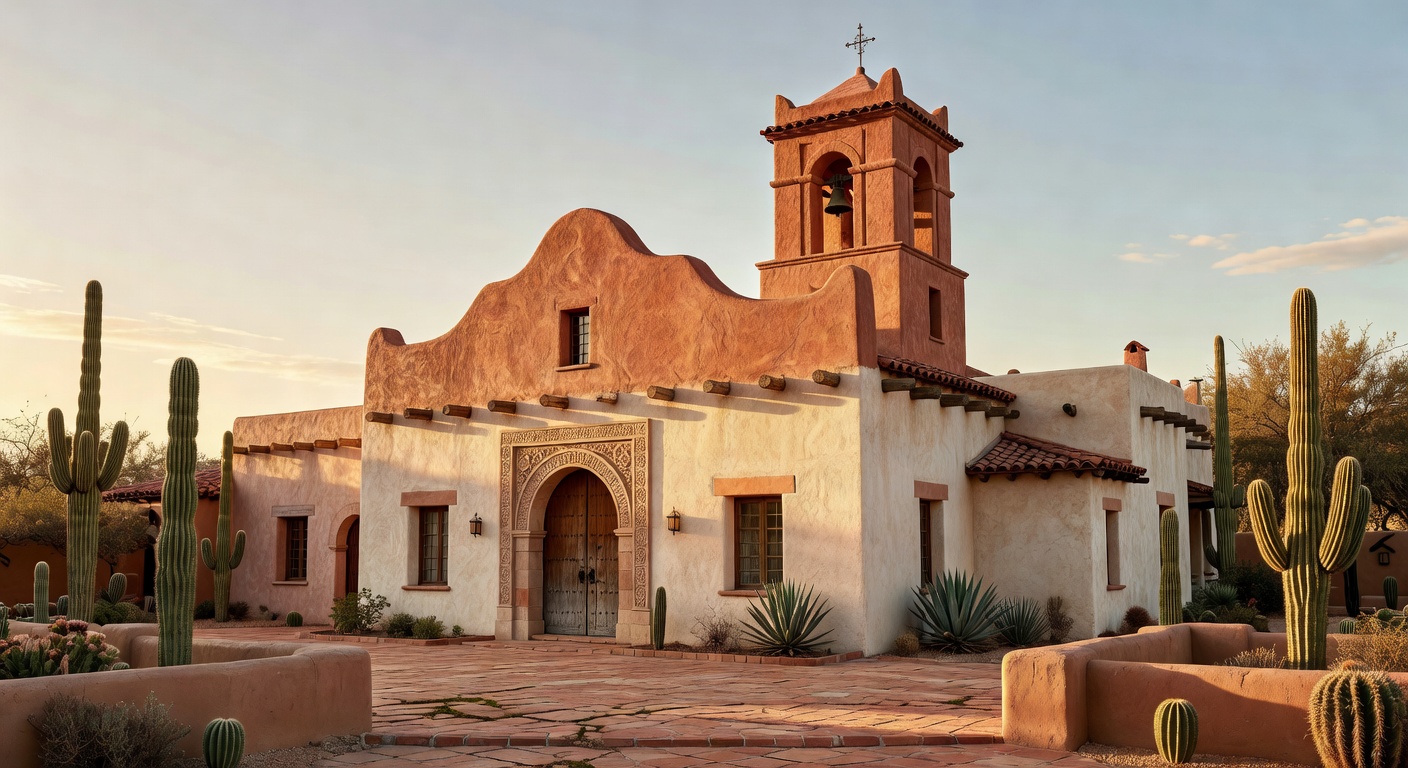
Nestled in the sun-baked landscapes of the American Southwest, Spanish Mission style stands as a testament to colonial ingenuity fused with indigenous craftsmanship. Emerging in the late 17th and early 18th centuries, this architectural vernacular arose from Franciscan and Jesuit missionaries tasked with converting Native American populations in regions like California, New Mexico, and Texas. Structures like Mission San Juan Capistrano (1776) or the Alamo (originally Mission San Antonio de Valero, 1718) weren’t just places of worship—they were self-sustaining compounds blending European ideals with local materials and labor.
At its core, Spanish Mission style thrives on simplicity and harmony with the arid environment. Thick adobe walls, often 2-3 feet thick, provide natural insulation against scorching days and chilly nights, their earthy tones blending seamlessly into the desert palette. Red clay barrel-tile roofs curve gently overhead, channeling rainwater efficiently in rain-scarce lands. Key features include rounded arches and doorways, evoking Moorish influences from Spain’s Islamic past, paired with simple bell towers or campanarios that pierce the sky with rustic crosses. Stucco finishes in warm ochres, creams, or terracottas cover the surfaces, while wooden vigas—massive hand-hewn beams—project from interiors, supporting latilla ceilings of peeled pine branches. Courtyards, or plazas, serve as communal hearts, surrounded by arcades that offer shade and foster gatherings.
Historically, these missions were more than spiritual outposts; they were economic engines introducing citrus orchards, vineyards, and cattle ranching to the New World. Built primarily from sun-dried adobe bricks (a Native American technique), they relied on local sandstone, limestone, or volcanic tuff for accents. Labor came from indigenous communities, creating a hybrid style that symbolized both conquest and adaptation. By the early 19th century, secularization stripped many missions of their religious role, leaving ruins that Romanticized artists like Henry Chapman Ford later immortalized.
Fast-forward to today, and Spanish Mission style enjoys a vibrant revival, especially in California bungalows and Southwestern resorts. Modern examples abound: the iconic Ahwahnee Hotel in Yosemite (1927) channels mission grandeur with its beamed ceilings and stone fireplaces, while contemporary homes in Santa Barbara or Palm Springs incorporate mission elements like talavera-tiled fountains and wrought-iron accents. Architects like Wallace Neff popularized “mission revival” in the early 20th century, influencing Craftsman hybrids during California’s population boom. Today, it’s a go-to for sustainable design—adobe’s thermal mass slashes energy needs, aligning with eco-conscious living.
Why does it matter now? In an era of glass skyscrapers and fleeting trends, Spanish Mission style offers grounded authenticity. It celebrates resilience, cultural fusion, and environmental attunement, reminding us that beauty blooms from necessity. Whether restoring a historic mission or adapting its motifs for a backyard casita, this style bridges past and present, inviting us to build lives as enduring as its sun-warmed walls. As climate challenges intensify, its lessons in low-tech efficiency feel more relevant than ever, proving that some echoes never fade.
Comments are closed