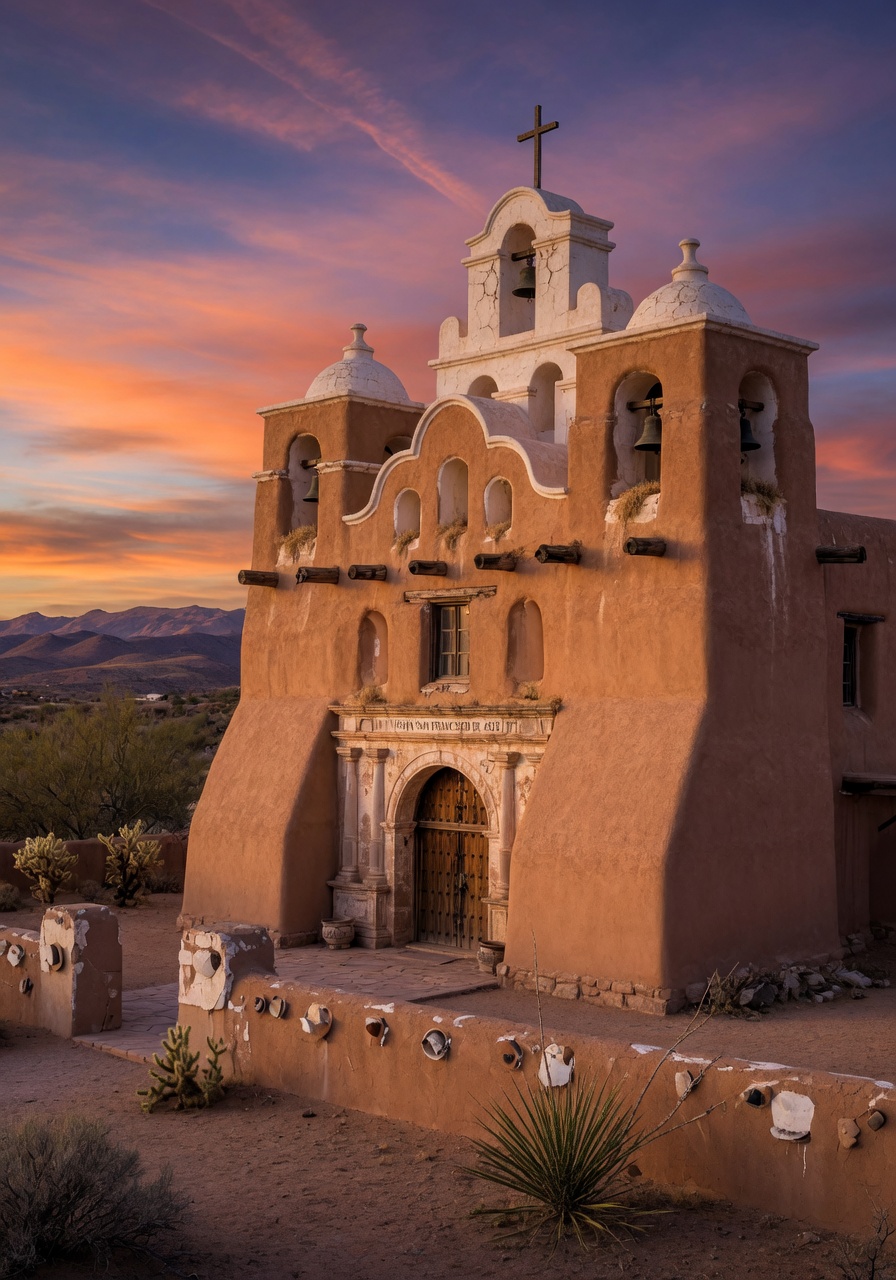
Long before sleek skyscrapers claimed the horizon, Spanish missions rose from the arid stretches of California, New Mexico, and Texas as sturdy compounds built to last. Franciscan and Jesuit priests arrived in the late 1600s and early 1700s with orders to establish outposts, and the structures they created—like Mission San Juan Capistrano in 1776 or the Alamo, founded as Mission San Antonio de Valero in 1718—quickly became more than chapels. They functioned as farms, workshops, and living quarters, shaped by European plans yet executed with local adobe bricks, sandstone, and Indigenous labor.
The style’s strength lies in its practical response to the desert. Walls two or three feet thick hold heat during cold nights and keep interiors cool under midday sun. Barrel-tile roofs shed rare but heavy rains, while rounded arches and simple bell towers add quiet rhythm to the skyline. Inside, thick wooden vigas support ceilings of peeled branches, and shaded courtyards once served as gathering spots for work and rest. Stucco in warm earth tones protects the adobe and blends with the surrounding landscape.
These missions also drove early economic change. Orchards, vineyards, and cattle herds introduced by the settlers transformed regional agriculture and trade. Over time, secularization in the early nineteenth century left many buildings in ruins, later captured in paintings that gave them a romantic glow. Yet the core techniques—sun-dried bricks, thick thermal mass, and low-tech ventilation—remained sound.
Today the same elements appear in updated forms. The Ahwahnee Hotel in Yosemite, finished in 1927, used heavy beams and stone hearths to echo mission scale. Contemporary houses in Santa Barbara and Palm Springs add talavera tile fountains and iron details, while architects such as Wallace Neff helped popularize the look during California’s growth spurt. Because adobe stores and releases heat slowly, modern versions cut cooling costs without extra equipment, fitting current priorities around energy use.
The appeal persists because the style grew from real constraints rather than passing fashion. Its thick walls and shaded outdoor rooms still offer comfort in hot, dry climates, and the mix of cultures that produced it shows how buildings can carry history without feeling frozen in time. Whether preserved as landmarks or adapted for new homes, Spanish Mission details continue to ground contemporary design in materials and methods that have already proved their worth.
Comments are closed