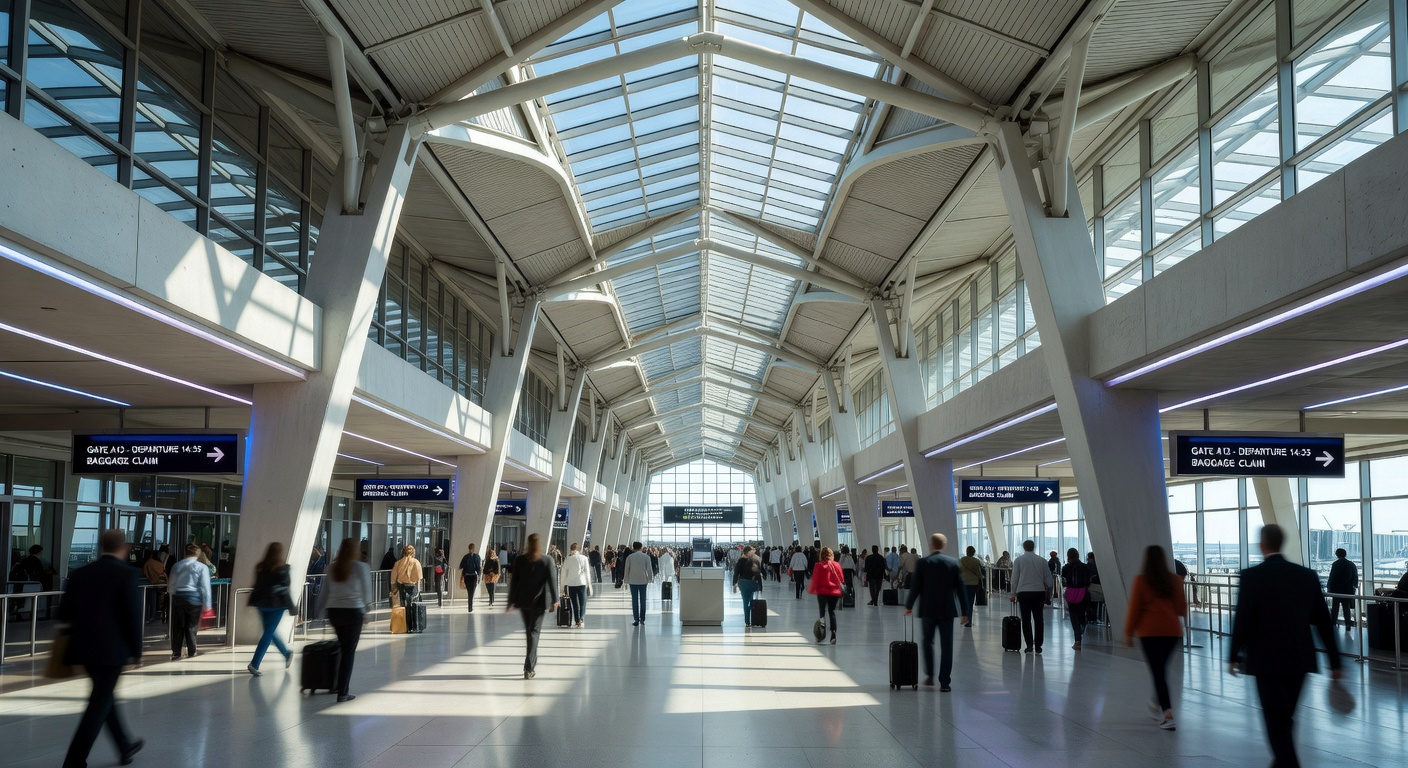
Ever stepped into a bustling airport terminal and felt like a particle in a high-stakes physics experiment? You’re not alone. Airport terminals are living organisms of movement, engineered to funnel millions through a symphony of gates, shops, and security chokepoints without descending into chaos. At their core, terminal flow is about optimizing human traffic—think wide corridors, strategic signage, and invisible nudges that guide you from curb to clouds.
Key features make this ballet possible. Landside areas handle arrivals and departures with expansive check-in halls and baggage drops, often using serpentine queues to maximize space. Airside, post-security zones prioritize efficiency: generous gate lounges with sightlines to aircraft, modular seating pods, and “people mover” walkways or trams for sprawling layouts. Biometrics and facial recognition are game-changers now, slashing passport control times by 70% at hubs like Singapore’s Changi. Color-coded flooring, dynamic digital screens, and even scent diffusers subtly direct crowds, while vertical flow—escalators, elevators, and skybridges—prevents ground-level gridlock.
Historically, terminals evolved from simple sheds. Early 20th-century airfields like London’s Croydon (1920s) treated passengers like freight, with minimal shelter. Post-WWII, the jet age demanded scale: Idlewild (now JFK) opened in 1948 as a radical U-shaped terminal cluster, pioneering finger piers to shorten walks to planes. The 1960s brought the “pier” model, but by the 1970s, energy crises and delays exposed flaws—Dallas/Fort Worth’s 1974 star-shaped design mitigated some with underground trains. Modern icons like Atlanta Hartsfield-Jackson refined this into the linear “skewer” concept, piercing a central spine with concourses.
Today, exemplars shine. Hamad International in Doha deploys vast, dune-inspired halls with automated people movers zipping 100,000 passengers daily. Istanbul’s mega-terminal, the world’s busiest since 2019, masters “dendritic” flow—branching paths mimicking veins for seamless expansion. Post-pandemic, contactless tech and wide social-distancing buffers became standard, as seen at Munich’s redesigned security halls.
Why does this matter now? In a world of 4.5 billion annual passengers (pre-COVID peaks), poor flow means delays costing airlines $60 billion yearly in fuel and crew alone. It impacts everything from economic hubs—Heathrow pumps £20 billion into the UK—to resilience against disruptions like weather or terror threats. Sustainable designs, like those integrating solar canopies at Denver, blend flow with green goals, reducing taxi times and emissions. For travelers, it’s sanity: intuitive layouts cut stress, boost spending (dwell time equals dollars at duty-free), and make flying feel less like herding cats.
Ultimately, masterful terminal flow isn’t just architecture—it’s the invisible hand turning potential pandemonium into precision. Next time you’re weaving through one, appreciate the choreography keeping the global skyways humming.
Comments are closed