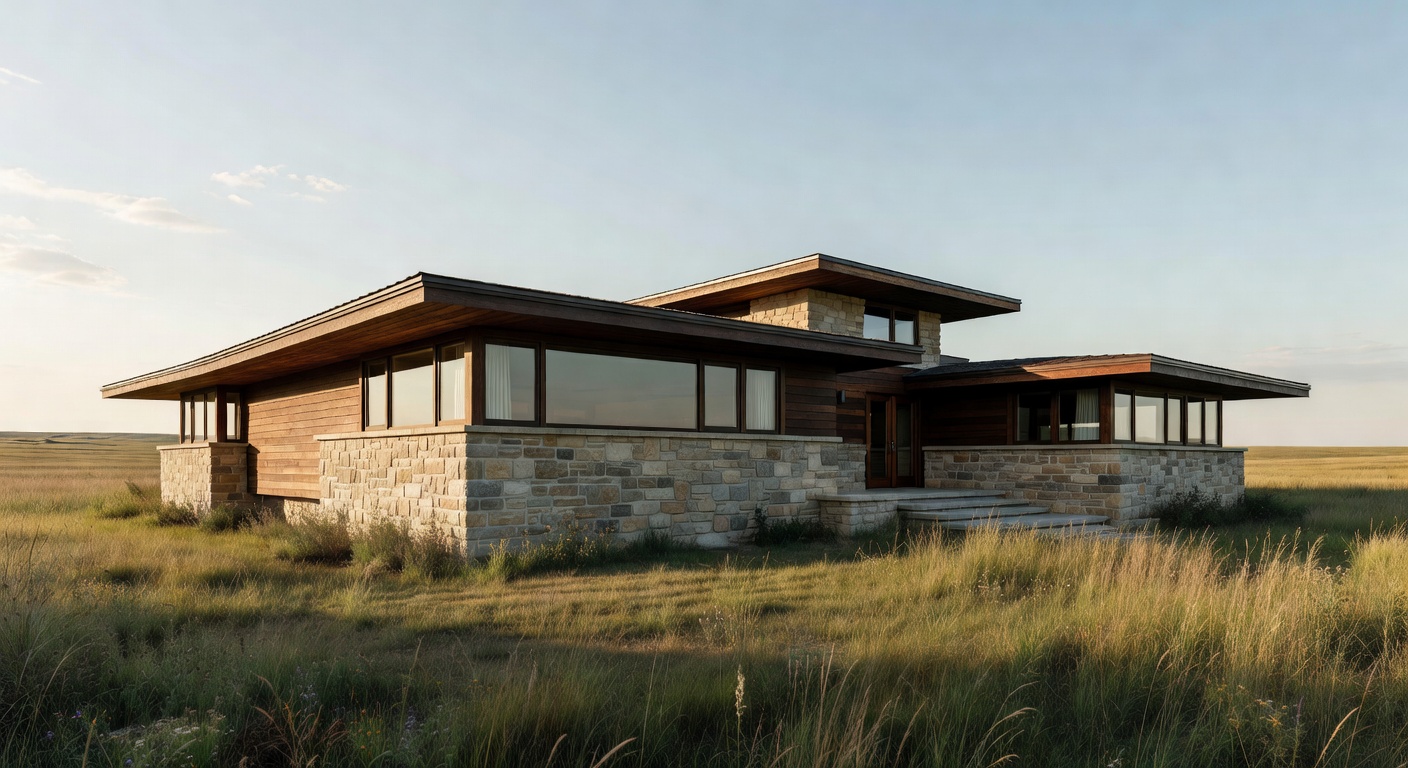
In the flat expanses of the American Midwest, where the horizon stretches unbroken, architects like Frank Lloyd Wright found inspiration in the land itself. The Prairie School movement, emerging around 1900, channeled this landscape into a revolutionary style defined by bold horizontal lines. These weren’t mere decorative flourishes; they were a deliberate echo of the prairie—low, sprawling, and organically grounded.
At its core, the Prairie School’s horizontal emphasis rejected the vertical pomp of Victorian architecture. Buildings featured overhanging eaves, cantilevered roofs, and continuous horizontal bands of windows and trim that hugged the earth. Wright’s Robie House in Chicago (1909) exemplifies this: its low-pitched rooflines cascade like gentle waves, while ribbon windows wrap around the structure, blurring indoor and outdoor boundaries. These lines created a sense of sheltering horizontality, mimicking the sheltering arms of prairie grasses bending in the wind. Materials played a key role too—brick, wood, and stucco in earthy tones reinforced the grounded feel, with ornamentation drawn from native flora in abstracted, geometric forms.
Historically, Prairie School arose amid rapid urbanization and industrialization. Wright and peers like George Elmslie and Marion Mahony Griffin sought an authentically American architecture, free from European Beaux-Arts excess. Influenced by the Arts and Crafts movement and Japanese prints—which Wright adored for their flat planes and asymmetry—they aimed to integrate homes with their sites. This was the birth of organic architecture, where form followed not just function, but the genius loci of the place. Spread through Wright’s Taliesin Fellowship and publications like Ladies’ Home Journal, the style influenced suburbs nationwide before fading with the Great Depression and modernism’s rise.
Today, Prairie principles resonate in sustainable design. Modern examples abound: the Pearl Brewery redevelopment in San Antonio adapts Wrightian horizontals into mixed-use spaces with green roofs and expansive glazing, fostering community amid urban density. In Australia, Griffin’s Canberra plan—rooted in Prairie ideals—still shapes the city’s low-rise layout. Architects like Sarah Susanka revive these lines in her “Not So Big House” series, prioritizing intimate, site-specific homes over McMansion sprawl.
Why does this matter now? In an era of towering glass skyscrapers and climate anxiety, Prairie horizontals remind us of humility and harmony. They promote energy efficiency through natural light and ventilation, reduce visual clutter, and counteract the alienation of verticality. By embracing the horizon, they reconnect us to nature’s scale—vital as we rethink living amid wildfires and floods. Prairie School isn’t nostalgia; it’s a blueprint for resilient, human-centered spaces that let the land lead. Dive into a Wright tour, and feel the pull of those lines: an invitation to root down and look out.
Comments are closed