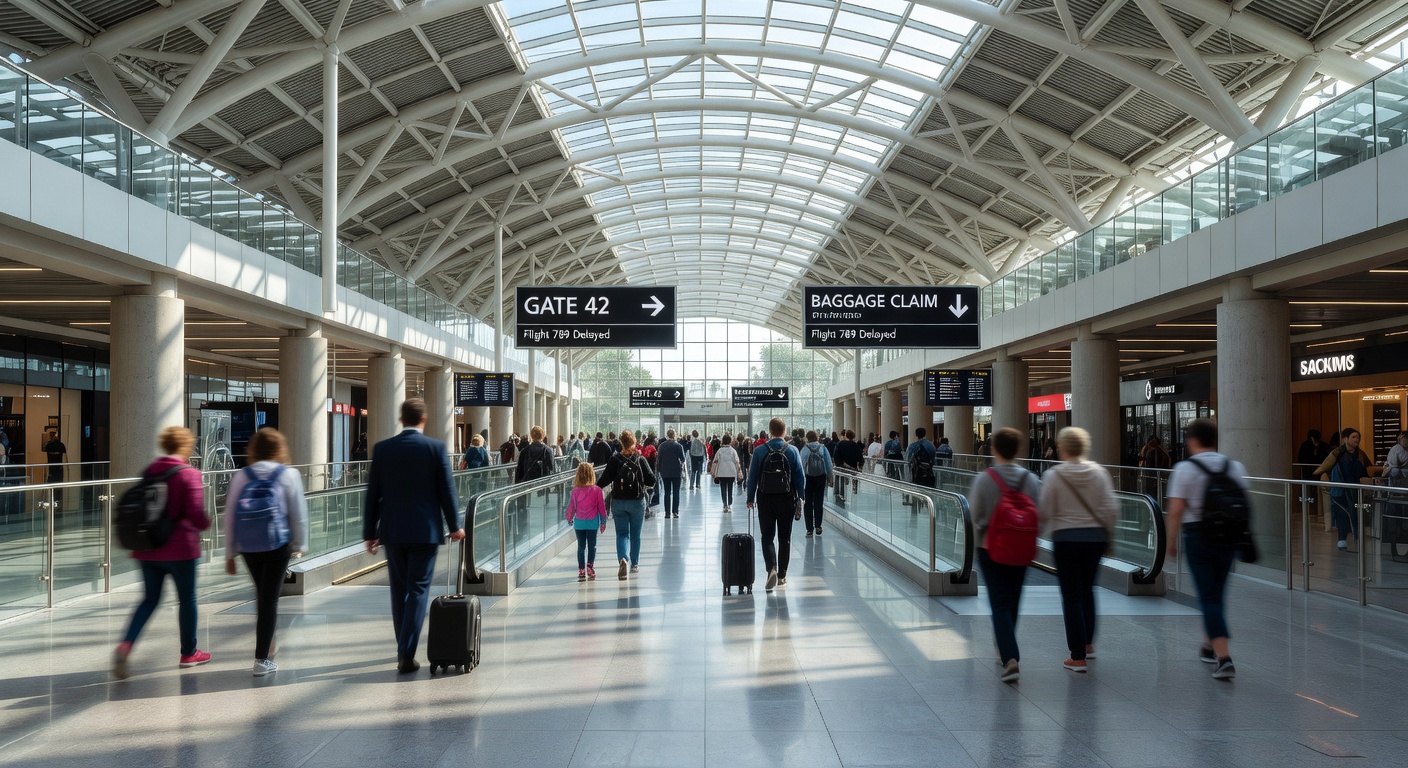
Ever watched a flock of starlings twist through the sky, each bird dodging collisions without a single crash? Airports pull off a similar feat daily, herding millions through vast terminals like living organisms pulsing with purpose. Terminal flow—the engineered ballet of passengers, luggage, and planes—turns potential chaos into clockwork efficiency. It’s not just architecture; it’s the unsung hero of global travel.
At its core, terminal flow hinges on three pillars: spatial layout, wayfinding, and capacity management. Linear terminals, like the old-school setups at many U.S. hubs, string gates in a straight shot from security to boarding, minimizing backtracking but stretching walking distances—think Dallas-Fort Worth’s marathon treks. Hub-and-spoke designs, pioneered by airlines like Delta at Atlanta’s Hartsfield-Jackson, cluster gates around central spines for quicker connections, though they can bottleneck during peaks. Modern stars like Singapore Changi or Hamad in Doha embrace the pier model: finger-like extensions jutting from a main building, served by automated people-movers or trains to slash transit times.
Wayfinding seals the deal. Color-coded zones, glowing digital screens, and intuitive signage (no more “proceed to Gate 47B via confusing Corridor Z”) guide the eye like breadcrumbs. Airports now deploy facial-recognition tech and AI-driven apps—Jewel Changi’s app, for instance, predicts your gate wait with eerie accuracy, rerouting you around crowds. Security checkpoints, once chokepoints, use behavioral analytics to flag risks faster, keeping lines under 10 minutes even at Heathrow during rush hour.
Historically, terminals evolved from rickety airstrips to flow-optimized behemoths. Pre-WWII fields like London’s Croydon were glorified tents; the jet age demanded more. Eero Saarinen’s TWA Terminal at JFK (1962) was a sculptural marvel but a flow flop—its curvy shell funneled passengers into dead ends. Post-9/11, security reshaped everything: Atlanta’s midfield terminal (2012) layered pre-check lanes and biometric scanners, boosting throughput by 30%. Today, pandemic lessons shine in contactless flows at Istanbul’s mammoth new airport, with UV-lit escalators and thermal scanners.
Why obsess over this now? In 2023, airports handled 8.7 billion passengers, projected to hit 16.9 billion by 2042 per ACI World. Climate pressures demand smarter flows—fewer idling planes via efficient gates cut emissions. Congestion costs billions: a 15-minute delay cascades into $500 million yearly losses for U.S. carriers alone. Poor flow amplifies stress, too; studies from Cornell show optimized terminals reduce traveler anxiety by 20%, turning dread into delight.
Tomorrow’s terminals? Biophilic designs like Denver’s Great Hall integrate greenery for calmer crowds, while hyperloops and flying taxis loom. Yet the genius endures: masterful flow keeps humanity airborne, connecting worlds one seamless stride at a time. Next layover, pause amid the rush—you’re dancing in a masterpiece.
Comments are closed