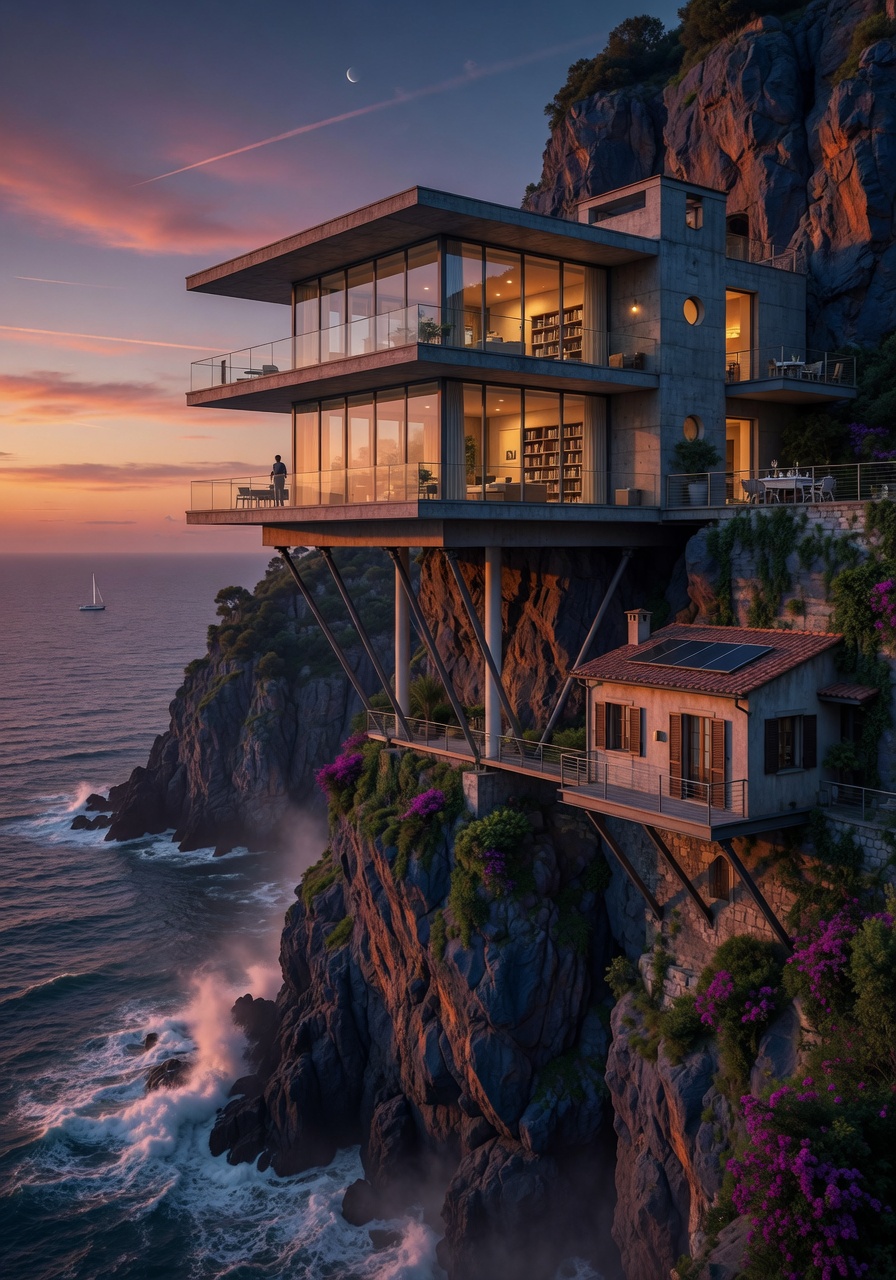
What compels architects and homeowners to anchor structures that jut dramatically from sheer rock faces, balancing comfort against the constant threat of erosion and wind? Cliffside hanging homes represent a niche yet growing segment of extreme architecture, where cantilevered platforms and tension cables allow living spaces to extend over voids that would terrify most builders. These designs blend engineering precision with aesthetic daring, creating residences that seem to float while rooted firmly in geology.
Historically, the concept echoes ancient settlements like the cliff dwellings of the Ancestral Puebloans in the American Southwest, though those relied on natural alcoves rather than artificial overhangs. Contemporary versions emerged in the mid-20th century with modernist experiments, evolving into today’s high-tech marvels. In Cuenca, Spain, the famous Hanging Houses from the 15th century still stand as early precedents, their wooden balconies projecting over the Huécar River gorge. Modern iterations appear in places like Malibu, California, and the Amalfi Coast of Italy, where steel beams and reinforced concrete defy gravity.
Construction demands specialized techniques. Engineers drill deep anchors into bedrock, using post-tensioned cables to support floor plates that can span 30 feet or more beyond the cliff edge. Materials favor corrosion-resistant alloys and impact-resistant glass to withstand seismic activity and storms. Seismic dampers and wind tunnel testing are standard, ensuring stability even during magnitude-7 earthquakes or hurricane-force gusts. Environmental considerations play a role too; many projects incorporate solar panels, rainwater collection, and minimal land disturbance to preserve fragile ecosystems.
Residents enjoy unmatched panoramas, from sunrise over canyons to stargazing without light pollution. Privacy feels absolute, with neighbors often miles away. Yet drawbacks include high maintenance costs, limited access for deliveries or emergencies, and psychological strain from the height. Insurance premiums soar accordingly. Despite these hurdles, demand grows among thrill-seekers and minimalists drawn to the raw integration with nature.
Innovations continue, with 3D-printed components and drone-assisted inspections making builds safer and faster. Projects in Norway and New Zealand showcase floating decks over fjords and oceans, pushing boundaries further. Ultimately, cliffside hanging homes challenge conventional notions of shelter, proving that human ingenuity can transform perilous landscapes into sanctuaries of wonder.
Comments are closed