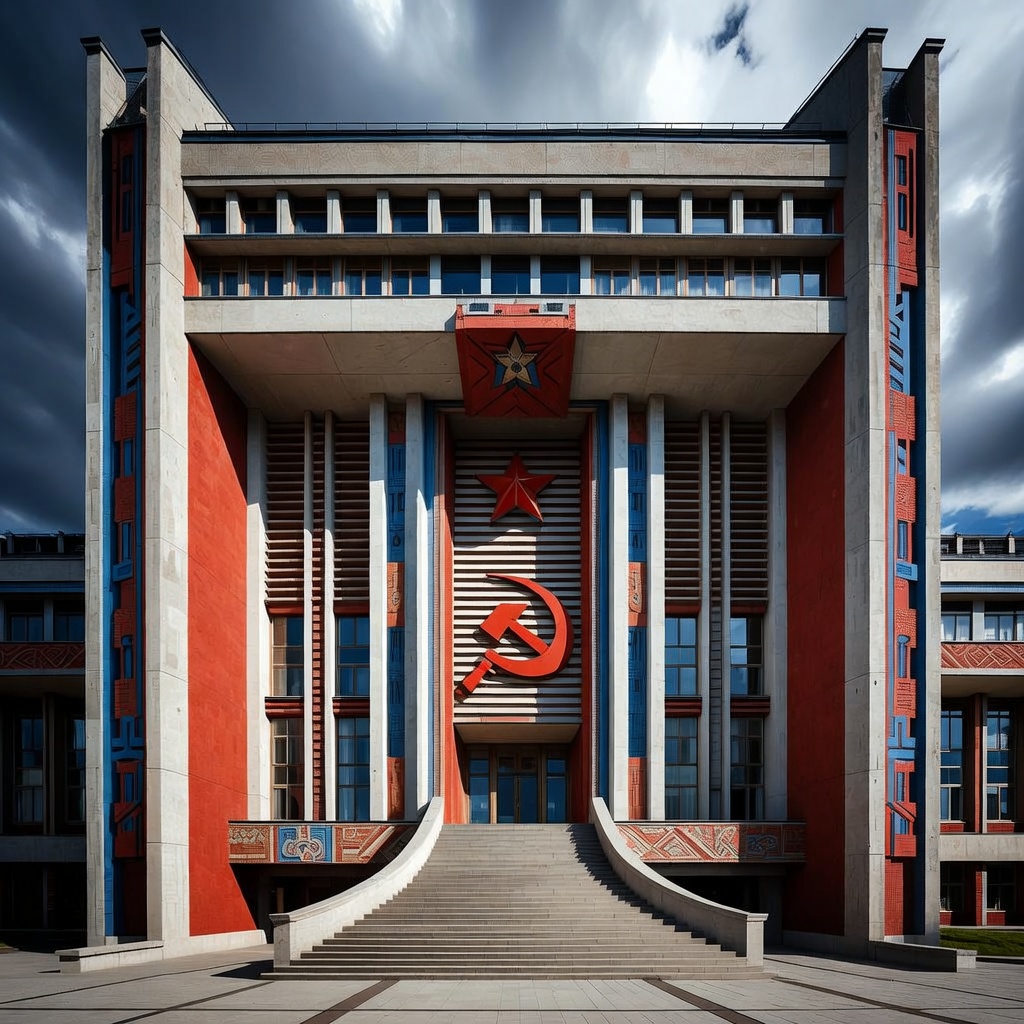
Imagine a world where buildings don’t just shelter people—they ignite revolutions. That’s the electrifying promise of Soviet Constructivism, a radical architectural movement that exploded onto the scene in the early 1920s amid the ashes of the Russian Revolution. Born from the chaos of civil war and the fervor of Bolshevik dreams, Constructivism wasn’t about ornate palaces or cozy homes. It was architecture as a weapon for the proletariat, designed to dismantle the old world and forge a utopian future through steel, glass, and unyielding geometry.
At its core, Constructivism rejected the decorative frippery of Tsarist Russia and bourgeois Europe. Pioneers like Vladimir Tatlin, El Lissitzky, and the Vesnin brothers envisioned structures that embodied “construction” itself—functional, efficient, and mass-producible. Tatlin’s unrealized Monument to the Third International (1919-1920), often called the “Tatlin Tower,” was the movement’s audacious manifesto. This spiraling, leaning pylon of iron, glass, and moving parts was meant to soar 400 meters over Petrograd (now St. Petersburg), housing Soviet offices that rotated with the Earth’s rhythms. It symbolized dynamism: a cube for the executive, a pyramid for planning, a cylinder for information—all in perpetual motion. Though never built due to engineering woes and resource shortages, its blueprint became Constructivism’s holy grail, plastered across manifestos and inspiring generations.
The Vesnin brothers brought these ideas to life with the Rusakov Workers’ Club (1927-1929) in Moscow. This cultural hub juts out like a mechanical beast, its cantilevered auditoriums thrusting toward the street like extended arms, ready to embrace the masses. No superfluous columns or cornices here—just raw concrete and glass framing communal spaces for theater, lectures, and propaganda films. It was architecture in service of the state: uplifting workers while broadcasting the party’s message.
Konstantin Melnikov’s designs pushed boundaries even further. His Rusakov Club rivaled the Vesnins’, but Melnikov’s own house (1921-1924) was a personal rebellion—a cylindrical tower honeycombed with hexagonal windows, like a beehive for a solitary architect-bee. Inside, it blurred public and private, with double-height spaces and a sense of infinite extension. Melnikov’s pavilions at the 1925 Paris Expo stunned the West, proving Soviet design could outshine Art Deco glamour with stark functionality.
Constructivism peaked in the mid-1920s, dotting Moscow and Leningrad with “Palaces of Culture” and communal housing like Moisei Ginzburg’s Narkomfin Building (1928-1930). This experimental slab block pioneered the “dom-kommuna”—corridor-less apartments with communal kitchens, embodying collectivism. Residents shared baths and laundries, dissolving bourgeois individualism.
But utopia crumbled. By 1932, Stalin’s socialist realism decreed Constructivism “formalist” and decadent. Skyscrapers and neoclassical facades supplanted the avant-garde. Many gems fell into disrepair, yet survivors like Melnikov’s house (now a museum) endure as testaments to ambition.
Today, Soviet Constructivism whispers of what might have been: cities as machines for living, where form follows ideology. In our era of sleek minimalism—from Zaha Hadid’s curves to BIG’s playful blocks—its legacy pulses on, reminding us that great architecture doesn’t just stand; it strives to remake society. Next time you spot a cantilevered facade or a glassy megastructure, tip your hat to the Constructivists—they built the blueprint for modernism’s bold heart.
(Word count: 478)
Comments are closed