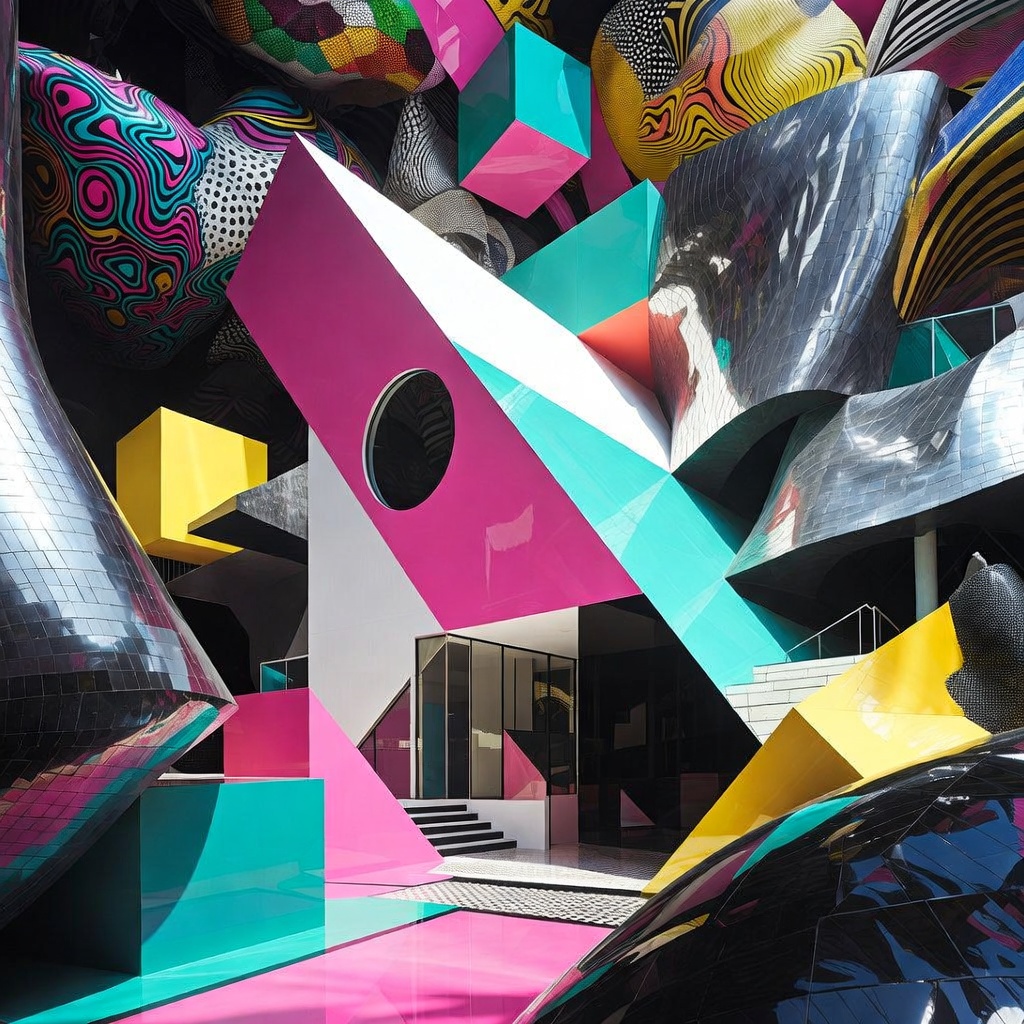
Picture this: it’s the early 1980s, and the design world is stuck in a rut of sterile minimalism and beige boredom. Enter the Memphis Group, a band of Italian mavericks who crashed the party with squiggly lines, clashing colors, and furniture that looks like it escaped from a psychedelic fever dream. Founded by architect Ettore Sottsass in 1980 (and officially disbanded by 1987), Memphis wasn’t just a collective—it was a full-throated rebellion against modernism’s rigid rules. This was postmodernism’s wild child, turning everyday objects into loud, irreverent statements.
At its core, Memphis embodied postmodernism’s cheeky disdain for highbrow seriousness. Modernism preached “form follows function”—clean lines, neutral palettes, and utility above all. Memphis flipped the script: why should a lamp be invisible? Their debut Milan exhibition in 1981 featured pieces like Sottsass’s Carlton room divider, a zigzagging laminate tower in Day-Glo pink, black, and green stripes that screamed “I dare you to ignore me.” Michele De Lucchi’s First Chair was a black steel frame wrapped in faux fur, more throne for a disco king than practical seating. And don’t get me started on the Tavolo con Ruote table—rolling aluminum and wood in acid yellow, evoking a shopping cart on steroids.
What made Memphis tick? A mash-up of influences: Pop Art’s bold graphics, 1950s Americana kitsch (think diners and tailfins), African and Oceanic patterns, and even ancient Egyptian motifs (hence the name, inspired by Bob Marley’s “Lollipop”). They embraced cheap materials like plastic laminates and Formica, usually dismissed as tacky, elevating them to high art. This was anti-elitist postmodernism—democratizing design by making it fun, accessible, and unapologetically tacky. As Sottsass put it, “We were trying to make objects that were emotional, not rational.”
The impact? Explosive. Memphis infiltrated homes, hotels, and MTV sets, influencing fashion (hello, power-pop prints) and even Apple’s early aesthetics. Critics sneered—Philip Johnson called it “the first Dada furniture”—but that only fueled the fire. It challenged the idea that design must serve quietly; instead, it demanded to be seen, touched, loved, or hated.
Today, Memphis is having a renaissance. Brands like Gucci and Versace riff on its vibes, and collectors pay six figures for originals at auctions. Yet its true genius endures: in a world of algorithmic sameness, Memphis reminds us that design can provoke joy, spark debate, and refuse to fade into the background. It’s not just furniture; it’s a manifesto for living loud. Dive into a Memphis piece, and you’ll feel the thrill of postmodern rebellion—colorful, chaotic, and utterly alive.
(Word count: 428)
Comments are closed