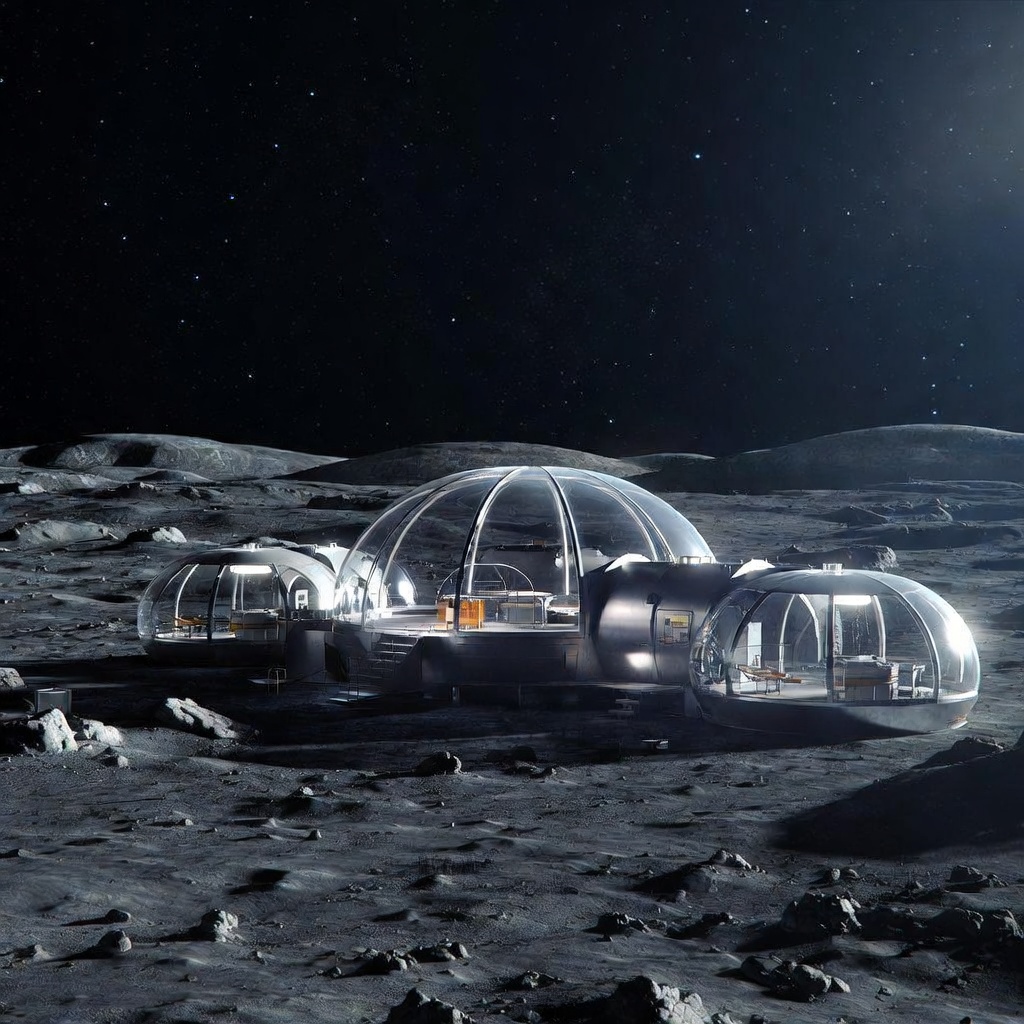
Imagine waking up to a sunrise that lasts two weeks, sipping coffee in a habitat that looks like a sci-fi prop, all while gravity gently tugs at you with just one-sixth the pull of Earth. Welcome to the era of lunar habitat modules—the inflatable, 3D-printed, radiation-shielding pods that could turn the Moon from a dusty rock into humanity’s next address. As NASA, SpaceX, and private innovators race toward sustainable lunar living, these modules aren’t just concepts; they’re the blueprints for our off-world future.
At the heart of lunar habitats are inflatable modules, pioneered by Bigelow Aerospace and now embraced by NASA’s Artemis program. Unlike rigid metal cans, these expand like high-tech balloons once in the vacuum of space. Deployed compactly in rockets, they inflate to volumes rivaling a small house—think 300 cubic meters of living space. Why inflatable? Launch costs plummet because they pack flat, and once puffed up, multi-layered fabrics (Kevlar-tough outer shells with inner bladders) provide pressure-tight homes against the Moon’s harsh 250-degree Celsius temperature swings.
But the Moon isn’t forgiving. No atmosphere means cosmic rays and solar flares bombard the surface with radiation lethal over time. Enter regolith shielding: lunar soil, or regolith, scooped by robots and piled over habitats like a 2-meter-thick blanket. Studies from the European Space Agency show this cuts radiation by 90%, mimicking Earth’s magnetic shield. For flair, companies like ICON are 3D-printing these shells on-site using regolith mixed with binding polymers, erecting dome-like structures in days. Picture a honeycomb of interconnected modules: one for sleeping (with personal pods for privacy), another a hydroponic farm glowing under LED lights, growing potatoes à la The Martian.
Life support is the real wizardry. Closed-loop systems recycle 95% of water from sweat, urine, and humidity—yes, even that. Air comes from electrolysis splitting regolith-derived water into oxygen and hydrogen fuel. Power? Solar arrays unfurl across craters, backed by nuclear micro-reactors for the 14-day lunar night. Inside, habitats buzz with smart tech: AI monitors CO2 levels, adjusts humidity, and even simulates Earth gravity via rotating sections to fend off muscle atrophy.
Challenges remain thrilling. Dust clings like glitter from hell, abrading seals, so electrostatic repellents are in testing. Psychological strain in confined spaces demands virtual reality windows beaming Earth views. Yet prototypes thrive: NASA’s HABITAT demo in 2023 simulated six-month stays, while SpaceX eyes Starship-delivered clusters for Starbase Luna.
These modules aren’t mere shelters; they’re stepping stones to Mars and beyond. By 2030, we could see crews thriving in them, mining helium-3 for fusion energy, or turning the south pole’s water ice into rocket propellant. Lunar habitats promise not just survival, but a new chapter of human ingenuity—where we don’t conquer the Moon, we cozy up to it. Who’s packing first?
Comments are closed