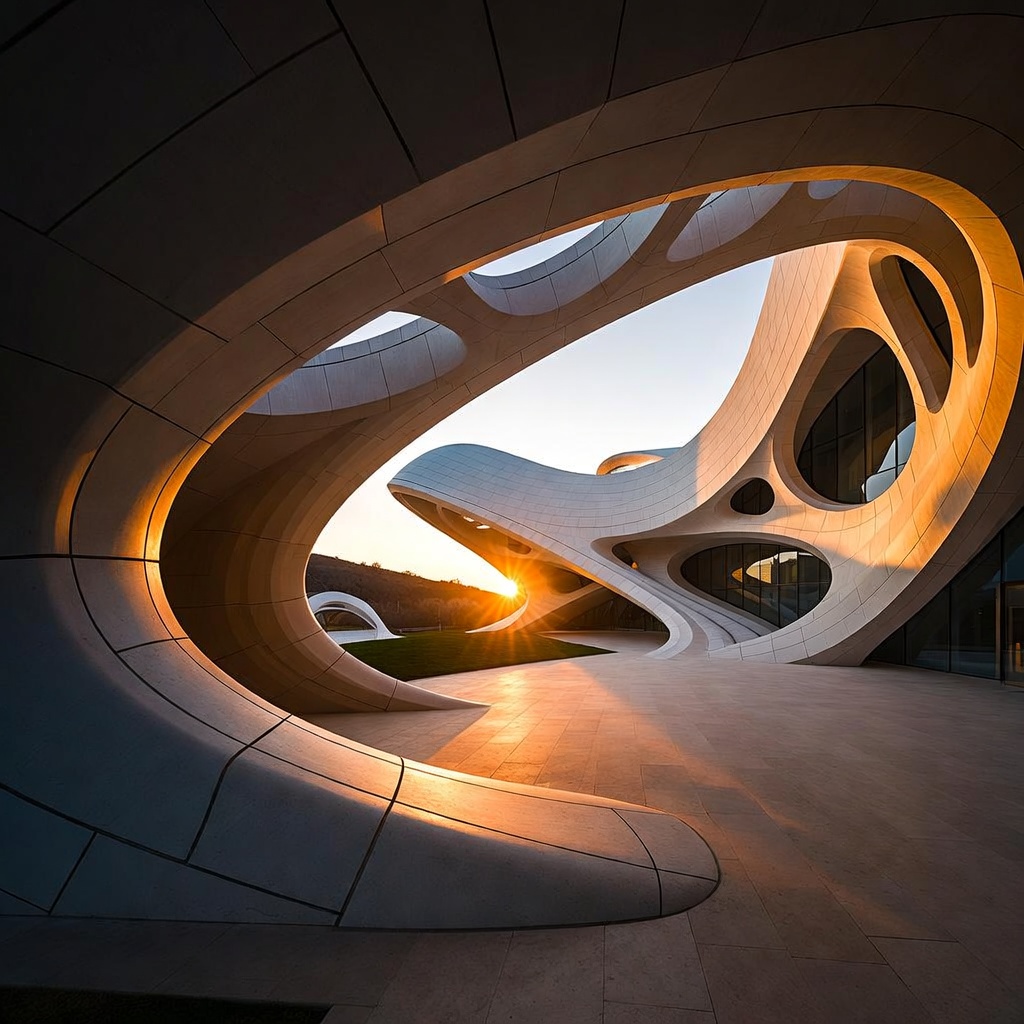
Imagine a building that twists like a blooming flower, its form responding fluidly to wind patterns or sunlight angles, all without a single straight line dictated by rigid blueprints. This isn’t science fiction—it’s parametric architecture, the revolutionary fusion of computational design and organic expression that’s reshaping our skylines. Born from the digital age, parametricism lets architects harness algorithms to create structures that are as beautiful as they are functional, pushing the boundaries of what we thought possible in construction.
At its core, parametric architecture relies on parameters—variables like size, shape, curvature, or environmental data—that feed into mathematical algorithms. Software like Grasshopper for Rhino or Dynamo for Revit acts as the architect’s paintbrush, generating complex geometries that adapt in real-time. Picture Zaha Hadid’s Heydar Aliyev Center in Baku, Azerbaijan: its undulating waves cascade seamlessly from roof to ground, optimized parametrically for structural integrity and pedestrian flow. No two curves are alike; they’re born from equations that balance aesthetics with physics.
What makes this approach so thrilling? Traditional architecture often starts with sketches and static models, but parametric design is iterative and responsive. Change one parameter—say, increase the building’s height by 10%—and the entire model regenerates, testing thousands of variations instantly. This democratizes innovation. Young designers in studios worldwide can now simulate wind loads, solar gain, or even crowd dynamics before a brick is laid. Sustainability gets a massive boost too: parametric tools optimize material use, minimizing waste. The Al Bahar Towers in Abu Dhabi, for instance, feature a kinetic facade of hexagonal umbrellas that deploy like sunflowers, slashing energy costs by 20% through algorithmic shading.
Critics might call it “blobitecture”—too flashy, too computer-dependent. But delve deeper, and you’ll find profound intelligence. Parametricism echoes nature’s own algorithms: think termite mounds that self-regulate temperature or nautilus shells spiraling in perfect proportion. Architects like Patrik Schumacher, who coined “parametricism” as a style, argue it’s the successor to modernism, embracing complexity over minimalism.
Looking ahead, emerging tech like AI and 3D printing supercharges this field. Projects like MX3D’s stainless-steel bridge in Amsterdam, printed parametrically by robots, hint at a future of fully customized megastructures. Cities could evolve into living organisms, with buildings that morph seasonally or heal structural cracks autonomously.
Parametric architecture isn’t just about eye-popping forms; it’s a mindset shift. It invites us to design with data, not dogma, creating spaces that enhance life. Next time you gaze at a soaring, sculpted facade, remember: beneath the curves lies code crafting tomorrow’s world. Dive in—your inner architect might just wake up.
Comments are closed