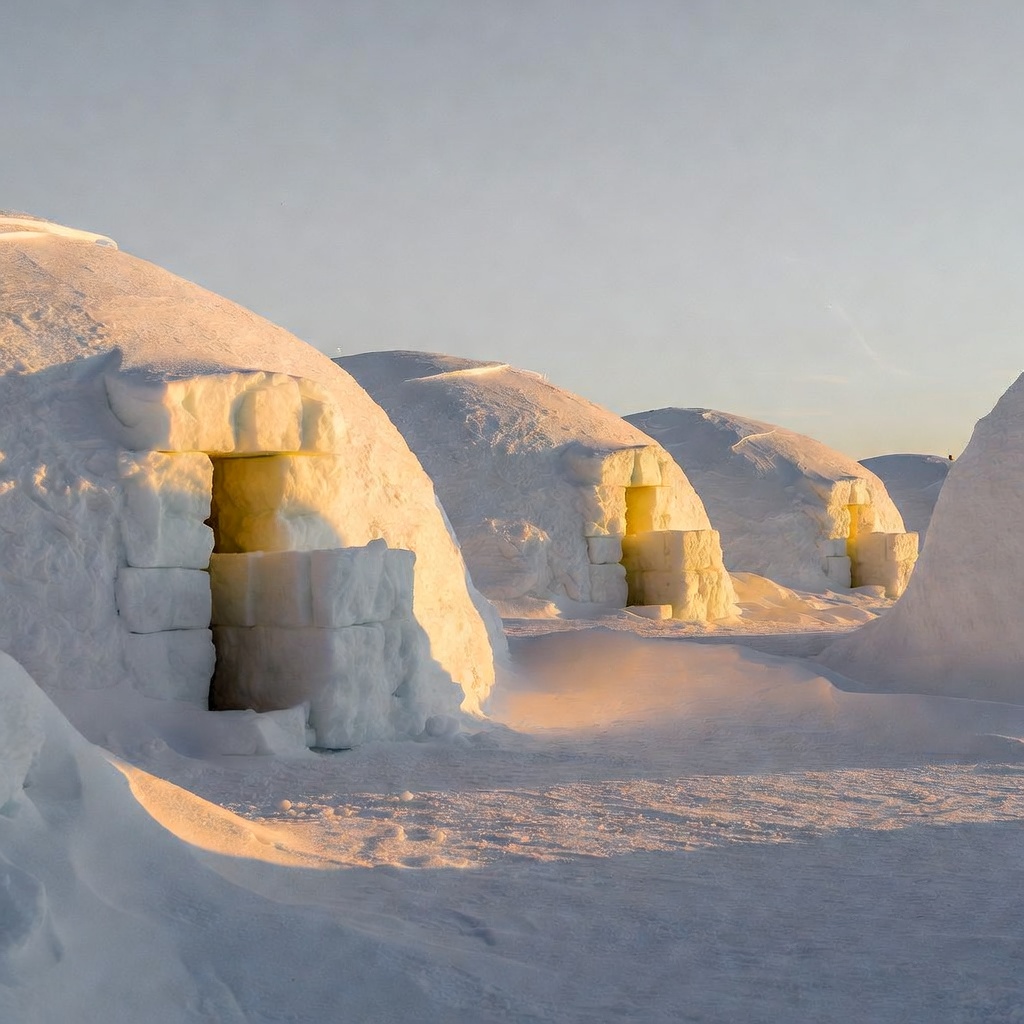
Imagine crafting a cozy home from snow in the dead of a -50°C Arctic night, where winds howl like wolves and survival hangs by a frozen thread. That’s the genius of the Inuit igloo—not a mere shelter, but a pinnacle of indigenous engineering born from necessity and brilliance. For centuries, Inuit hunters across the Canadian Arctic, Greenland, and Alaska turned snow into sanctuaries, proving that the right knowledge can conquer the harshest environments.
The igloo’s construction begins with site selection: a deep, stable snowdrift, ideally wind-packed for strength. Using only a snow knife—a long blade of bone, ivory, or later steel—the builder cuts precise blocks from the upwind side, stacking them in a spiral that leans inward at a 30- to 60-degree angle. This catenary dome shape, wider at the base and tapering upward, distributes weight perfectly, preventing collapse under its own mass. Each block is shaped to interlock seamlessly, with gaps filled by packing snow or slush, which freezes into mortar-like bonds. A small entrance tunnel, dug low and curving upward, blocks cold air—denser than warm air—so it pools outside, while body heat rises inside.
Inside, the magic unfolds. The dome’s curvature traps heat from a soapstone lamp fueled by seal blubber, warming the inner snow layer to near-melting (about 0°C). This creates a sealed ice membrane that insulates superbly, while the outer layer stays brutally cold. Temperatures can soar to 15-20°C inside, even as blizzards rage out. Ventilation comes via a precisely placed top hole, regulated by a block or skin flap, balancing fresh air with warmth. No nails, no tools beyond the knife—pure elegance in adaptation.
Historically, igloos were temporary winter camps for hunters, lasting weeks amid caribou or seal pursuits. Permanent homes used sod, stone, or whalebone, but the igloo shone for mobility. Elders passed techniques orally, refining them over millennia against climate whims.
Today, igloos echo in modern survival training, polar expeditions, and eco-architecture. Researchers at the Cold Regions Research and Engineering Laboratory study igloo domes for inspiring lightweight, insulated structures. Architects draw parallels to geodesic domes, while festivals like Quebec’s Igloo Fest showcase rebuilt versions. Climate change amplifies their relevance: as Arctic ice melts, reviving Inuit knowledge aids resilient housing and informs sustainable design amid rising seas and extreme weather.
Why does it matter now? In our high-tech world, the igloo reminds us that human ingenuity thrives on harmony with nature. It’s low-impact, zero-waste engineering—blocks melt back into the landscape. Amid global warming, it teaches thermal efficiency: better insulation than many homes, using local materials. The Inuit igloo isn’t relic; it’s a blueprint for future-proof living, blending ancient wisdom with tomorrow’s needs. Next time you shiver in winter, tip your hat to these ice architects—they mastered the freeze long before central heating.
(Word count: 462)
Comments are closed