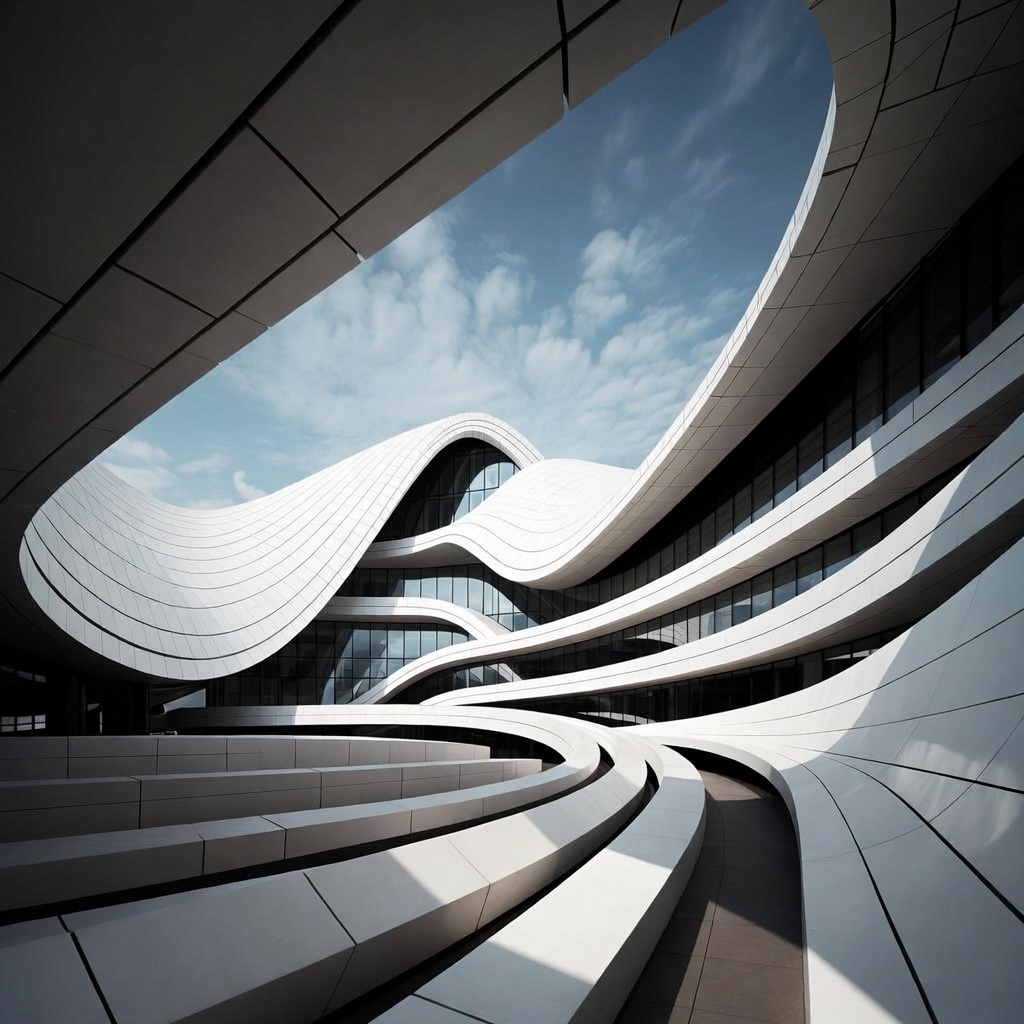
Zaha Hadid, the queen of architectural fluidity, didn’t just design buildings—she sculpted motion into steel and concrete. At the heart of her visionary style lie parametric curves, mathematical marvels that twist, morph, and flow like digital rivers. Born from algorithms and software wizardry, these curves aren’t random squiggles; they’re precisely engineered paths generated through parametric equations, where variables like time, angle, or force dictate their shape. Imagine feeding a computer data on wind patterns, structural loads, and human flow, then watching it birth a form that’s both organically beautiful and brutally efficient. Hadid pioneered this in the 1980s, when most architects still clung to straight lines and right angles.
Flash back to her early days. Trained under Rem Koolhaas at the Architectural Association in London, Hadid exploded onto the scene with explosive paintings—think jagged urban landscapes frozen in mid-eruption. Her 1983 entry for The Peak Club in Hong Kong was a parametric fever dream: fragmented forms defying gravity, hinting at the computational tools she’d soon master. By the 1990s, software like Rhino and Grasshopper became her playground. Parametricism, as she dubbed it, allowed her to iterate thousands of variations instantly. No more laborious sketches; curves could self-adjust to site constraints or client whims. This was revolutionary in an era dominated by modernism’s rigid grids—Hadid’s curves screamed futurism, challenging the boxy status quo.
Fast-forward to modern icons. The Heydar Aliyev Center in Baku, Azerbaijan (2012), is parametric poetry: its undulating skin, formed by interlocking curves derived from NURBS (Non-Uniform Rational B-Splines), seamlessly blends roof, walls, and plaza. No sharp edges, just a 57,500-square-meter waveform that seems to ripple like silk. Or consider Beijing’s Galaxy Soho (2012), where twisting parametric loops create airy atria, optimizing light and circulation. These aren’t just pretty; they’re smart. Parametric curves enable generative design, where algorithms simulate real-world stresses—earthquakes, crowds, climate—yielding structures 30% lighter yet stronger than traditional ones.
Why does this matter today? In a world grappling with climate chaos and urban explosion, Hadid’s legacy is a blueprint for sustainable innovation. Parametric tools cut material waste by up to 20%, as seen in her firm’s post-Hadid projects like the Morpheus Hotel in Macau, with its parametric exoskeleton that maximizes views while minimizing steel. They democratize complexity too—firms worldwide now use accessible software to craft biomimetic forms inspired by nature’s curves, from termite mounds to whale fins. Amidst cookie-cutter skyscrapers, parametric curves remind us architecture can be alive, adaptive, and joyous.
Hadid passed in 2016, but her curves pulse on, proving that math plus imagination can reshape our skyline—and our dreams. Dive into parametric design yourself; the future’s not straight, it’s supremely swoopy.
Comments are closed