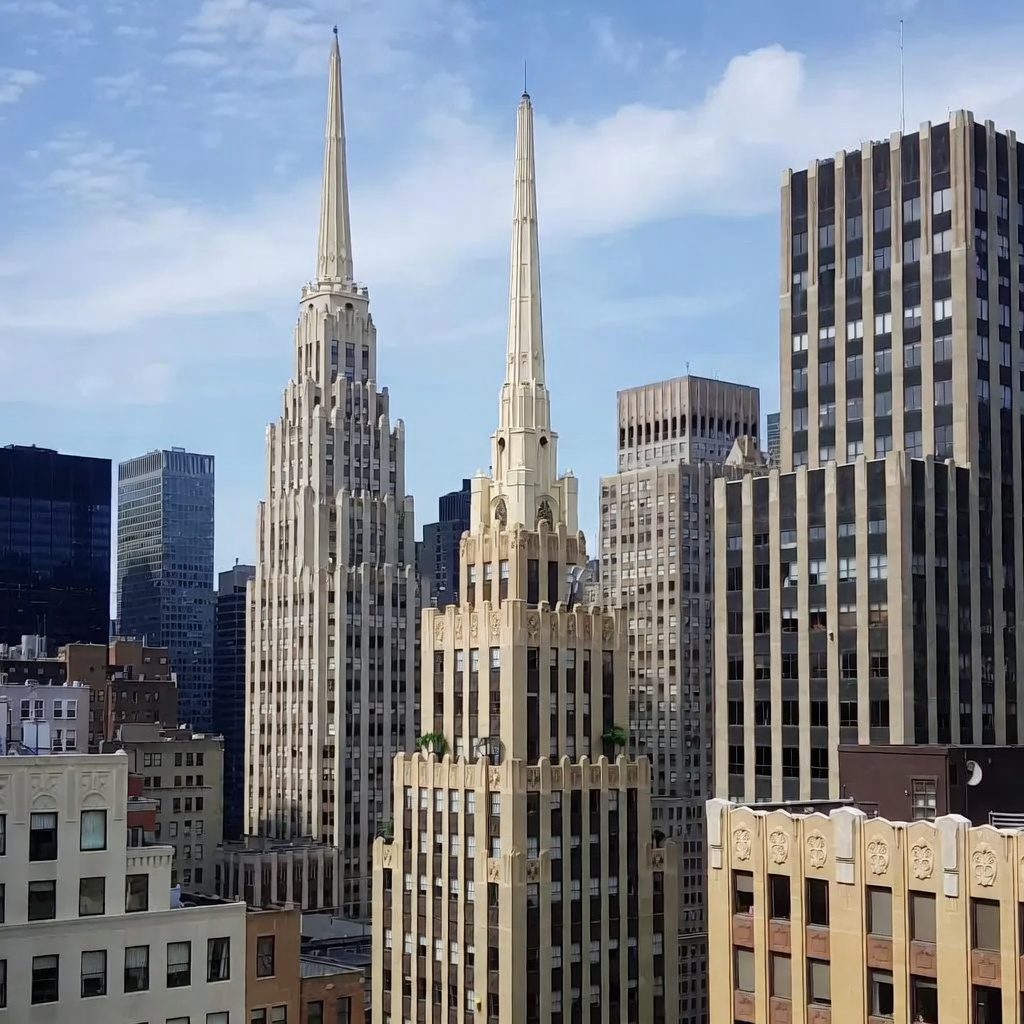
The Manhattan skyline is a jagged crown, but its sharpest jewels are the Art Deco spires—those audacious pinnacles that pierce the clouds like gilded spears. From the Empire State Building’s mooring mast to the Chrysler Building’s sunburst crown, these architectural flourishes defined New York’s vertical ego in the 1920s and ’30s. More than mere decoration, they embodied the era’s fusion of machine-age precision and ancient grandeur, turning steel skeletons into aspirational totems.
Art Deco’s spires emerged from a perfect storm of history and hubris. The 1929 stock market crash cast a long shadow, yet skyscrapers rose anyway, fueled by real estate tycoons betting on optimism. The style drew from the 1925 Paris Exposition Internationale des Arts Décoratifs, blending streamlined modernism with motifs from Mayan pyramids, Egyptian ziggurats, and Babylonian towers. Architects like William Van Alen and Shreve, Lamb & Harmon used setbacks—mandated by the 1916 Zoning Resolution—to create tiered forms that allowed light to streets below. Atop these, spires added vertigo-inducing height without extra bulk, often clad in stainless steel, nickel, or terracotta for a shimmering effect.
Take the Chrysler Building (1930), New York’s quintessential Art Deco masterpiece. Its 125-foot spire, secretly assembled inside the crown and hoisted in a single night, features radiating Van Alen-designed stainless-steel gargoyles and a jewel-like cap. It briefly claimed the world’s tallest title at 1,046 feet before the Empire State Building eclipsed it. The Empire State’s spire, originally a dirigible dock, rises 200 feet from its 102nd floor, etched with aluminum panels and topped by a beacon that once guided ships (though zeppelins never docked). Rockefeller Center’s GE Building (1933) sports a subtler spire, its geometric setbacks echoing radio towers of the age. Lesser-known gems like the Daily News Building (1930) boast antenna-topped spires mimicking broadcasting masts, symbols of the information era.
These spires weren’t just tall; they were theatrical. Clad in materials that caught the sun—polished steel for the Chrysler, moiré-patterned stone for the McGraw-Hill Building—they transformed buildings into vertical spectacles, visible for miles. Engineering feats relied on riveted steel frames and innovative cladding, defying gravity while nodding to mythology.
Today, amid glass-box minimalism, Art Deco spires matter as cultural anchors. They survived 9/11’s trauma, symbolizing resilience— the Empire State’s LED-lit spire now honors holidays and heroes. Restoration efforts, like the Chrysler’s $100 million facelift in 2021, preserve their patina against weathering. In a city of flux, they remind us of pre-digital wonder: hand-crafted optimism amid depression. Modern echoes appear in One World Trade Center’s subtle spire or supertall designs like 432 Park Avenue, but none match the Deco’s exuberance. Visit at dusk when they glow, and you’ll feel the pulse of a city that dared to dream upward. These spires aren’t relics; they’re eternal invitations to look up.
Comments are closed