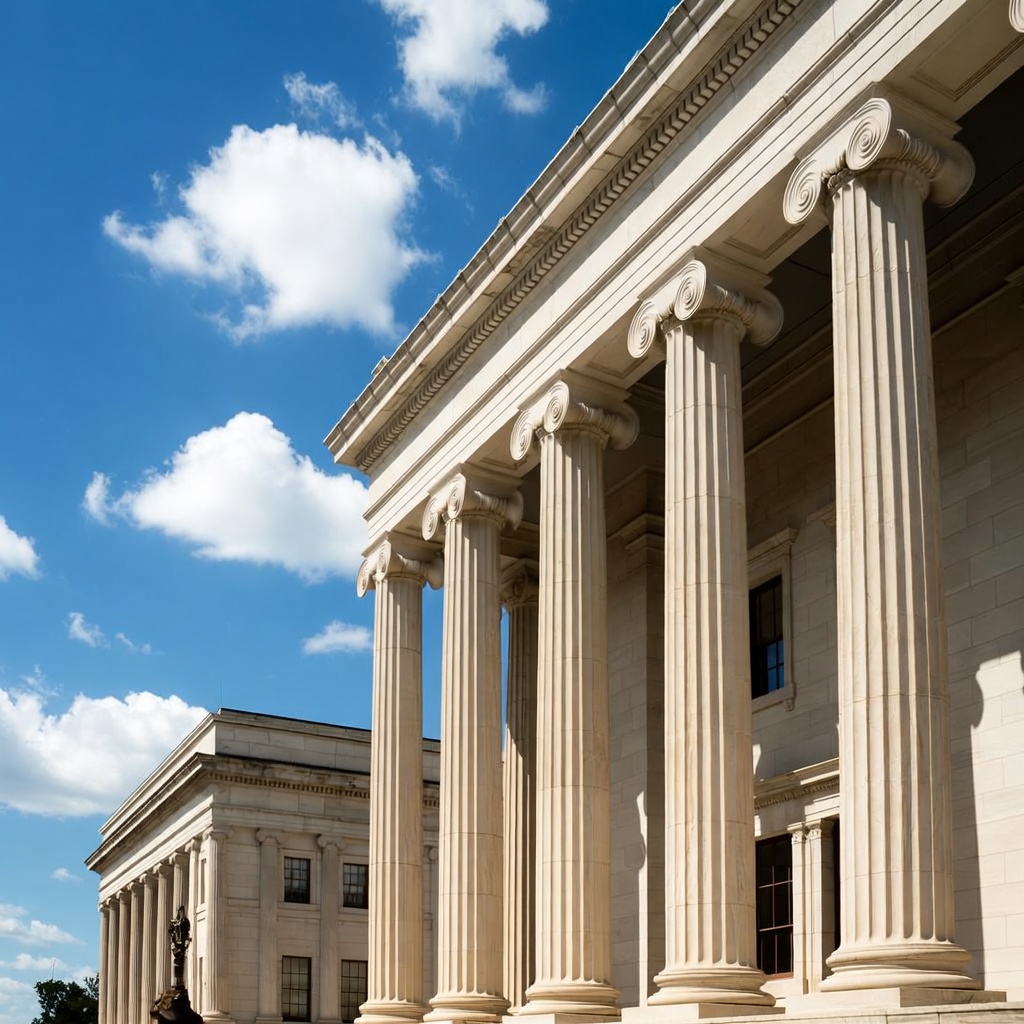
Standing tall against the sky, Greek Revival columns evoke the grandeur of ancient Athens while anchoring modern landscapes. These architectural stalwarts, with their precise proportions and unyielding symmetry, have shaped skylines from grand estates to public halls. But what makes them tick?
At their core, Greek Revival columns draw directly from classical orders: Doric, Ionic, and Corinthian. Doric columns, the simplest and sturdiest, feature fluted shafts tapering gently upward to a plain capital—no frills, just raw power. Think of the Parthenon on the Acropolis, where Doric columns supported a temple to Athena around 447 BCE. Ionic columns add elegance with volute scrolls on their capitals, like curly rams’ horns framing the sky, seen in the Temple of Athena Nike. Corinthian, the most ornate, bursts with acanthus leaves, embodying Hellenistic exuberance from the 4th century BCE.
Revived in the late 18th century amid Europe’s fascination with classical antiquity—spurred by archaeological digs at Pompeii and Herculaneum—these columns exploded in popularity during America’s early republic. Architects like Thomas Jefferson incorporated them into Monticello and the University of Virginia, symbolizing democratic ideals borrowed from Greece’s birthplace of democracy. In Britain, the movement fueled neoclassical gems like the British Museum.
Key features set them apart: entasis, a subtle convex curve in the shaft to counter optical illusions of straightness; the stylobate base for elevation; and perfect ratios, often 9 or 10 times the column diameter in height. Materials evolved too—from marble in antiquity to stucco, cast iron, or fiberglass today—making them accessible for contemporary builds.
Fast-forward to now: Greek Revival columns grace the U.S. Capitol, where Corinthian giants frame the dome, and Southern plantation homes like Oak Alley in Louisiana, their white Doric rows whispering of antebellum splendor. Modern twists appear in banks, courthouses, and even McMansions, where prefabricated fiberglass versions mimic authenticity at a fraction of the cost. Take the Nashville Parthenon, a full-scale 1897 replica in Tennessee, its columns hosting art exhibits and weddings.
Why do they matter today? In a world of sleek glass towers, these columns offer timeless stability—a visual anchor amid flux. They remind us of enduring values: proportion, harmony, civic pride. Psychologically, their verticality inspires awe, fostering community in public spaces. Environmentally savvy replicas reduce quarrying impacts, blending heritage with sustainability. As urban designers revive them in mixed-use developments, like Charleston’s historic districts, they bridge past and future, proving classical beauty never fades. Next time you spot those fluted sentinels, pause—they’re not just stone; they’re a conversation across millennia.
Comments are closed