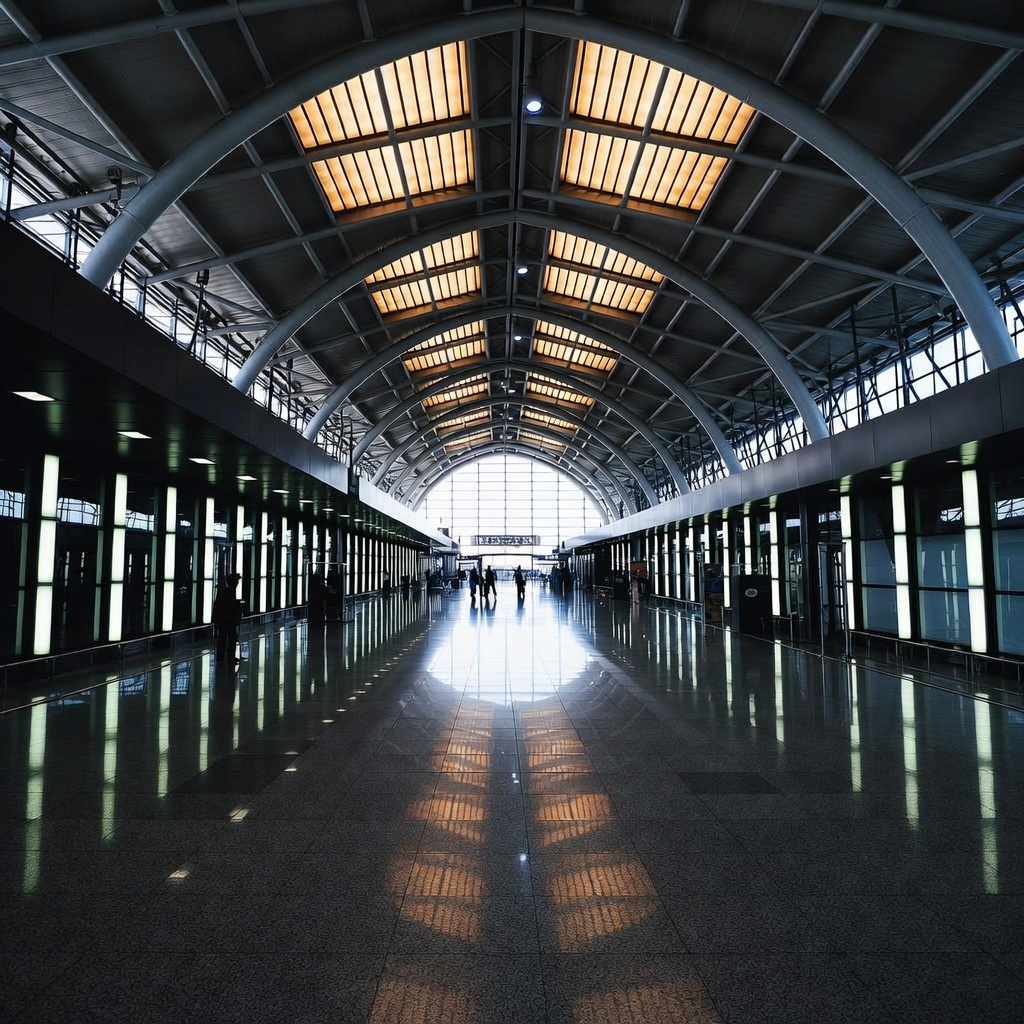
Airports are humanity’s grand hubs of motion, where thousands of lives converge and scatter in a daily ballet of suitcases and security lines. At the heart of this frenzy lies terminal flow—the engineered pathways that guide passengers from curb to gate with deceptive grace. It’s not chaos; it’s a science of queues, signage, and spatial psychology, honed over decades to minimize delays and meltdowns.
Terminal design traces back to the jet age’s dawn. Before 1950, airports were little more than airstrips with sheds, passengers shuttled by bus. The shift came with pioneers like Eero Saarinen’s TWA Terminal at Idlewild (now JFK) in 1962—a swooping, bird-like structure celebrating flight but prioritizing intuitive flow. Saarinen’s curves funneled crowds through fluid lounges, a stark contrast to rigid rail stations. By the 1970s, as air travel exploded, architects like those at Atlanta’s Hartsfield-Jackson introduced spoke-and-wheel layouts: central security hubs radiating to concourses, slashing walking distances by 20-30%.
Key features define effective flow today. Linear terminals, like Denver International’s, stretch passengers end-to-end with moving walkways and color-coded zones—think blue for A gates, green for B—to combat decision fatigue. Hub-and-spoke models, perfected at Dallas-Fort Worth, cluster gates around piers for quick connections, while people-movers (those speedy trams) bridge vast expanses. Biometrics and apps now layer on smart tech: Singapore Changi scans faces for seamless boarding, predicting bottlenecks via AI crowd analytics. Security chokets evolve too—San Francisco’s clear-bag zones and automated scanners cut wait times from 45 to under 10 minutes.
Modern marvels shine in Asia. Hamad International in Doha deploys vast, mosque-inspired halls with linear escalators and ambient gardens, channeling 50 million passengers yearly without gridlock. Istanbul’s mega-terminal, the world’s largest, uses three-story voids and high-speed rails to process 200,000 daily transients. Retrofitting old guards, like Heathrow’s Terminal 5, involved behavioral studies: wider lanes for luggage carts, curved queues to hide lines’ lengths, boosting throughput 30%.
Why does this matter now? In a post-pandemic world, air travel surges—expected to hit 10 billion passengers by 2050—while climate pressures demand efficiency to cut idling emissions. Poor flow costs billions: a 10-minute delay cascades into $1,000 per flight in fuel and crew overtime. It shapes equity too; intuitive designs aid families, elderly travelers, and those with disabilities, turning stressful scrambles into smooth journeys. As urban air mobility (drones, eVTOLs) looms, terminals must adapt for vertical flow—rooftop pads feeding ground levels.
Ultimately, masterful terminal flow isn’t just logistics; it’s the unsung art of human movement, ensuring we soar without stumbling. Next time you glide through an airport, notice the invisible hand steering you—it’s what keeps the world connected.
Comments are closed