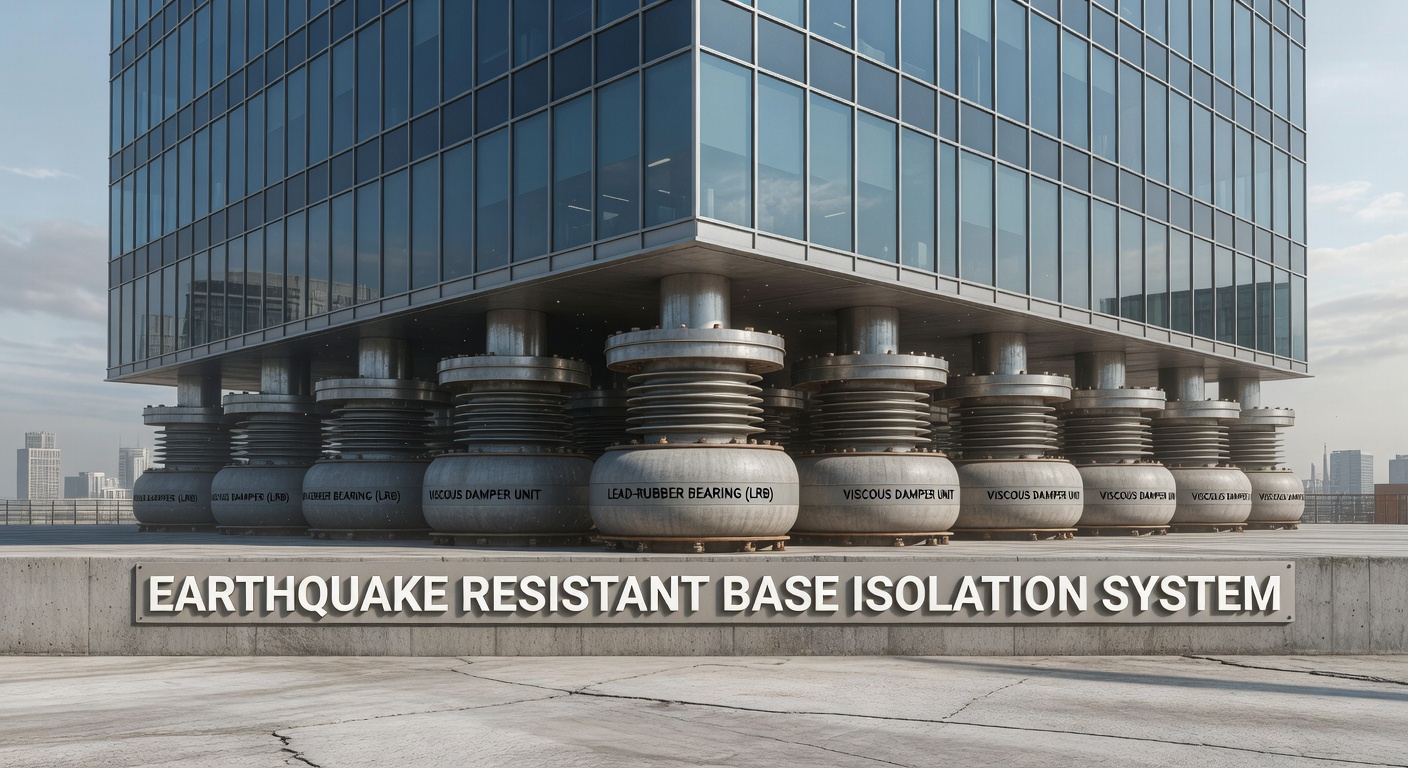
Earthquakes strike without warning, turning solid ground into a treacherous wave. Yet amid the chaos, innovative engineering keeps buildings standing tall. Enter base isolation, a technique that decouples structures from the earth’s violent tremors, allowing them to sway gently while the ground bucks beneath them. It’s like giving a skyscraper roller skates—smooth, stable motion amid pandemonium.
At its core, base isolation relies on isolators placed between a building’s foundation and its superstructure. These aren’t ordinary pads; they’re sophisticated devices, often made from high-damping rubber bearings layered with steel plates. When seismic waves hit, the rubber flexes and absorbs energy, while lead cores in some designs melt slightly under friction to dissipate even more force. Friction pendulum bearings take it further: curved surfaces let buildings slide laterally on a lubricated interface, recentering themselves via gravity after the shaking stops. Viscoelastic dampers and sliding pads add layers of control, tuned to a building’s mass and local quake risks. The result? Up to 80% reduction in transmitted accelerations, sparing interiors from collapse.
This isn’t sci-fi—it’s battle-tested history. Japan’s pioneering work dates to the 1960s, but the 1985 Mexico City quake, which liquefied soil and toppled mid-rise buildings, accelerated global adoption. Tokyo’s Shinjuku Mitsui Building, retrofitted in the 1990s, survived the 2011 Tohoku monster without a scratch. Fast-forward to modern marvels: San Francisco’s new Transbay Transit Center (2018) sits on 93 isolators, designed for the San Andreas Fault’s wrath. In Christchurch, New Zealand, post-2011 rebuilds like the Reserve Bank tower used triple-pendulum isolators to handle aftershocks. Even Italy’s Aqaba Hospital, quake-proofed after 2009’s L’Aquila disaster, employed flat sliding isolators. These examples showcase adaptability—from retrofits in heritage sites to new mega-structures in seismic hotspots.
Why does base isolation matter today? Climate change amps up seismic risks through induced quakes from fracking and reservoir filling, while urbanization packs millions into vulnerable zones. The 2023 Turkey-Syria quakes killed over 50,000, many in poorly engineered high-rises—highlighting the human cost. Base isolation slashes repair bills (often 90% less post-quake) and saves lives, buying precious seconds for evacuation. It’s cost-effective long-term: initial premiums of 2-5% of construction budgets pale against rebuilding trillions in damages, as seen in Japan’s ¥16 trillion Tohoku toll.
Critics note it’s pricier upfront and trickier for low-rises, but advancements like 3D-printed isolators and AI-optimized designs are closing gaps. In a world where plates grind relentlessly—think Istanbul’s overdue Big One or California’s Hayward Fault—base isolation isn’t luxury; it’s lifeline. By letting buildings dance with danger rather than duel it, engineers are rewriting disaster’s script, one isolator at a time.
Comments are closed