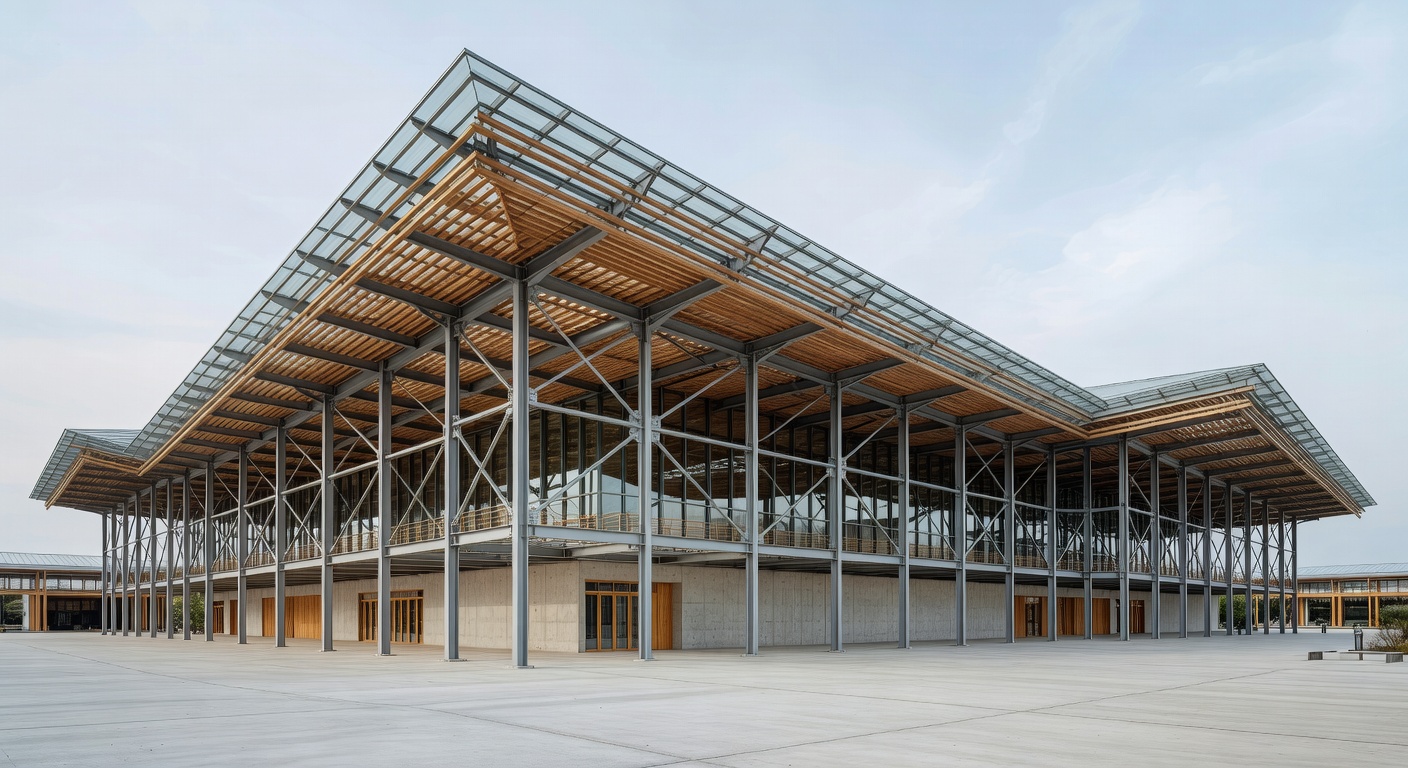
Renzo Piano doesn’t just build structures; he coaxes materials into revealing their essence, layer by unadorned layer. The Italian architect, now 87, has spent decades championing “material honesty”—a principle where every beam, panel, and joint declares its true nature without disguise. No faux finishes or deceptive veneers here; Piano’s work insists that steel should gleam as steel, glass should transmit light transparently, and concrete should bear the honest imprint of its formwork. This approach turns buildings into eloquent manifestos, where form follows not just function, but the intrinsic poetry of stuff itself.
At its core, material honesty in Piano’s lexicon means letting substances perform authentically. Take his use of glass: in the Centre Pompidou (1971, co-designed with Richard Rogers), vast expanses of it form flexible enclosures, exposing the building’s guts—ducts, pipes, escalators—like a high-tech carcass on display. Steel frames are left raw, painted only for protection, not prettification. This High-Tech ethos, born amid 1970s energy crises and postmodern skepticism of modernism’s slick utopias, rejected ornament for operational clarity. Piano drew from earlier modernists like Mies van der Rohe, whose “less is more” mantra celebrated steel-and-glass skeletons, but Piano infused it with Italian warmth, blending industrial rigor with humanistic scale.
Fast-forward to today, and Piano’s principles shine in contemporary icons. The Shard in London (2012) layers glass facets that shift with sunlight, honestly reflecting the city’s flux without mimicry. Its diagrid steel structure—exposed and efficient—distributes loads visibly, a nod to engineering poetry. Similarly, the Whitney Museum of American Art in New York (2015) employs weathering steel and concrete terraces that patina over time, embracing entropy as beauty. In the Jérôme Seydoux Pathé Foundation (2014, Paris), matte glass veils delicate steel filigree, allowing natural light to filter truthfully while shielding interiors. These aren’t gimmicks; they’re responses to sustainability demands. Honest materials minimize waste—recyclable steel over composites, durable concrete over fleeting trends—aligning with net-zero goals.
Why does this matter now? In an era of greenwashing and digital facades, Piano’s honesty combats architectural amnesia. Parametric designs and 3D-printed exoskeletons dazzle, but often obscure their carbon-heavy truths. Piano reminds us that buildings shape culture: honest ones foster trust, demystifying construction to inspire awe in the everyday. They endure, adapting without apology—Pompidou thrives post-renovation, its innards updated transparently. Amid climate urgency, material candor drives innovation: think mass timber in Piano’s upcoming projects, celebrated for its renewability and tactile warmth.
Ultimately, Piano’s legacy urges architects to ask: What does this material want to be? By stripping away illusions, his work elevates the built environment, proving that truth, not trickery, builds lasting resonance. In a world craving authenticity, that’s no small feat.
Comments are closed