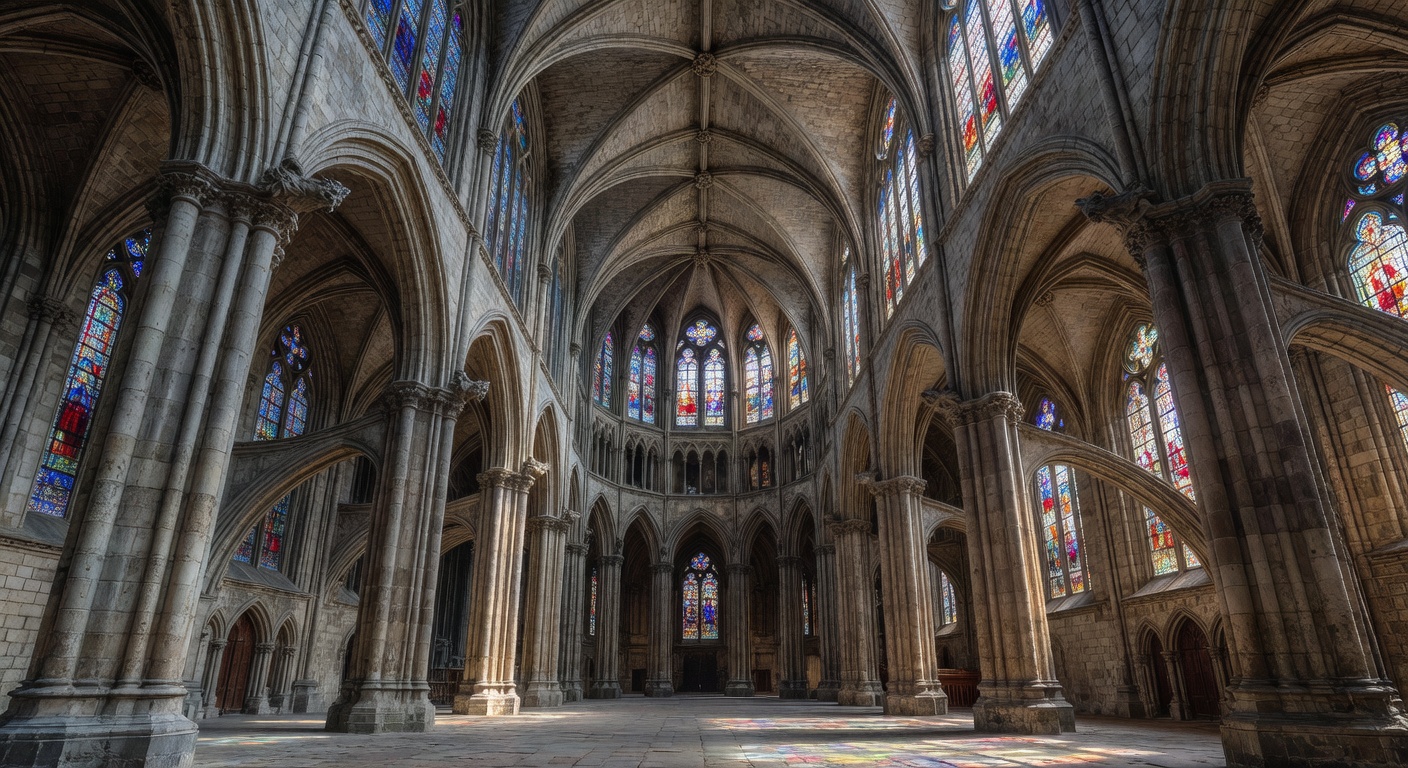
Gothic cathedrals stand as testaments to medieval ingenuity, where stone masons and architects pushed the boundaries of physics to touch the heavens. Emerging in 12th-century France, this architectural style revolutionized church design, replacing the squat Romanesque forms with vertiginous vaults that drew worshippers’ eyes upward. At its core, Gothic engineering hinged on three innovations: pointed arches, ribbed vaults, and flying buttresses.
Pointed arches were the first breakthrough. Unlike the rounded Roman arches that distributed weight evenly but limited height, pointed ones directed thrust downward and inward, allowing walls to rise taller while supporting heavier loads. This enabled vast open interiors flooded with light, a deliberate theological choice symbolizing divine illumination. Notre-Dame de Paris, begun in 1163, exemplifies this: its nave soars 108 feet, creating an ethereal space that feels infinite.
Ribbed vaults took the concept further. Instead of a solid barrel vault, intersecting stone ribs formed a skeletal framework over the ceiling, concentrating weight on specific points. This reduced the need for thick walls, freeing up space for enormous stained-glass windows. The vaulting at Reims Cathedral, completed in the 13th century, features intricate six-part ribs that elegantly transfer loads to slender piers, a feat calculated through empirical trial and error—no computers, just plumb lines and intuition.
Flying buttresses sealed the triumph. These external half-arches, like stone skeletons propping up the walls, countered the outward thrust of the vaults. At Chartres Cathedral (1194–1220), they allow walls to become transparent veils of glass, depicting biblical scenes in jeweled light. Engineers refined them over generations; later examples, like those at Beauvais (unfinished after 1284 collapses), pushed limits too far, collapsing under ambition but informing safer designs.
Historically, Gothic arose amid economic booms from trade and Crusades, funding massive builds via guilds and bishoprics. Cathedrals like Amiens (1220–1270), the tallest complete Gothic structure at 139 feet in the nave, required unprecedented coordination—up to 1,000 workers over decades. They weren’t just religious hubs but civic centers for markets, trials, and relics that drew pilgrims, boosting local economies.
Today, Gothic engineering resonates profoundly. Modern architects study them for sustainable design: the lightweight skeletons minimize material use, echoing green building principles. Restoration projects, like Notre-Dame’s post-2019 fire revival using 3D scanning and carbon-fiber reinforcements, blend medieval wisdom with tech. Flying buttresses inspire earthquake-resistant skyscrapers, while the emphasis on natural light influences energy-efficient atriums.
Why does it matter? In an era of disposable architecture, Gothic cathedrals remind us of enduring ambition. They prove human creativity can defy gravity, fostering awe that unites communities across centuries. Visiting one today—say, the luminous Laon Cathedral—still quickens the pulse, whispering that engineering isn’t just functional; it’s soul-stirring poetry in stone.
Comments are closed