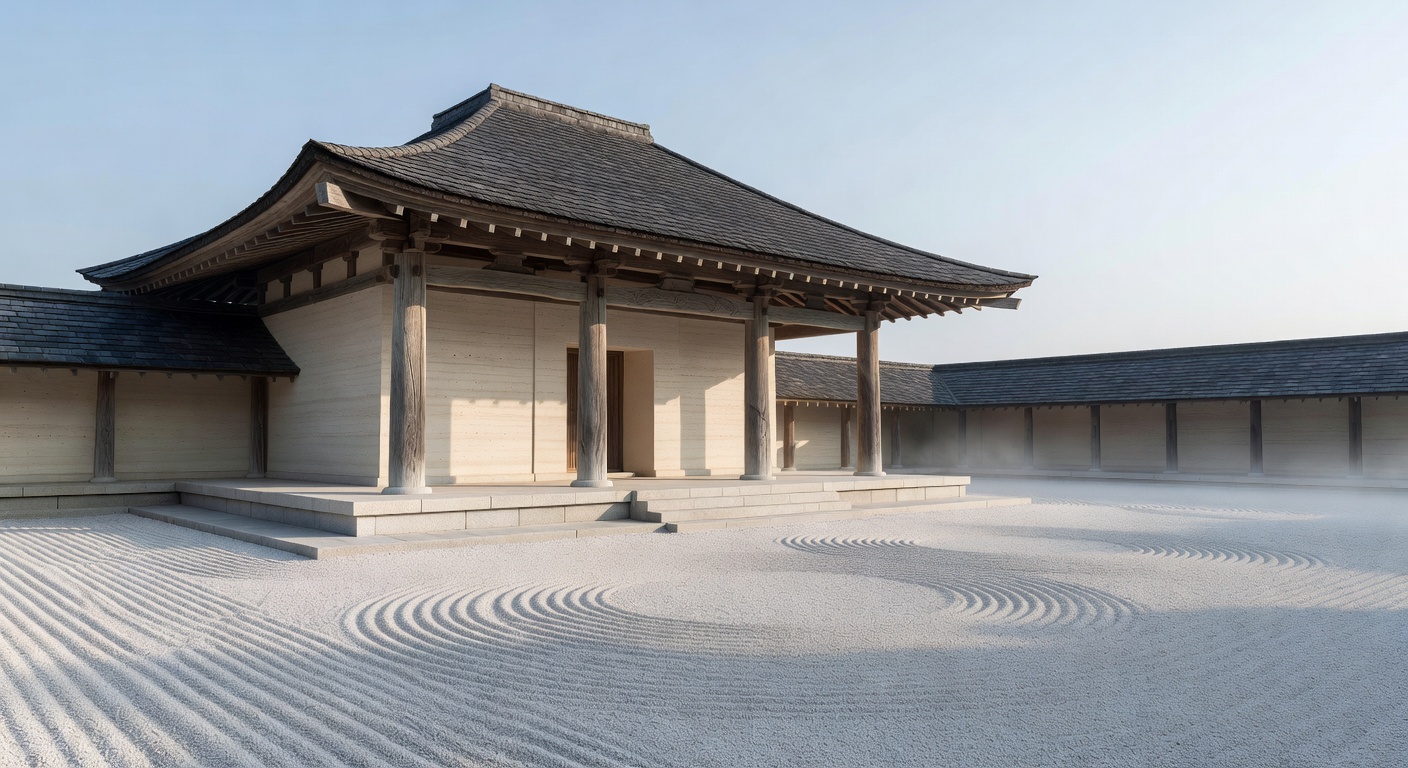
Zen gardens whisper secrets of emptiness, where raked gravel stands in for oceans and a single stone evokes a mountain’s majesty. Buddhist temple minimalism isn’t mere decor—it’s a philosophy etched in wood, stone, and void. Rooted in ancient doctrines, this aesthetic strips away excess to reveal profound truths, inviting us into spaces that challenge our cluttered minds.
At its core, Buddhist temple minimalism embodies wabi-sabi, the beauty of imperfection and transience, intertwined with the principle of ma—negative space that breathes life into form. Key features include vast open halls with polished wooden floors reflecting faint light, shoji screens diffusing sunlight into ethereal glows, and altars holding just a Buddha statue, incense burner, and perhaps a lone flower. Ornate gold leaf or vivid murals? Rare. Instead, raw timber beams expose the skeleton of construction, moss-covered lanterns age gracefully in courtyards, and rock gardens demand contemplation over distraction. Colors mute to earth tones—charcoal grays, warm umbers, crisp whites—while asymmetry reigns, mirroring nature’s unpolished harmony.
Historically, this ethos crystallized in Japan’s Kamakura period (1185-1333), when Zen Buddhism, imported from China, reshaped temple design. Influenced by Chan masters like Eisai, architects rejected Tang Dynasty opulence for stark functionality. Eiheiji, founded in 1244 by Dogen, exemplifies this: its sodo (monks’ hall) features bare tatami mats and low tables, fostering zazen meditation amid unrelenting simplicity. In China, Song Dynasty Chan temples like Shaolin pared down to essentials, emphasizing impermanence (anicca) amid warring states. Tibet and Southeast Asia adapted it too—think Bhutanese dzongs with whitewashed walls and minimal icons, or Thai wats using space to evoke boundlessness.
Fast-forward to today, and modern examples pulse with relevance. Tadao Ando’s Water Temple on Awaji Island (1991) channels minimalist Zen: concrete slabs pierce a lotus pond, leading to subterranean worship halls where light filters through slits, amplifying silence. Kenzo Tange’s Tokyo temples blend concrete brutalism with shoji voids. Globally, architects like John Pawson draw from this wellspring—his St. Moritz Chapel in the Swiss Alps is a glass-and-stone box cradling a single cross, echoing Buddhist voids.
Why does it matter now? In our swipe-saturated, stuff-stuffed era, temple minimalism offers an antidote to overload. Studies from environmental psychology, like those in the Journal of Environmental Psychology, show such spaces reduce cortisol, boosting focus and calm—proven by fMRI scans of visitors to Kyoto’s Ryoan-ji temple. It nudges us toward mindful living: declutter homes, curate digital feeds, prioritize essence over excess. Amid climate anxiety, its sustainable ethos—using local, enduring materials—models low-impact beauty. Ultimately, it reminds us: true richness lies not in accumulation, but in the courage to let go, finding infinity in the empty space between. Step into a temple, and feel the weight lift.
Comments are closed