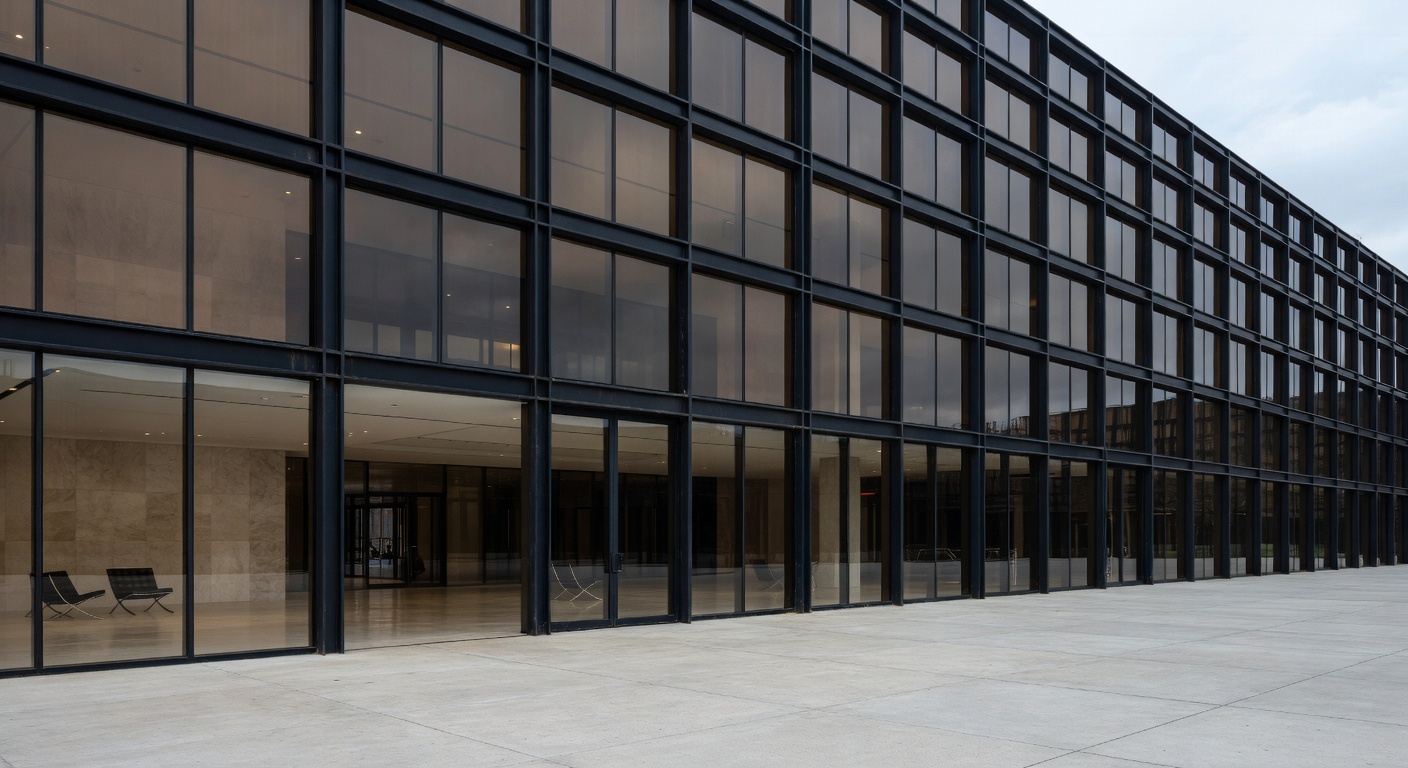
Ludwig Mies van der Rohe didn’t just design buildings—he redefined how we inhabit space. Born in 1886 in Germany, the architect behind the iconic Barcelona Chair and the Seagram Building championed a philosophy summed up in his famous dictum: “Less is more.” Minimalism, in his hands, wasn’t about stark deprivation but elegant precision, stripping away the superfluous to reveal structure’s pure poetry. His work emerged from the chaos of early 20th-century Europe, where ornate styles like Art Nouveau clashed with industrial realities.
Mies’s breakthrough came in the 1920s amid the Bauhaus movement, which he directed from 1930 to 1932. The Barcelona Pavilion (1929), built for the International Exposition, exemplifies his vision: a pavilion of glass, steel, and marble with no enclosing walls, floating planes that blur indoor and outdoor realms. Key features include the “universal space”—open, flexible layouts free from rigid partitions—and honest materiality. No faux finishes here; travertine floors gleam raw, chrome-plated steel frames expose their engineering, and vast glass sheets dissolve boundaries. This “skin and bones” architecture prioritizes light, proportion, and flow, making every element functional and expressive.
Historically, Mies navigated turbulent times. Weimar Germany’s economic woes fueled functionalism, rejecting bourgeois excess. Exiled by Nazis who branded modernism “degenerate,” he arrived in Chicago in 1938, where he became dean of the Illinois Institute of Technology. There, he erected stark towers like the 860-880 Lake Shore Drive apartments (1949-1951), pioneering the glass-and-steel skyscraper with their rhythmic I-beam curtain walls—a nod to structural honesty amid post-war urban boom.
Today, Mies’s minimalism pulses in contemporary design. Apple’s stores echo his pavilions with open glass boxes and precise fixtures. Tadao Ando’s concrete serenity in Osaka’s Church of the Light channels Miesian light play, while firms like SANAA deploy translucent screens for fluid spaces. Even residential trends—think Japanese wabi-sabi hybrids or Scandinavian hygge minimalism—owe debts to his clarity.
Why does it matter now? In our cluttered digital age, Mies offers respite. His work combats visual noise, promoting mental calm through restraint. Sustainability aligns too: minimal materials mean less waste, and adaptable spaces suit evolving needs, from remote work to flexible living. Critics decry his austerity as cold, yet Farnsworth House (1951)—a glass box amid Illinois woods—proves intimacy in simplicity, forcing dwellers to engage intimately with nature.
Mies matters because he taught us elegance thrives in economy. His legacy urges us to edit ruthlessly: in homes, offices, lives. Amid excess, “less is more” isn’t slogan—it’s salvation, a timeless call to build better by building less.
Comments are closed