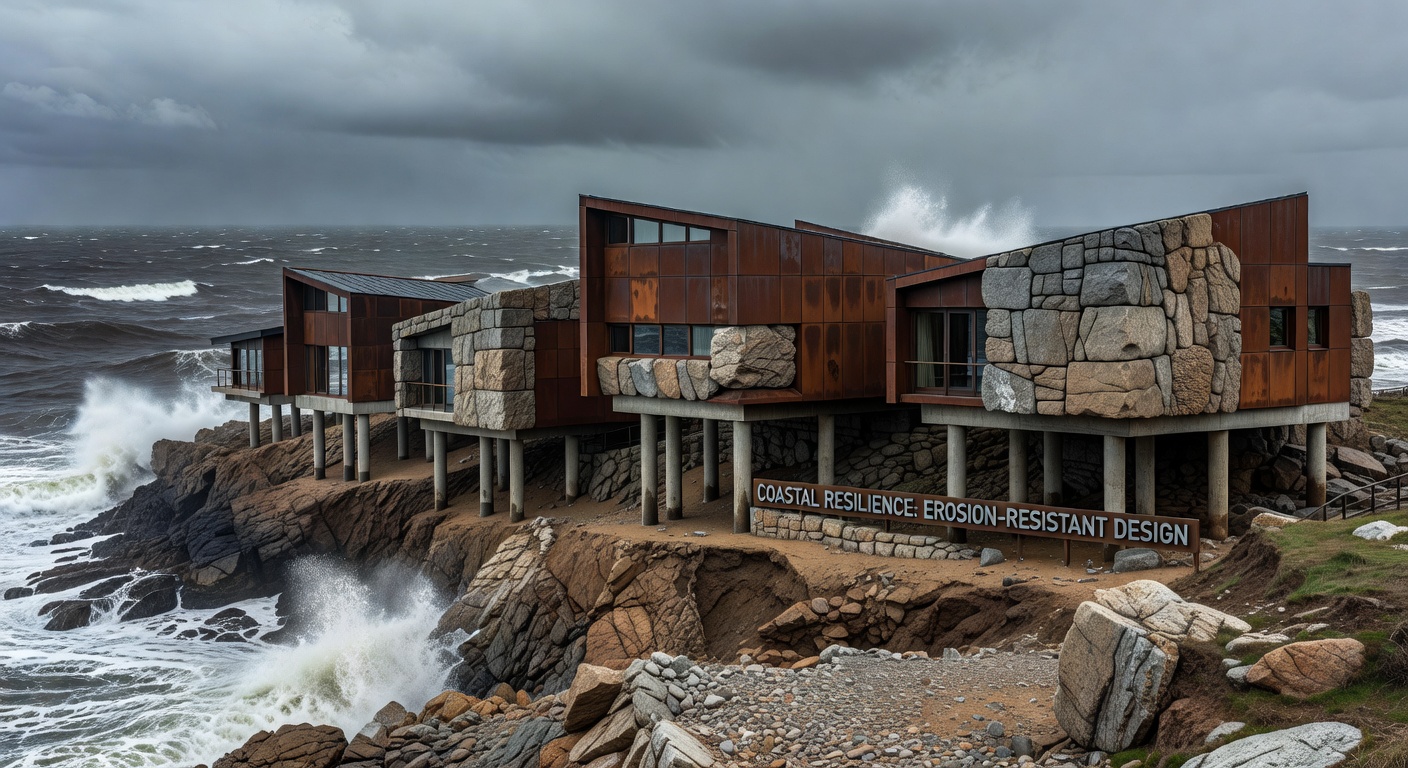
Coastal erosion isn’t just a slow creep—it’s a relentless assault on shorelines worldwide, gobbling up land at rates up to 50 feet per year in hotspots like Louisiana’s bayous. Yet amid this watery onslaught, architects and engineers are crafting structures that stand firm, blending innovation with nature’s own defenses. These erosion-resistant buildings aren’t mere fortifications; they’re smart adaptations that protect lives, property, and ecosystems.
At their core, these designs prioritize elevation and flexibility. Elevated structures on pilings or stilts—think homes perched 10-20 feet above sea level—allow waves and storm surges to flow beneath without toppling the foundation. In the Netherlands, the amphibious homes of Maasbommel float during floods, rising with water levels via flexible mooring posts anchored to concrete bases. This buoyancy turns a liability into an asset, preventing scour erosion where rushing water digs out soil around fixed foundations.
Materials play a starring role too. Corrosion-resistant concrete reinforced with fibers withstands salt spray, while helical piles—screw-like anchors—bite deep into stable subsoil, resisting lateral forces from waves. Vegetated “living shorelines” integrate with buildings: oyster reefs and mangrove plantings dissipate wave energy before it hits, reducing erosion by up to 80% according to U.S. Army Corps of Engineers studies. Modern examples shine in places like Florida’s post-Hurricane Ian rebuilds, where “fortified homes” feature impact-resistant windows, metal roofs that shed water efficiently, and breakaway walls on lower levels that sacrifice themselves to surges.
History offers gritty lessons. In 18th-century Britain, timber-framed beach huts on the Norfolk coast used shingle banks for natural buffering, a precursor to today’s hybrid approaches. The 1953 North Sea flood spurred the Dutch Delta Works, massive barriers that inspired floating and retractable building tech. Fast-forward to Kiribati’s climate migrants, where elevated, solar-powered “adaptation houses” on artificial islands combat sinking atolls.
Why does this matter now? Sea levels have risen 8-9 inches since 1880, accelerating with climate change—projections warn of 2-6 feet by 2100. Erosion threatens $1 trillion in U.S. coastal property alone, displacing communities and spiking insurance costs. Resilient buildings cut these risks: FEMA data shows elevated homes suffer 70% less damage in floods. They also boost biodiversity, as eco-integrated designs foster habitats amid development.
Beyond survival, these structures redefine coastal living. Denmark’s floating neighborhood in Bjarke Ingels Group’s ISOLA project offers urban amenities on water, proving resilience can be luxurious. As tides rise, investing in such innovation isn’t optional—it’s the blueprint for thriving shorelines. By merging engineering prowess with ecological wisdom, we’re not just building against erosion; we’re building with the sea.
Comments are closed