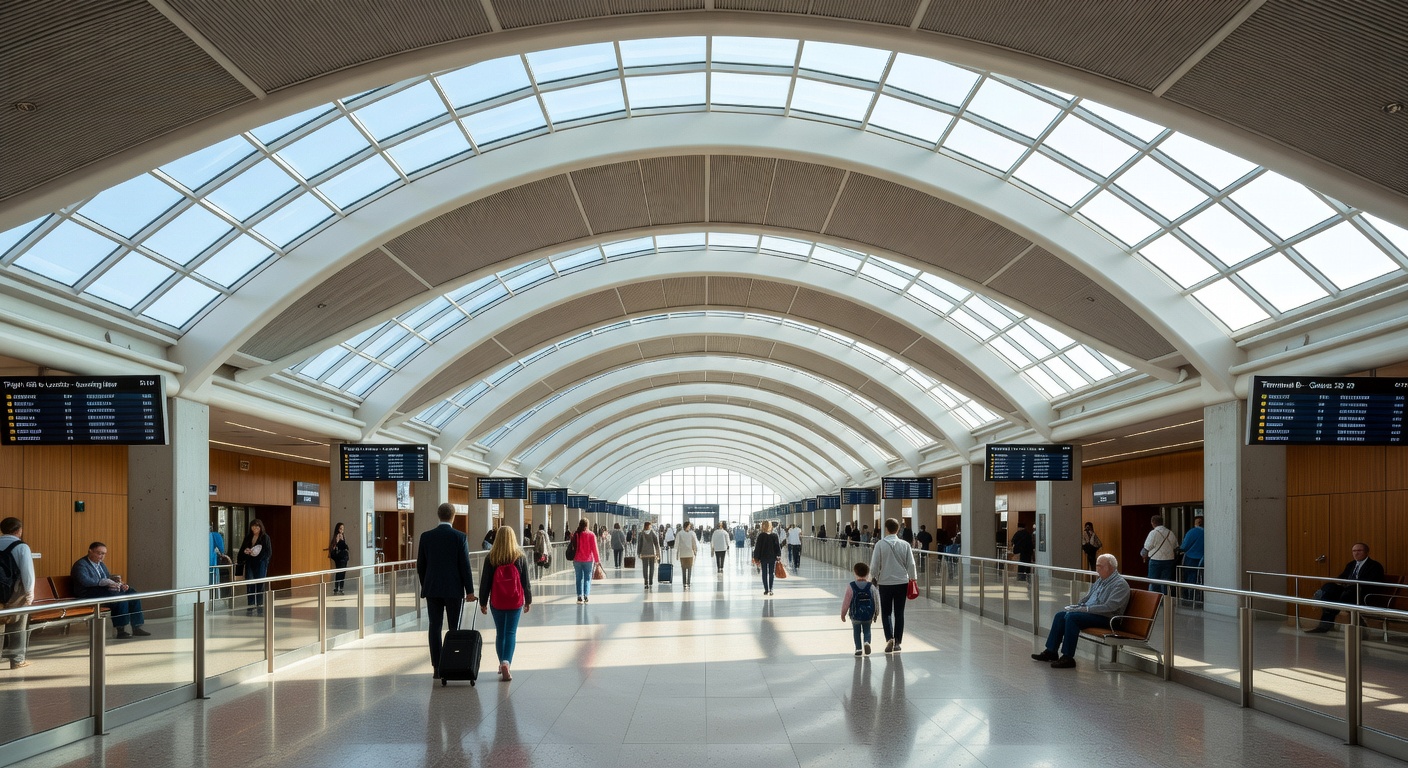
Airports are humanity’s grand hubs, where millions converge in a ballet of suitcases and security lines. At the heart of this spectacle lies terminal flow—the engineered pathways that guide passengers from curb to gate without descending into pandemonium. It’s not just architecture; it’s a science of movement, blending psychology, data, and design to keep the world’s busiest skies humming.
Consider the basics. A well-designed terminal operates like a living organism, with distinct zones pulsing in sequence: arrivals, check-in, security, lounges, gates, and baggage claim. Key features include wide concourses to prevent bottlenecks, intuitive signage in multiple languages, and escalators angled for natural crowd surges. Natural light floods atriums to reduce stress—studies show brighter spaces cut perceived wait times by up to 20%. Moving walkways, those gliding carpets, aren’t luxuries; they boost throughput by 30% in long hauls, as seen in Atlanta’s Hartsfield-Jackson, the planet’s busiest airport.
History adds depth. Post-WWII, airports evolved from basic airstrips. Idlewild (now JFK) in 1943 pioneered the “pier” design—central building with radiating arms like spokes—handling propeller-era crowds. The jet age exploded this in the 1960s; Denver’s 1995 terminal introduced the “dinosaur spine,” a single spine with gates branching off, slashing walking distances. Singapore’s Changi, opening phases since 1981, redefined flow with indoor gardens and skytrains, turning transit into tourism.
Modern marvels push boundaries. Hamad International in Doha deploys AI-driven dynamic signage, rerouting flows in real-time based on flight delays or passenger density sensors. Jewel Changi’s HSBC Rain Vortex, a 40-meter waterfall, isn’t mere eye candy—it disperses crowds, improving flow by 15%. Biometrics at U.S. hubs like LAX now fast-track 70% of passengers via facial recognition, compressing security queues. Post-pandemic, touchless tech and wider aisles became standard, with Delta’s JFK revamp adding 50% more space per passenger.
Why does this matter today? Air travel is booming—4.5 billion passengers in 2023, projected to double by 2040. Poor flow means delays cascading into billions in losses; a single hour’s backup at Heathrow costs airlines $100 million yearly. It affects safety too: cramped terminals fueled the 1975 Tenerife disaster, aviation’s deadliest. Efficient flow mitigates risks, cuts emissions via optimized routing, and enhances experience—vital as low-cost carriers democratize flying.
Yet challenges persist: aging infrastructure in Europe and Asia strains under growth, while climate regs demand greener designs like vertical farms in terminals for self-sustaining flows. Tomorrow’s airports, like Saudi Arabia’s NEOM, promise hyperloops and drone ports, reimagining flow entirely.
In essence, terminal flow is the invisible conductor of our global rhythm. Master it, and airports become portals of possibility; botch it, and they’re purgatories. Next time you glide through, appreciate the genius keeping the chaos at bay.
Comments are closed